Sabine River ferry disaster
The ThicketThe Sabine River ferry disaster is the decisive catastrophe that separates Jack Parker from Lula Parker, apparently kills Old Caleb Parker, and sends the surviving characters into the dangerous geography of the Big Thicket. It begins as a robbery and attempted assault on the ferry, but becomes an elemental disaster when a water devil breaks the ferry rope and overturns every human calculation. The event changes Jack’s objective from simple survival to rescuing his sister and establishes the pattern of violence, displacement, and improvised justice that governs the rest of the journey.
Causes and Background
The disaster grows out of a confrontation already charged with captivity and sexual threat. Fatty Worth has handed a revolver to the large armed man, while Old Caleb Parker has drawn a derringer and fired at him. The small pistol wounds the man’s shoulder, but his return shot hits Old Caleb Parker with enough force to knock him onto the ferry’s deck. Water rolls over him as he sits clutching his bleeding middle, and Lula Parker runs to support him. The physical instability of the ferry makes the gunfight more than a contained exchange: every shot is fired on a platform already moving over dangerous water.
The armed man then threatens Jack Parker directly and declares that he and the other men intend to take Lula Parker, not merely as a prisoner but as a sexual possession. His threat transforms the stakes from robbery into the seizure of a family member and gives Jack a clear, immediate purpose. Old Caleb Parker’s second derringer shot strikes the man in the thigh, forcing him to one knee, but the moment of possible resistance collapses when Fatty Worth and Nigger Pete lunge toward the old man. Old Caleb Parker goes limp, held upright only by Lula Parker, and the family’s defensive position fails before the natural disaster arrives.
The Ferry Breaks Apart
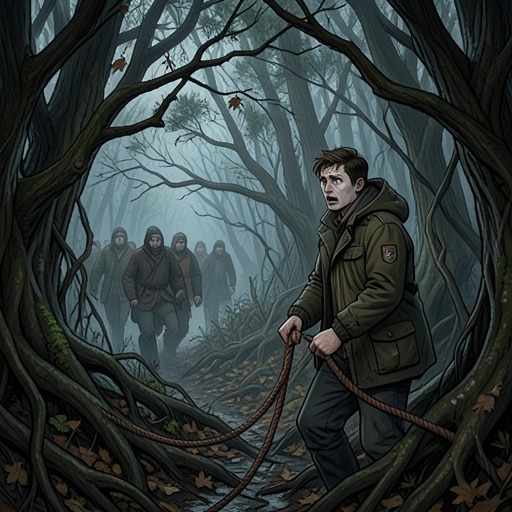
The ferry rope begins to fray just as the attackers close in. Then the wind lifts the Sabine River into a water devil, described as a howling force that swirls and heaves through the middle of the river, tears trees apart along both banks, and slams into the ferry. The rope snaps completely, and everyone aboard is thrown into the water. The sequence produces a sharp reversal: the attackers appear to have control of the captives, but the same unstable crossing that enabled their violence suddenly removes control from every person present.
The last image Jack Parker remembers before striking the water is his mule flying overhead as if it had grown wings and chosen to travel ahead without the riders. That grotesque image gives the disaster its characteristic mixture of terror and frontier absurdity. Human weapons, family loyalty, and the ferry’s intended route all become irrelevant at once. The boat is no longer transportation or shelter; it is a broken object carried by the river, while people and animals are reduced to scattered bodies in the storm.
Immediate Survivors and Losses
After the disaster, a witness cannot identify who died, but reports that three men, a girl, and some horses reached the far side. The surviving group is described as a fat fellow and a big man on one horse, with Nigger Pete and Lula Parker on another. The witness adds that Lula Parker did not seem willing to go with them. This account confirms the central danger without resolving the fate of every participant: Lula Parker survived the crossing but remained in the hands of the men who had taken her, while Old Caleb Parker was absent and presumed dead.
Jack Parker later states that Lula Parker and Old Caleb Parker made it to the other side, but that Old Caleb Parker had been shot and was already dead before the water devil struck. The distinction matters. The river does not kill the old man; it prevents the family from recovering him and magnifies the consequences of the gunshot. Jack Parker himself reaches safety only after the crossing and immediately defines his next aim as getting Lula Parker back. A local warning that the river remains too rough even for an alligator to swim reinforces how impossible a direct pursuit would be.
Matilda’s advice sends Jack Parker toward the law rather than across the river on foot. The recommendation acknowledges both the physical scale of the disaster and the weakness of individual action after it: the kidnappers will gain too much distance, and the water has become a barrier rather than a route. Yet the appeal to law does not erase Jack Parker’s personal obligation. The event leaves him alive, but survival is morally inseparable from pursuit.
Narrative Consequences and Later Echoes
The ferry disaster functions as a threshold between the Parker family’s old life and the extended chase through the frontier. Before the crossing, Jack Parker’s immediate world consists of Grandpa, Lula Parker, and a shared attempt to resist armed men. After it, the family is divided, Old Caleb Parker is dead, and Jack Parker must depend on strangers, testimony, and uncertain trails. The disaster therefore converts a violent encounter into an episodic search whose route will pass through towns, forests, sawmills, and the Big Thicket.
Its consequences also establish the book’s recurring contrast between institutional systems and uncontrolled forces. The smallpox epidemic at Hinge Gate had produced road signs, quarantine, hurried burials, and official restrictions on movement, while the ferry disaster offers no comparable organized response: bodies are missing, survivors are identified imperfectly, and the river itself has erased evidence. Later, Jack Parker and his companions insist on burying three murdered people before continuing their pursuit, refusing to let urgency erase the dead. That decision carries the ferry disaster’s lesson forward: catastrophe is not only a matter of reaching safety, but also of deciding what obligations remain after order has broken down.
The memory of the disaster is further framed by other forms of frontier violence. Shorty’s account of Sheriff Winton’s homestead raid recalls a family shattered when Comanche fighters seize Sarah and her child, while the account of the circus-tent fire describes an enclosed community transformed into a death trap by burning oil, resin, and wax. In each case, a familiar structure—home, tent, or ferry—fails under pressure, and escape depends on improvised movement through a hostile environment. The ferry disaster is the clearest instance of this pattern because armed human predation and natural violence arrive in the same sequence.
The wider narrative eventually moves beyond the immediate wreck, but not beyond the event’s logic. The Big Thicket is later presented as a forest being cut apart by sawmills, with stumps, burning hardwood, abandoned milk cans, overturned sweet potatoes, and a dead dog marking the road. Even the landscape through which Jack Parker searches for Lula Parker has been reorganized by violence and extraction. Much later, oil is discovered on land divided between Eustace Cox and Shorty, though they choose to preserve the trees and farmland rather than pursue further drilling. Against that later, more deliberate choice, the ferry disaster remains the moment when natural force appears absolute: a rope frays, a river rises, and an entire family’s future is redirected within seconds.
Significance
As an event, the Sabine River ferry disaster combines a family abduction, a death, a failed rescue, and an environmental catastrophe. Its value shift is severe: a threatened but still unified family becomes a bereaved and divided one; a crossing intended to carry people safely becomes a mechanism of separation; and a conflict that might have ended with a gunshot instead expands into a long pursuit. The disaster’s lasting significance lies in this multiplication of consequences. It does not merely interrupt the plot. It supplies the wound, the objective, and the unstable moral terrain that propel the story afterward.