Smallpox epidemic
The ThicketThe Smallpox epidemic is the decisive catastrophe that breaks the Parker family’s settled life. It kills Jack Parker and Lula Parker’s parents, turns Hinge Gate into a landscape of mass death and quarantine, and forces the siblings to leave their home under the care of Old Caleb Parker. The epidemic is therefore more than background: it is the first great pressure that converts illness into displacement, grief into movement, and a local disaster into the chain of violence and unlikely attachments that follows.
Outbreak and Destruction
Smallpox moves through the country with the speed and seeming purpose of an animal, but its most devastating local effects are concentrated in Hinge Gate. The disease appears as a blistering, oozing death and kills so many people that the town’s experience is formally recognized as an epidemic. Jack Parker’s parents, who had previously never been ill, are among its victims. Jack, then sixteen and newly healthy after a sickly childhood, and Lula Parker, fourteen and still physically slight, escape infection even while watching their parents deteriorate.
The illness makes the parents’ suffering visible and intimate. Fever covers them in blisters; scratching leaves their skin pocked and bloody; damaged breathing takes on the sound of a broken squeeze box. Jack and Lula are forced to witness this decline while avoiding physical contact, since even comfort may carry infection. Their isolation is intensified by the fact that there is no effective treatment available to them. Jack rides into town to fetch a doctor, but the doctor can do no more than provide pills that create the appearance of medical effort. When Jack returns for further help, the doctor has already died of smallpox and been buried.
The epidemic also destroys the ordinary handling of the dead. Bodies are piled outside houses, loaded into wagons, buried rapidly, or burned when nobody can identify them. The unclaimed dead include travelers who entered Hinge Gate without leaving names or destinations, making the disease a force that erases both bodies and personal histories. The epidemic thus produces not only mortality but anonymity: death severs people from the records and relationships that would ordinarily preserve who they were.
Quarantine and Failed Protection
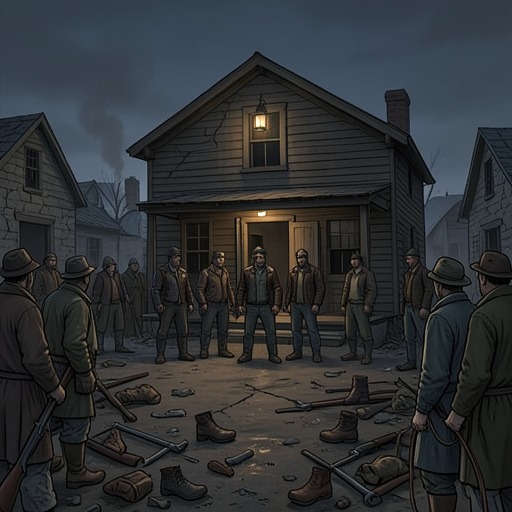
Sheriff Gaston attempts to contain the outbreak by placing signs on the roads into Hinge Gate. The signs prohibit residents from leaving and outsiders from entering, turning the town into a sealed space governed by emergency restrictions. The quarantine recognizes that movement itself has become dangerous, but it also leaves those inside the infected area with fewer routes to medicine, assistance, or escape. The law can mark boundaries; it cannot restore the social world that the disease has already shattered.
Fear generates improvised defenses whose usefulness is doubtful or actively harmful. Residents burn smoke pots around and inside their houses, believing smoke will keep smallpox away. Instead, the smoke fills the air and makes breathing even harder for those already sick. The practice captures the epidemic’s atmosphere of confused reasoning: people act because inaction is unbearable, even when the action offers no real protection. Jack’s recollection acknowledges that the disease has frightened the living into losing their reason, and he includes himself within that judgment.
Jack suspects that a tinker carried the disease to the family’s home after his father shook hands with him and bought a skillet. The tinker shows no visible symptoms, so the suspicion cannot be confirmed, but the episode reveals how contagion encourages retrospective searches for a single carrier. A handshake and an ordinary household purchase become, in memory, the possible hinge between normal life and disaster. The epidemic makes causation feel personal even when its actual movement is diffuse and difficult to trace.
Death, Burial, and Departure
Old Caleb Parker is able to enter the infected house because he had survived smallpox years earlier while living as a missionary among the Cheyenne near the Wind River Range. He and his wife had contracted the disease through infected blankets given to the Cheyenne by white people as a joke. His immunity makes him the only family member capable of handling the bodies safely, linking the present crisis in East Texas to an earlier history of racial violence and deliberately transferred disease.
After Jack finds both parents dead, he and Old Caleb Parker bury them themselves. Old Caleb Parker rolls the bodies onto fresh sheets, drags them from the house, places them in pine boxes, and pours lime over them. He believes the lime will prevent the disease from spreading from the graves, while Jack suspects that the six feet of earth does more to contain the danger. The contrast is characteristic of the epidemic’s practical world: burial is necessary, but the living can only estimate which measures will actually protect them.
Old Caleb Parker reads from the Bible over the graves, though Jack is too stunned to remember the passage. Lula Parker has become nearly unresponsive after finding their mother and father dead; even before the burial, she has stopped speaking. The ceremony supplies a religious form for grief without restoring comprehension. Immediately afterward, Old Caleb Parker burns the house, places the siblings in his wagon, and ties their exhausted mule behind it. Fire completes the quarantine of the infected home by destroying the place itself.
When Jack asks where they are going, Old Caleb Parker explains that they will not return to the burning house and that Jack is being sent to Kansas to stay with Aunt Tessle. The epidemic therefore ends not with recovery but with forced migration. The children lose their parents, home, local identity, and familiar future in a single transition from burial ground to road.
Recurring Pattern of Catastrophe
The epidemic establishes a pattern that the later narrative repeatedly revisits: disaster overwhelms ordinary safeguards, people improvise under pressure, and survival depends on acts that are both practical and morally burdened. The same world later contains the Sabine River ferry disaster, when a fraying rope and a violent water devil send the ferry and its passengers flying into the river; the circus-tent fire, when oil, resin, and wax turn rainproof canvas into a death trap; and the devastated logging road, where trees are dynamited out, hardwoods burn, pines disappear into lumber, and even birds have fallen silent.
These later disasters differ in cause, but they echo the epidemic’s structure. A community or landscape is exposed to a force larger than individual control; official order proves partial; bodies require urgent handling; and survivors must move through a damaged environment. Jack’s insistence that the dead be buried before the pursuit of Lula Parker continues shows how the epidemic has shaped his ethics. Even during the rescue mission, he refuses to treat the dead as obstacles to speed, arguing that their remains should be marked so relatives can recover them. The memory of his parents’ burial turns care for the dead into a boundary he will not cross.
Historical and Narrative Significance
Smallpox also provides the novel’s earliest connection between personal catastrophe and larger histories of displacement, racial violence, and expansion. Old Caleb Parker’s earlier infection among the Cheyenne came through contaminated blankets used as a cruel joke, while the epidemic in Hinge Gate is remembered through quarantine signs, mass graves, smoke pots, and an unavailable doctor. The disease crosses social and geographic boundaries, but its consequences are unevenly borne by families who lack reliable medical protection and must manage death themselves.
As a narrative origin, the epidemic strips Jack Parker and Lula Parker of the stable world that might otherwise have contained them. Their departure from the burned homestead opens the path toward the ferry, the frontier, gun violence, captivity, rescue, and the relationships that later become central to Jack Parker’s life. The epidemic’s most lasting effect is therefore not simply that it kills the parents. It creates the condition in which the siblings become travelers, and in which survival replaces inheritance as the organizing fact of their lives.