Spot
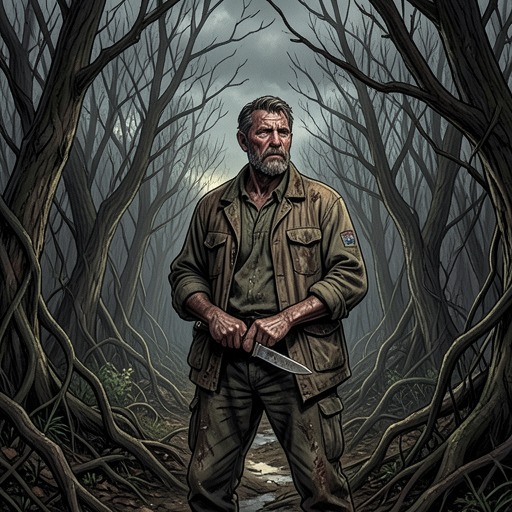
The ThicketSpot is a Black laborer whose practical intelligence and willingness to enter danger make him an important companion in the pursuit of Fatty Worth. He is introduced carrying a bucket and mop into Sheriff Winton’s office, a working man summoned from the margins of public authority rather than seated within it. His identity is shaped by several trades—farm labor, grave digging, tracking, and miscellaneous frontier work—and by a family history that reaches back into slavery. The story gives him both a distinctive physical mark and a sharply remembered social inheritance, then places him inside the most dangerous stage of the pursuit, where his usefulness cannot protect him from racial violence.
Identity and Background
Spot first appears as a lanky man with a white spot on his forehead beginning above the right eye and spreading upward into the hairline. The mark makes him immediately recognizable, but it does not define the whole person. When he enters Sheriff Winton’s office with cleaning tools, his occupation appears humble and functional: he asks whether the cell needs swabbing while the sheriff is occupied with a prisoner and witnesses. That entrance establishes the contrast central to Spot’s character. He performs necessary work that others overlook, yet he is observant, mobile, and capable of acting beyond the narrow role assigned to him.
His account of employment reveals the economic afterlife of slavery. Spot had once worked land for Old Man Rutledge, growing corn high enough to conceal a person, and understood how to use animal manure to improve farmland. Rutledge’s widow resented having to pay him in crops and wages for labor that her family had once extracted from his people without payment. Her family, the Cox family, had formerly owned Spot’s people; the end of slavery changed the legal arrangement without erasing the resentment attached to paid Black labor. Spot consequently moved between farming and grave digging, receiving a quarter for burying a corpse where a white gravedigger might receive fifty cents. His labor is useful, skilled, and badly valued, while the difference in pay exposes racial hierarchy as an economic practice rather than merely a personal insult.
Spot’s family memory extends that history backward through his grandfather Weeden. In the account passed down to him, Weeden had been separated from his parents and sold as a child partly because his purchaser wanted to isolate him from his family, much as a cruel farmer separated a piglet from its sow. The image is not ornamental: it describes the logic of slavery as the conversion of kinship into property management. Spot carries that memory into a world that is formally changed but still structured by unequal wages, vulnerability, and the power of white employers to determine whether Black work is recognized or exploited.
Skills and Role in the Pursuit
Spot’s work has made him adaptable. He farms, digs graves, tracks people, and takes occasional jobs that require leaving one place for another. He learns about the bank robbers through the town’s papers and knows that Cut Throat Bill and Nigger Pete have been robbing banks across the North, with substantial prices on their heads. He also recognizes that the newspapers turn Cut Throat Bill into a dime-novel hero even though the actual man is a killer; Spot’s blunt conclusion is that there are no heroes. His knowledge therefore combines local observation, public information, and skepticism toward the stories circulated about outlaws.
He accepts participation in the pursuit partly because the work offers money and partly because his practical abilities can be put to use. Sheriff Winton agrees to pay him five dollars for riding along, and Spot insists on accompanying the party so that he may help prevent the sheriff from being killed and ensure that he receives his payment. The bargain is starkly transactional, but Spot’s humor gives it a harder edge: if he is killed, he will have no need for the money, and the sheriff will avoid owing him anything. The joke acknowledges that Black labor is being purchased for a task whose ordinary risk may become fatal, while also showing Spot refusing to pretend that danger is not part of the contract.
His role is especially important because the pursuit enters the Big Thicket without reliable directions. The trail of the wagon wheel disappears among ordinary traffic marks, and the available guidance consists mostly of guesses about a sawmill somewhere in the woods. There are many sawmills and an immense amount of forest, so the search depends on people who can read uncertain traces and understand the working landscape. Spot belongs to that landscape through labor: he knows farms, roads, burial grounds, and the economic routes by which men and goods move. His presence turns the search from a simple lawman’s chase into a collective effort assembled from people whose knowledge comes from occupations the formal authorities do not control.
Relationships and Social Position
Spot’s relationship with Sheriff Winton is based on negotiation rather than unquestioning loyalty. Winton needs his help and agrees to compensate him, while Spot openly calculates the value of the arrangement. The two men shake hands over the deal, but the handshake does not erase the unequal world surrounding it. Spot remains a Black worker entering a violent pursuit under a white sheriff’s authority; his insistence on payment is therefore a small assertion of contractual dignity within a society that has repeatedly treated Black labor as something to be taken for free.
Spot also stands in a revealing relation to Eustace Cox and Shorty. Eustace can track the gang, but his anger at racial mistreatment may make his shotgun dangerous, especially when alcohol is available. Shorty keeps Eustace’s gun and money under control because Eustace cannot handle drink and may react violently when someone treats him poorly because of his color. Spot’s own position clarifies the stakes of that description. Eustace and Spot are not identical, but both live under bodies that others interpret as grounds for contempt: Eustace has his skin color, while Shorty has his small size. Spot’s later fate shows that the shared burden is not abstract. The racial label attached to him can become permission for cruelty, even when his usefulness has already been acknowledged by the people seeking his help.
Spot’s connection to Jack Parker is likewise practical and humane rather than sentimental. Spot knows about the Parker family’s land and can speak about the circumstances that made him a gravedigger. He becomes part of Jack’s rescue effort because the search requires people willing to work under uncertainty and risk. Yet the relationship is marked by limits. When Spot is captured by Cut Throat Bill and Nigger Pete, Jack sees him but cannot intervene without exposing himself and endangering the rescue. Spot’s vulnerability therefore becomes a test of solidarity that the immediate circumstances do not allow Jack to pass.
Captivity, Torture, and Death
At the gang’s camp, Spot is stripped and held beside a fire, just beyond the black bear tethered to a tree. Cut Throat Bill sits on his legs while Nigger Pete pins his arms and holds the back of his head against a knee. Cut Throat presses a burning stick against Spot’s chest, spits tobacco on him, and speaks to him while other gang members wander over to observe and then lose interest. The scene makes violence into a form of casual frontier entertainment. Spot is treated as an object to be inspected, handled, and displayed, while the bystanders’ indifference shows how thoroughly the gang has normalized domination.
The bear intensifies the scene’s structure. It is tied by a logging rope to a tree, given roughly twenty feet of movement, and kept away from the fire. A shirtless man throws dirt clods at it, laughing when it rises, waves its paws, and growls. Spot is placed near the same apparatus of cruelty, though his tormentors exercise deliberate control over him. The contrast links human and animal abuse without equating them: the bear is provoked as spectacle, while Spot is tortured through racial power and physical restraint. Both are confined bodies, but Spot’s captors also use speech, humiliation, and social contempt to reinforce the violence.
Spot looks toward the brush and may glimpse Jack’s face through a split in the vegetation. He does not call out. The narration cannot establish whether Spot truly sees Jack, whether he remains silent to protect him, or whether exhaustion has robbed him of the strength to make a sound. This uncertainty preserves Spot’s agency without romanticizing his suffering. He may be brave, he may be unable to respond, or the observer may be mistaken; all possibilities coexist because the scene is filtered through a witness who arrives too late to save him.
Spot’s death is consequently not an isolated shock but the culmination of the book’s treatment of labor, race, and expendability. The man who can farm, bury the dead, gather information, and help guide a dangerous pursuit is still made vulnerable by a system in which white men can transform a Black body into a target without consequence. His work had purchased a promised five dollars; his captivity shows how little that promise can protect him once legal and social protections collapse. The moral value of his life exceeds the price placed on his labor, and the story’s violence exposes the distance between those two measures.
Narrative Significance
Spot is a rounder figure than his initial entrance suggests because the story repeatedly revises the role assigned to him. He first looks like a cleaner, then emerges as a farmer and gravedigger, then as a source of local and historical knowledge, then as a paid participant in a manhunt, and finally as a captive whose suffering reveals the gang’s moral emptiness. Each disclosure changes the meaning of the previous one. The mop does not cancel the tracker; the gravedigger is not merely a disposable laborer; the paid companion is also a person carrying inherited knowledge of family separation and racial exploitation.
His presence also broadens the frontier setting. The Big Thicket is not empty wilderness but a working territory cut by sawmills, roads, labor, and violence. Spot’s history connects farms and burial grounds to slavery’s aftermath, while his movement through town, law office, and forest reveals how Black workers navigate spaces governed by white employers, sheriffs, outlaws, and informal bargains. The later discovery of oil on land divided between Eustace Cox and Shorty contrasts sharply with Spot’s earlier underpayment and danger: resources may enrich property holders, but no comparable security is granted to the laboring Black man whose knowledge and body sustain the community.
Spot’s decisive narrative function is to make the pursuit’s cost visible. The chase is not only a sequence of tracking problems and outlaw confrontations; it is also a movement through institutions that value people unevenly. Spot recognizes the difference between newspaper legend and lived violence, negotiates his wage, and brings needed skill to the search, yet he is ultimately exposed to torture because the surrounding order permits his dehumanization. His character joins economic history, racial memory, frontier labor, and personal courage in one trajectory, turning a secondary participant into one of the story’s clearest measures of what justice fails to protect.