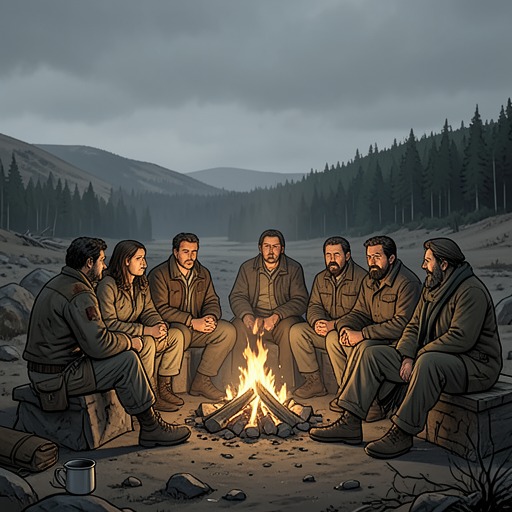
Spot's murder by the gang and bear
The ThicketSpot's murder by the gang and bear is a defining atrocity in the novel: Cut Throat Bill and Nigger Pete torture the captive beside a fire, kill him with a razor, and feed him to a restrained black bear while Jack Parker watches helplessly from cover. The event converts the gang's brutality from a threat described at a distance into an intimate spectacle of domination, and its horror gives the rescue mission its clearest moral and emotional charge.
Circumstances and Discovery
The killing occurs during Jack Parker's search for Fatty Worth in the Big Thicket, a vast wooded region where the trail is already uncertain. Efrem's directions amount to guesses about a camp beyond a sawmill, and the road marks have swallowed the peculiar wagon-wheel tracks that might otherwise have guided the search. At the sawmill, Black laborers work the logs with axes and a gasoline-driven saw, placing the gang's hidden violence within a landscape being rapidly altered by timber extraction. The search is therefore both a rescue pursuit and a passage through a frontier space organized by labor, commerce, and concealed force.
The camp reveals its danger through concrete signs before Jack sees Spot. A black bear is tied to a tree by a logging rope, with roughly twenty feet of movement, while twelve horses stand in a crude corral. A fresh logging road cuts into a clearing that appears newly stripped of its trees. The bear is not an incidental animal but part of the camp's apparatus: restrained, provoked, and held near the place where the gang exercises power over its human victim.
Torture and Killing
Cut Throat Bill has stripped Spot and is holding a burning stick against his chest. He chews tobacco, spits on the captive, and speaks to him while sitting on his legs; Nigger Pete pins Spot's arms and braces the back of his head against his knee. Other gang members drift over, look at the scene as though examining a curiosity, and wander away to drink, spit, and relieve themselves. Their casual movement makes the torture more chilling. Violence is not an emergency within the camp but a leisure activity around which ordinary idleness continues.
The gang's treatment of Spot also implicates the bear. A shirtless man throws dirt clods at the chained animal, laughing when it rises, waves its paws, and growls. The same camp therefore turns both a human captive and a wild creature into objects for amusement. The bear is contained by a rope but still possesses enough force to become the final instrument of execution; the gang's cruelty depends on converting the surrounding environment and its inhabitants into tools of spectacle.
Jack sees Spot glance toward the brush. The look may mean that Spot recognizes him, hopes for help, or merely appears to do so through Jack's frightened interpretation. Jack admits that he does nothing. He is only a boy with a gun he barely knows how to use, facing the entire gang from concealment, and fear prevents him from intervening. This hesitation is not erased by his sympathy: the scene preserves the moral fact that wanting to rescue Spot and actually rescuing him are different things.
After Spot turns his face aside in apparent resignation, Cut Throat Bill puts down the burning stick and draws a razor from the dead man's suit he is wearing. He opens a deep cut across Spot's forehead with the controlled precision of a barber. The wound initially appears only as a red line; then Nigger Pete tilts Spot's head back, and the blood sprays. Nigger Pete lifts Spot so that his feet leave the ground, while Cut Throat makes a second cut at the throat. Blood crosses the clearing, splattering the bear's face and catching the sunlight like wet rubies.
The bear hesitates, then responds to the hot blood and its hunger. Nigger Pete pushes Spot toward it, causing him to fall face-first before the animal. The bear grabs him by the back of the head and shakes him. Jack hopes that Spot is already dead when this begins, and the narration offers no further movement that would prove continued suffering. That uncertain mercy is part of the event's lasting horror: even the witness can only imagine a point at which the violence may have ended.
Immediate Consequences
The killing leaves Jack physically and psychologically disordered. He feels detached from the real world, as though common decency and human law have become absurd. His eyes fill with tears, his bowels loosen, and he cannot decide whether he is able to move or remain still. The reaction marks a collapse of the ordinary moral vocabulary by which he has understood danger. The gang's camp is not merely a place where criminals break the law; it is a space in which law and decency appear powerless before organized pleasure in suffering.
When Jack reports what he has seen, Shorty responds with a concrete strategy rather than consolation: the posse must surprise the gang and shoot before the gang knows the attack is coming. Shorty also identifies Eustace Cox as a potential problem because Eustace has disappeared while drinking and becomes a wild animal when alcohol takes him over. The rescue party needs Eustace's shotgun, so the killing immediately creates two linked imperatives: retaliate against the gang and recover the unstable but essential force required to do so.
Wider Meaning
Spot's death is connected to the novel's broader history of racial violence. Spot is a Black worker who appears elsewhere carrying water and a mop at the sheriff's office, where Sheriff Winton tells him to return later because a prisoner and visitors occupy the room. His ordinary labor stands in sharp contrast to the camp's reduction of his body to entertainment. The gang's treatment does not simply kill him; it stages the denial of his personhood before observers who treat the spectacle as disposable amusement.
That denial echoes the older history recounted around the search. Eustace Cox explains that the Cox family once owned his mother's people and that a Cox man fathered him through violence against her. A separate account of Grandpa Weeden recalls a child sold away from his parents during the slave days, compared to a piglet torn from its mother. These memories establish that Spot's captivity belongs to a continuum in which Black bodies are bought, separated, used, underpaid, and exposed to violence. The murder makes that historical structure visible in one concentrated scene.
The event also belongs to a changing frontier economy. The Big Thicket is being cut by sawmills and fresh logging roads, while the gang's camp uses a chained bear, horses, fire, and the newly opened clearing as instruments of control. Later, oil is discovered on the land divided between Eustace and Shorty, although they choose to leave most of it rich in trees and farmland. Set against that later decision, Spot's murder exposes a darker model of possession: the gang treats living beings and the landscape as consumable property, extracting pain, spectacle, and eventually a body from everything within reach.
Spot's murder thus changes the narrative from uncertain tracking to purposeful confrontation. Jack's inability to save Spot becomes part of the burden carried into the coming shootout, while Shorty's decision to assemble the posse supplies the event with a direct consequence. The killing is remembered not as an isolated death but as the moment when fear, racial terror, environmental exploitation, and retaliatory justice converge, making the gang's destruction necessary even though the violence required to achieve it will be equally dangerous.