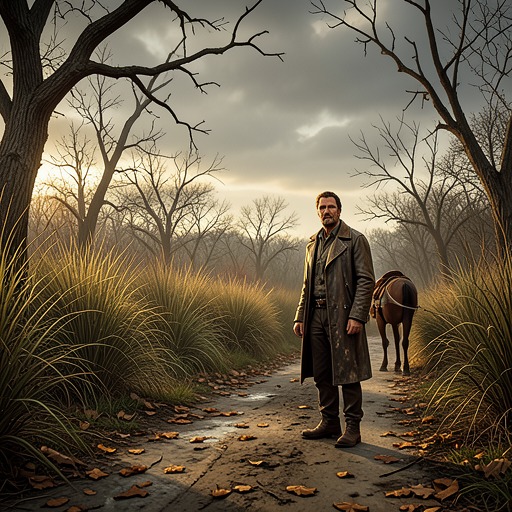
Winton homestead Comanche raid
The ThicketThe Winton homestead Comanche raid is the defining disaster in Sheriff Winton’s history: a surprise attack that kills his livestock, abducts his wife and young daughter, and leaves him mutilated and tortured before Shorty intervenes. Recounted by Shorty beside a fire, the episode explains the sheriff’s ruined face and his enduring toughness while refusing to reduce frontier violence to a simple opposition between civilized settlers and monstrous enemies.
Background and Frontier Pressure
Shorty places the raid in North Texas, a region he describes as one of the Comanche’s haunts when their way of life was nearing destruction. White settlers were arriving in large numbers with superior weapons, while the buffalo—the Comanche’s essential source of food and materials—had nearly disappeared. Winton had attempted to establish a ranch in that contested landscape, raising livestock while the Comanche resisted the expanding settlement. Shorty had previously known Winton as a fellow buffalo hunter and had himself participated in the wasteful killing of buffalo for hides, leaving most of the meat to rot. His later judgment that people should be shot and animals left alone gives the raid a broader moral setting: the violence inflicted on Winton exists within a frontier order already shaped by conquest, resource depletion, and reciprocal retaliation.
Winton was not merely a solitary rancher. Before the attack he had met Sarah, married her, and become the father of a daughter about three years old. Shorty visited the homestead while pursuing the bounty of James Plant, a suspected storekeeper’s murderer, and stayed several days. The visit established a domestic world that the raid would erase. The child treated Shorty’s dwarfism with uncomplicated curiosity, playing piggyback and cards with him without judgment, while Sarah gradually accepted his presence. The intimacy of this household makes the subsequent violence more than an attack on property: it becomes the destruction of a family and of the temporary community Shorty had entered.
The Surprise Attack
The Comanche approached before dawn, silently and close to the house. They had already cut the throats of the hogs and cattle and shot the dog with an arrow, eliminating the usual warnings. Their apparent purpose was to steal the horses, but the raid quickly became an act of punishment against Winton for attempting to settle and raise livestock on their land. When the little girl went outside to look at a new calf, the raiders seized her. She screamed before they could cover her mouth, and Sarah rushed out after her. By the time Winton, Shorty, and the others reached the doorway with rifles, Sarah had been thrown over a saddle and the child had vanished from sight, her repeated cries for her father carrying across the homestead.
The raiders scattered the horses rather than simply taking them, leaving Winton and Shorty to spend more than an hour gathering a few animals and preparing to pursue. They did so in bare feet and underwear while carrying rifles, a detail that strips the chase of any formal military appearance. The attack has already transformed them from householders and visitors into desperate trackers. Its immediate material damage is severe—the livestock is dead, the dog is dead, the horses are dispersed—but the emotional stakes are greater: Sarah and the child are being carried into an unknown fate, and Winton’s attempt to build a home has been answered by annihilation.
The Child’s Death and Winton’s Torture
Shorty and Winton eventually followed signs through thorny brush. Torn pieces of the child’s clothing appeared first, followed by the horrifying discovery that the raiders had dragged her through the thorns and impaled her through the belly on a sharpened branch. The physical setting turns the landscape itself into an instrument of violence. The child’s death is not presented as an accidental consequence of flight but as a deliberate, prolonged torment. When the narrator calls the perpetrators monsters, Shorty answers that they are human, making the horror more disturbing rather than less. The statement rejects the comfort of treating atrocity as something outside humanity.
The pursuit led to a plain covered with buffalo bones, the remains of a mass slaughter. Shorty crawled behind a buffalo skull and saw Winton tied to a lone scrub tree. Six Comanche were gathered around him, using a fire of dung and sticks to heat implements, burn his face, cut him, and saw off one of his ears. The scene links Winton’s personal mutilation to the ecological ruin already represented by the buffalo-bone mounds: a homestead, a family, cattle, buffalo, and human bodies all occupy the same landscape of retaliatory violence.
Shorty’s Rescue
Shorty carried the Sharps rifle that Winton later used, and from behind the buffalo skull he chose a target who was bringing a burning stick toward Winton’s eye. His first impulse was to kill Winton and spare him further torture, but he decided that the sheriff was still rescuable. He shot the torturer in the head, then immediately killed another attacker with a shot to the back. The remaining four fled toward their horses, abandoning the stolen animals; Shorty fired once more, though he could not tell whether the shot struck anyone. The rescue therefore depends on extraordinary marksmanship, surprise, and the raiders’ mistaken belief that a larger posse was pursuing them.
After the attackers disappeared, Shorty cut Winton down, found food among the belongings of a dead Comanche, tore clothing into bandages, and put dirt on Winton’s burns to reduce the pain. Winton had lost an ear and suffered severe burns, yet after resting he insisted on continuing the pursuit with only a knife. His refusal to remain behind defines the stubborn endurance that later characterizes him as a sheriff and bounty hunter. The two men followed the raiders for two days before abandoning the chase when the trail vanished, possibly toward Palo Duro Canyon. Hunger weakened them on the return journey; apart from a rabbit Shorty shot and badly damaged with the Sharps, they had little to eat.
Consequences and Narrative Significance
Back at the homestead, Shorty and Winton found the bodies of Sarah and their daughter, brought them home, and buried them beneath a large oak, the only place nearby with sufficient greenery and water. The raid thus ends not with recovery but with burial and permanent loss. Winton survives, but survival is inseparable from mutilation, grief, and the knowledge that the family he tried to protect cannot be restored. His later face, described as visibly damaged, becomes a physical record of the raid rather than merely a mark of ruggedness.
The story also explains the depth and complication of Shorty’s loyalty to Winton. Winton had cheated Shorty at cards, taken several bounties from him, lied to him, and insulted him while drunk, yet Shorty followed him into danger because he regarded him as a boon companion on whom he could depend to be himself. Their friendship is therefore not based on moral purity. It survives dishonesty and resentment, and is sealed instead by shared pursuit, bodily risk, and the obligation to recover the dead.
As part of the book’s wider frontier history, the raid stands beside later searches through the Big Thicket, timber mills, changing roads, and the eventual discovery of oil on land connected to the survivors. The landscape does not remain fixed: buffalo disappear, forests are cut, motorcars multiply, and oil wealth alters property. The raid is the violent human counterpart to those slower transformations. It shows how settlement, dispossession, labor, and resource extraction are experienced not as abstract historical processes but as ruined homes, dead animals, abducted children, and bodies permanently marked by force.