Edward Derby and Asenath Waite Marry
The Thing on the DoorstepEdward Derby and Asenath Waite marry after a brief, intense courtship, beginning a union that Edward later describes as the route into a struggle over identity and bodily control. Their wedding is a quiet civil ceremony, but the marriage’s consequences reach far beyond its modest beginning: the couple settle in Arkham, where Asenath’s occult studies and Edward’s dependence on her shape the life he later recounts as an ordeal.
Courtship and Opposition
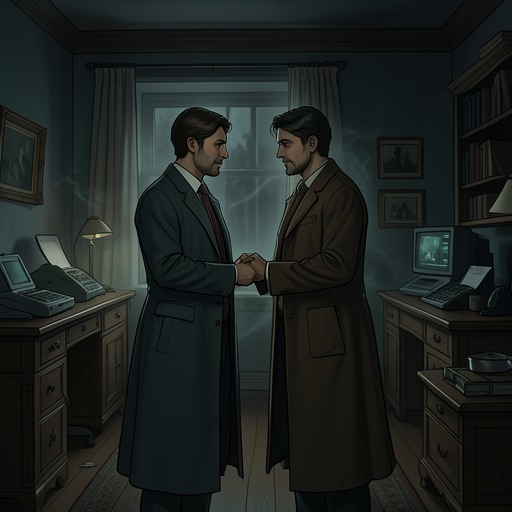
Edward meets Asenath at a gathering in a student’s room and is captivated by her appearance, learning, and shared intellectual interests. He speaks of little else to Daniel Upton afterward. Their attraction is reciprocal: when Asenath visits Upton with Edward, she watches her prospective husband with an intensity that convinces Upton their intimacy is already difficult to undo.
Edward’s father learns that his son intends to marry and has begun looking at suburban houses. He asks Upton, who has considerable influence with Edward, to help end the relationship. Upton doubts he can intervene, judging that this attachment is not a repetition of Edward’s earlier dependence on his parents: Asenath’s will appears stronger than Edward’s, and Edward is unlikely to be dissuaded. At Upton’s advice, the elder Derby does not oppose the wedding.
Ceremony and Settlement
The wedding takes place a month later, conducted by a justice of the peace at Asenath’s request. The brief ceremony is attended by Edward’s father, Upton, Upton’s wife and son, and a group of young people from the college. Asenath has bought the old Crowninshield House at the end of High Street, and the couple plan to settle there after a short trip to Innsmouth. Three servants, books, and household goods are to come from Innsmouth with them.
Their choice of Arkham keeps Asenath near the college, its library, and its social circle. Upton understands this preference as more decisive than any wish to return permanently to her former home. The settlement therefore places the marriage not only in Edward’s familiar town but also within reach of the intellectual and occult resources Asenath brings into their shared household.
Early Married Life
When Edward visits Upton after the honeymoon, he seems more sober and thoughtful than before. Asenath has persuaded him to remove his undeveloped moustache, but Upton notices a broader change: Edward’s childish rebelliousness has given way to an expression of sadness, and for a time he appears more adult. Upton wonders whether the marriage might redirect Edward’s dependence toward greater independence.
Asenath is occupied with restoring the house and grounds and has brought a large collection of books and apparatus from Innsmouth. Edward tells Upton that he is advancing quickly in esoteric studies under her guidance, though he declines to describe some of the experiments she proposes. He trusts her abilities and intentions at this stage. The household also includes three servants associated with Asenath’s family: an elderly couple who had served Ephraim Waite and speak cryptically of him and Asenath’s dead mother, and a young woman whose unusual appearance and persistent fishlike odor unsettle Edward.
Later Accounts and the Marriage’s Consequences
More than three years into the marriage, Edward emerges from the Maine woods in a disordered state and tells Upton that Asenath has forced him into an occult rite near Chesuncook. He says he had refused to be taken there, yet found himself at the ceremony after a sudden displacement from the library. Later, he claims that Asenath intended a Hallowmass sacrifice to make their bodily exchange permanent, leaving her in his body and him in hers. These accounts recast the marriage’s early intimacy as the beginning of a conflict over who could inhabit Edward’s body; they remain Edward’s testimony rather than events Upton witnesses directly.
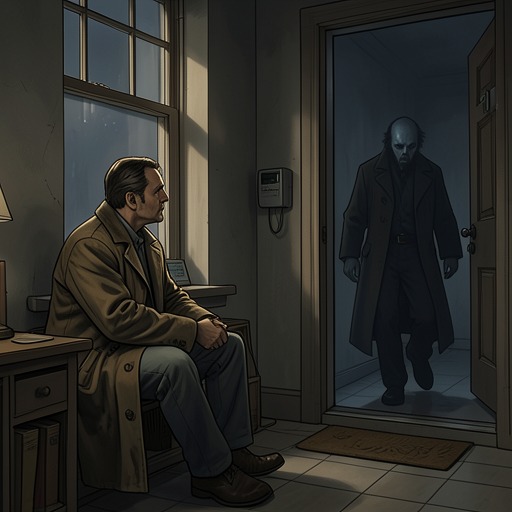
In a final written warning, Edward says that he killed Asenath before the feared Hallowmass outcome, concealed her body in the cellar, and initially believed himself safe. He then reports that her consciousness continued after death and was taking control of him again, eventually trapping him in her corpse while she occupied his body at the sanitarium. The warning gives the marriage an ending that is also a reversal: even Asenath’s death, as Edward describes it, does not end her claim on him. The wedding’s significance thus lies in the distance between its restrained public ceremony and the private struggle Edward later says began within the marriage.