Edward Encounters a Cult Ritual in the Maine Woods
The Thing on the DoorstepEdward Derby Encounters a Cult Ritual in the Maine Woods is the episode in which Edward describes being taken from his locked room and made to experience a secret rite in the Maine wilderness. The account turns his earlier, seemingly incoherent warnings about exchanges of personality into an immediate crisis: Asenath Waite appears able to use his body for journeys and ceremonies while he is left in hers. Yet Daniel Upton does not witness the rite itself. Its setting and actions reach him through Edward’s distressed, disjointed report, preserving uncertainty even as the account reveals the danger Edward believes he faces.
Background and Journey
By the August in which the episode comes to light, Edward and Asenath have been married for more than three years. Daniel has not seen Edward for two months and has heard that he is away on business. Asenath is supposedly with him, but local gossip has noticed a person upstairs behind the doubly curtained windows of their house. The servants’ purchases have also drawn attention. These indirect signs give the couple’s apparent absence an uneasy quality, but they do not establish what has happened.
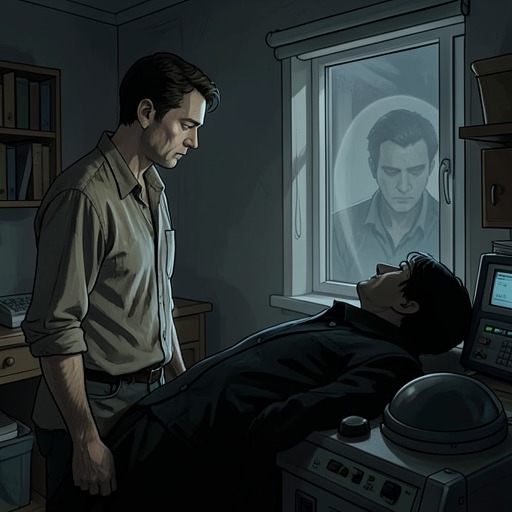
The news arrives by telegram from the town marshal of Chesuncook. Edward has stumbled out of the woods in a distressed and confused state, calling for Daniel’s protection and able to recall little beyond his own name and address. Daniel travels for a day through the remote forest country to reach him. He finds Edward in a cell at the town farm, shifting between agitation and withdrawal. The journey and the cell frame the report as a crisis requiring care, not as an account Daniel can independently verify.
Edward’s Account of the Rite
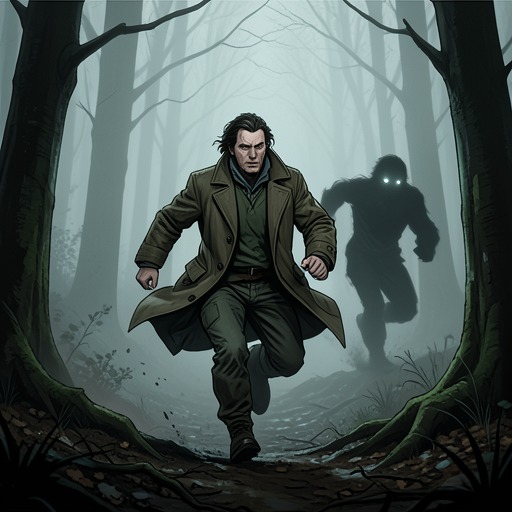
When Edward begins to speak, his account comes in fragments. He describes a descent of six thousand steps, a pit associated with Shoggoths, and a ceremony in which a shape rises at an altar while hundreds howl. A hooded presence voices the name Kamog, which Edward identifies as Ephraim Waite’s secret name within the coven. The details suggest an organized rite with a concealed name and a gathering of participants, but Daniel receives them in the form of Edward’s delirious recollection rather than direct observation.
Edward’s central claim is that he had resisted Asenath’s efforts to take him to such a place, yet found himself there all the same. He had been locked in a library moments earlier; then he was at the ceremony, in the body Asenath had left behind while she had gone there in his. The suddenness is essential to his account. No ordinary journey connects the locked room to the distant ritual site: the transition occurs through the bodily exchange that Edward says Asenath can impose on him.
He recalls a figure rising at the altar and the crowd’s response, then says that a Shoggoth changes shape. His report breaks down into repeated expressions of fear and a determination to prevent Asenath from sending him there again. The repetition conveys the immediate effect of the episode on him: whatever the rite’s purpose, he experiences it as a violation of his control over where he is and which body he inhabits.
The Pattern Behind the Encounter
On the drive back toward Arkham, Edward’s fragments become a broader account of recurring exchanges. He says Asenath has repeatedly taken his body and traveled to unnamed places for rites, leaving him in hers and confined upstairs. At times, he claims, her hold weakens and he suddenly finds himself in his own body at a remote location, stranded and forced to make his way home. He describes these episodes as a continuing pattern rather than a single unexplained displacement; the Maine ceremony is its most frightening instance so far.
Daniel’s observations make the account harder for him to dismiss, without proving its supernatural explanation. Edward appears more physically developed and alert than Daniel remembers, as though he has been made to move and exercise more than his previous habits would suggest. At the same time, his mental state is plainly precarious. Daniel considers that some actual hypnotic ordeal may lie behind Edward’s delusions, but remains uncertain about their content. Earlier, Edward had spoken of cyclopean ruins in the Maine woods, immense staircases descending into hidden spaces, and strange objects that he said came from outside. These warnings give the Chesuncook episode a larger, otherworldly context, while remaining claims reported by Edward.
Consequences and Significance
The encounter changes Daniel’s understanding of Edward’s marriage. Edward now presents Asenath’s actions not as isolated acts of influence but as an attempt to occupy his body permanently. He believes she wants to become fully human and that the body exchange would leave him trapped in hers. He further alleges that Hallowmass is the intended point of no return: a ceremony and sacrifice at a gathering beyond Chesuncook would make the transfer permanent. The Maine rite he recounts therefore stands both as an ordeal already endured and as a warning of a more decisive ceremony he fears is still to come.
Daniel does not take Edward home. Judging that Edward’s suspicions may arise from a real ordeal and that contact with Asenath could worsen matters, he brings him to Arkham and plans to shelter him himself. Edward’s fury subsides during the return, although it returns in fragments as they pass through Augusta and Portland. His description makes the episode consequential even before Daniel can determine what is true: Edward is frightened, his confidence in his own bodily identity has been shaken, and Daniel now sees the marriage as potentially dangerous.
The later warning Edward sends from the asylum gives the Hallowmass threat a grim aftermath. He says he killed Asenath before the anticipated ceremony, but that after her death she continued to take his body; he warns that the exchange could become permanent even without her presence at the sacrifice. This later revelation does not make Daniel a witness to the earlier Maine rite or resolve every uncertainty in Edward’s account. It does show why he remembers the encounter as more than a vision: it was evidence, in his understanding, that Asenath could move him against his will and bring him into the reach of the cult’s ritual world.