Edward Pickman Derby
The Thing on the DoorstepEdward Pickman Derby is a gifted poet and occult scholar whose transformation from sheltered prodigy to desperate fugitive drives the story’s conflict over identity and bodily control. His lifelong friendship with Daniel Upton offers a steady human bond, but cannot protect him from the hidden practices he encounters through Asenath Waite or from the consequences of his attempt to escape her power.
Identity and Early Formation
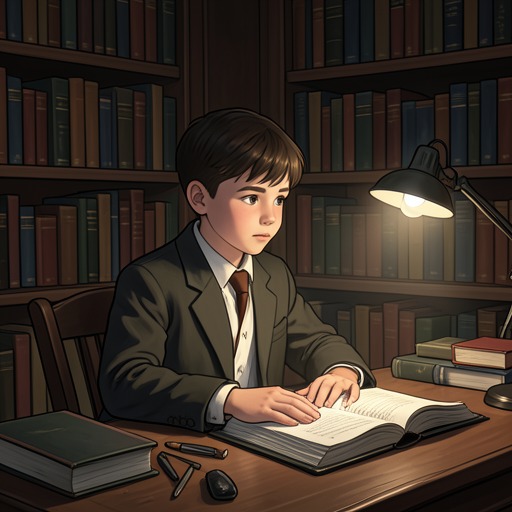
Derby is eight years younger than Daniel Upton, yet the two became close when Derby was eight and Upton was sixteen. An only child with physical weaknesses, he was kept close to his parents and rarely allowed to play freely with other children; even outings required a nurse’s company. Within that restricted life, imagination became his chief avenue of freedom. By seven he was writing dark, fantastic verse that astonished his tutors, and his early learning was both unusually extensive and unconventional.
The two boys found common ground in an interest in shadows and marvels. As they grew older, Upton turned toward architecture, while Derby’s unusual poetic talent developed. At eighteen, Derby published a collection of nightmare-themed poems that brought him a measure of attention. His precocity gave way to a more complicated adult character: learned and imaginative, but also shy, socially isolated, and long sheltered from ordinary responsibilities.
Scholarship and Friendship with Daniel Upton
Derby attended Miskatonic University in Arkham from the age of sixteen, completing his course in three years. He studied English and French literature and earned high marks in most subjects, while doing less well in mathematics and the sciences. He kept apart from most students, though he envied the freedom of the more daring social set and imitated some of its mannerisms. His academic distinction did not translate into broad experience or independence.
At the university library, Derby’s interest in the fantastic deepened into a private devotion to occult writings. He read works including the Necronomicon without telling his parents. This clandestine study connected his imaginative life to lore he treated not merely as literary material but as a possible guide to realities beyond ordinary experience. By twenty-five he was known as a learned poet, although his isolation and lack of practical obligations had, in Upton’s view, limited his artistic development.
Upton became Derby’s closest friend and confidant. Derby turned to him for advice on matters he did not want to discuss with his parents, while Upton valued their conversations and visited the growing library in Derby’s home. When Upton had a son, Derby was pleased that the child was named in his honor. Their closeness gives the later appeal for help particular force: Derby’s final warning is directed not to an abstract rescuer but to the friend who had known him since childhood.
Marriage and the Signs of Exchange
Derby’s marriage to Asenath Waite placed him in a relationship that increasingly threatened his sense of self. His visits to Upton became more frequent, and his once-obscure hints turned into accounts of dangerous meetings in remote places, immense ruins in the Maine woods, and stairways descending into hidden depths. He also described exchanges of personality that allowed journeys into forbidden regions and other spaces. Upton found the claims difficult to accept, but Derby’s apparent sincerity made them troubling rather than merely fanciful.
Derby sometimes showed Upton strange objects whose colors, textures, curves, and surfaces seemed unlike anything familiar on Earth. He said they came from outside and that Asenath knew how to obtain them. He also raised an unresolved fear about her father, Ephraim Waite, wondering whether the old occultist might remain present in some spiritual sense after death. These fragments link Derby’s domestic crisis to a larger, uncertain world of occult practices without giving him a complete explanation of what was happening to him.
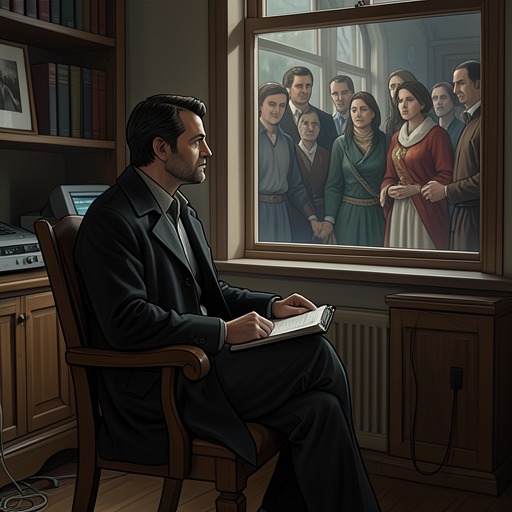
Asenath appeared able to interfere with Derby’s attempts to speak to Upton. At times Derby abruptly stopped disclosing what he knew; Asenath seemed to anticipate or obstruct his visits, and he could reach his friend only with difficulty. The pattern makes his increasing confidence and his intermittent access to Upton signs of a struggle over agency, not evidence that he had escaped it. His marriage had become the setting in which private knowledge, movement, and even the boundary between persons could be controlled.
Captivity and Resistance
More than three years into the marriage, Derby disappeared from Arkham and was reported to be away on business. In August, the town marshal at Chesuncook contacted Upton after a disheveled, delirious man emerged from the woods asking for protection. The man was Derby, barely able at first to recall his own name and address. Upton found him in a cell at the town farm, shifting between agitation and apathy.
Derby’s fragmented account connected his ordeal to a cult ritual in the forest. He described being taken against his will to a place of worship beneath the ruins, despite having been elsewhere shortly before. He said that Asenath had promised not to send him there, and that he had been forced to witness a terrifying presence and a gathering of worshippers. His account ended in a threat to kill the entity responsible if it sent him there again. The episode turns the body exchange he had described in theory into an imposed experience: Derby is not exploring these places freely but is being made to undergo them.
Upton brought him back toward Arkham and concluded that Derby did not want to return home. He resolved to house him temporarily and help him seek a divorce, believing that the marriage was dangerous to his friend. Derby’s account remained incoherent and frightening, but Upton interpreted it as the aftermath of a real ordeal rather than as simple delusion. The rescue offered a brief possibility of separation from Asenath, not a resolution of the threat.
Asenath’s Death and Derby’s Final Warning
In a written message delivered to Upton late at night, Derby explained that he had killed Asenath three and a half months earlier. He said he acted because she was about to take his body permanently at Hallowmass. He had believed the danger ended with her death, concealed her body in a cellar storeroom beneath boxes, and sent away servants who might have suspected what had happened. His confession presents the killing as an attempt to prevent the loss of his own identity, while also revealing how far the conflict had already driven him.
Derby then recognized that Asenath’s influence had continued after death. He believed that a soul only partly attached to its body could persist as long as that body endured, and that Asenath was again exchanging bodies with him: she was taking his living body and putting him into the corpse hidden in the cellar. He urged Upton to go to the sanitarium and destroy the being inhabiting Derby’s body. The note reverses the apparent outcome of Derby’s escape: killing Asenath had not ended the contest, and the familiar body could no longer be trusted to contain the familiar person.
The messenger who brought the note wore one of Derby’s overcoats and could not speak intelligibly. After delivering the message, it became motionless. The remains found inside the clothes included a skull that dental work identified as Asenath’s. This physical evidence supports the story’s central horror of identity detached from the body, even as the exact nature of what happened remains filtered through Upton’s account. Derby’s final act is therefore both an appeal for rescue and a last effort to make his friend understand that the person appearing to be Edward Derby is no longer Edward Derby.
Narrative Role and Ending
Derby’s life is presented through Upton’s retrospective testimony, which begins with their childhood friendship and proceeds toward the unexplained final visit. Upton admits uncertainty about whether he has been misled or has become mad, while insisting that the evidence cannot be explained by his own instability alone. Derby’s early literary imagination thus forms a deliberate contrast with the material evidence at the end: what once belonged to poems and occult books becomes a crisis that affects bodies, movement, and the possibility of recognizing a person.
His arc also turns the language of protection inside out. As a child, Derby was kept dependent and sheltered; as an adult, he sought knowledge in secret and entered a marriage that brought him into contact with forces he could not control. His last message depends on the friendship that endured across those changes, but arrives only after his attempts to save himself have failed. The unresolved boundary between Derby and Asenath is the story’s final measure of his loss: his warning survives, while his own identity cannot be securely recovered from the body that bears his name.