Edward's Corpse Arrives at Upton's Doorstep
The Thing on the DoorstepEdward’s Corpse Arrives at Upton’s Doorstep is the final warning Daniel Upton receives from Edward Derby: a disguised, failing figure reaches Upton’s home carrying a letter that exposes the struggle over Derby’s body and the danger still alive at the sanitarium. The arrival turns a hoped-for reunion into proof that the person occupying Edward’s form is not Edward, while leaving Upton with a threat that he cannot confirm or contain by ordinary means.
Background and Warning Signs
Before the night of the arrival, Derby had gradually begun confiding in Upton about events he could scarcely make credible. He spoke of meetings in remote places, vast ruins beneath the Maine woods, passages into other regions of space and time, and exchanges of personality that allowed journeys beyond ordinary human experience. He also showed Upton strange objects whose forms and surfaces seemed to follow no recognizable purpose or geometry, saying they came from outside and that Asenath knew how to obtain them. His hesitant references to Asenath’s father, Ephraim Waite, raised the further possibility that Ephraim might persist after bodily death.
Derby’s account of a forced journey to a forbidden ritual site had already shown how much he feared Asenath’s power. He described being moved from a locked library to a place of worship in the Maine wilderness, where he witnessed an incomprehensible ceremony and a changing creature. He said that Asenath had taken his body there while he experienced the ordeal in hers. Upton had treated these statements as delusions shaped by a real hypnotic ordeal, but the arrival makes them part of a larger explanation: Derby’s experiences concern a continuing transfer of identity, not simply his marriage or his mental health.
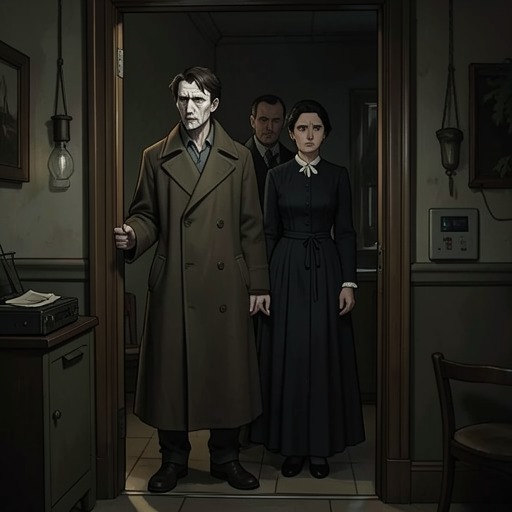
Upton is awakened shortly after two in the morning by the doorbell and knocker, used alternately in a weak attempt to reproduce Edward’s familiar signal of three strokes followed by two. That remembered code initially persuades him that Edward has returned to himself. The hope is sharpened by the fact that the personality Upton had recently encountered at the sanitarium did not remember the signal. He hurries downstairs believing that whatever has happened, his old friend is again at the door and needs help.
The Arrival and the Letter
The caller is a short, hunched figure, almost hidden beneath one of Edward’s overcoats, a low slouch hat, and a black muffler. Its sleeves cover its hands, and the coat hangs nearly to the ground. Rather than speak intelligibly, it makes the same bubbling sound Upton had heard during an unexplained telephone call earlier that night. The figure pushes forward a closely written sheet fixed to the end of a long pencil. The handwriting is Edward’s, but unusually awkward and unsteady. The messenger follows Upton into the hall and stops at the inner threshold.
The paper explains the contradiction between the caller’s appearance and its message. Edward writes that Asenath had been dead for three and a half months. He had killed her when they were alone, fearing that she would take his body permanently at Hallowmass, and had hidden her remains beneath boxes in a cellar storeroom at the Crowninshield House. He had sent the servants away after they suspected what had happened, but feared that they, or others connected with the cult, might act against him.
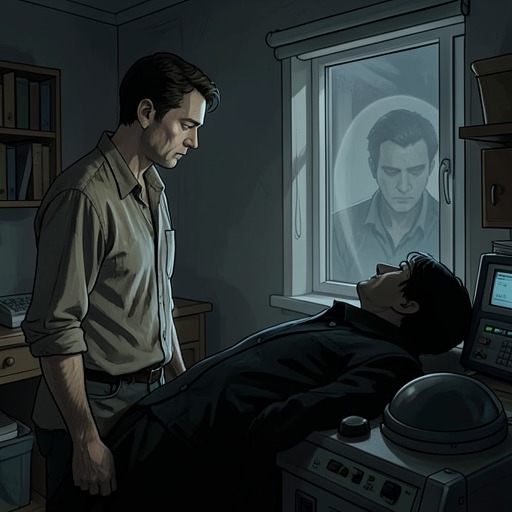
For a time, Derby believed that killing Asenath had ended the danger. Then he felt the familiar force acting on his mind and understood that death had not stopped her. In his account, a soul like Asenath’s—or Ephraim’s—could remain active as long as its body lasted and could continue exchanging bodies. Derby says he found himself trapped in Asenath’s concealed remains while Asenath occupied his body at the sanitarium. Because the exchange had occurred after Hallowmass, he believed the sacrifice had made her possession permanent even in his absence, leaving her sane and ready to be released.
Escape and Identification
Derby explains that the prospect of being confined in Asenath’s body drove him to the asylum. When the exchange took effect, he escaped from the cellar despite his weakened condition. Unable to manage a telephone call, he wrote the warning and brought it to Upton himself. He asks Upton to kill the entity at the sanitarium and have the body cremated, fearing that otherwise the entity could continue from body to body. The letter also warns Upton away from black magic and apologizes for drawing his friend into the danger. Its closing turns the message from a request for rescue into a farewell: Derby believes that the body carrying him will not hold together much longer.
Upton collapses while reading. When he recovers, the messenger has fallen silent and is no longer conscious. In the morning the butler calls the police. The figure’s unusual clothes conceal remains that are largely liquefied, but the bones and skull provide a decisive material clue: dental work identifies the skull as Asenath’s. The evidence establishes that the visitor’s physical body was hers, even as the letter identifies the consciousness within it as Derby’s. The scene therefore separates bodily identity from personal identity at the very moment when Upton had taken Edward’s familiar signal as proof that Edward was himself again.
Consequences and Significance
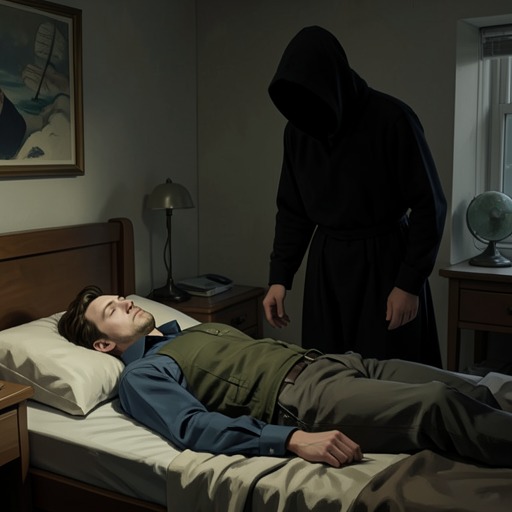
The arrival reframes Upton’s recent actions at the sanitarium. He had shot the person in Edward’s body because he believed that the personality looking through Edward’s face was not his friend. Derby’s letter confirms that Asenath had taken control of that body, but the messenger’s collapse shows that killing an occupied body has not necessarily ended the underlying danger. Upton now fears that the force can survive the death of its physical form, and insists that the sanitarium body must be cremated; the doctors are instead keeping it for examinations.
The scene builds its reversal through small signs before disclosing the full explanation. The three-and-two knock seems to promise Edward’s return; the concealed figure, the written message, and the skull’s identification unsettle that expectation one by one. The note supplies a causal account of the corpse’s arrival, but not a reassuring solution: Derby has managed to warn Upton, yet Asenath remains in Edward’s body and the limits of bodily death remain uncertain. The event closes the story by making the threshold a place where identity can arrive in the wrong body and where physical evidence confirms only part of what has happened.