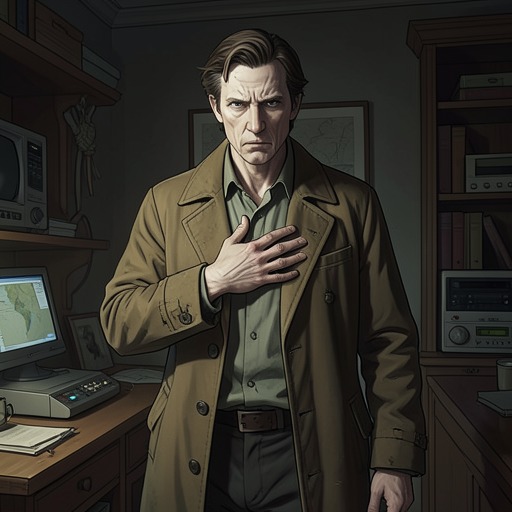
Ephraim Waite and Asenath's Body Exchange
The Thing on the DoorstepEphraim Waite and Asenath's Body Exchange is the exchange of bodies that Edward Pickman Derby believes explains Asenath Waite’s identity and her later attempt to take his body. As Derby tells it to Daniel Upton, Ephraim transferred himself into his daughter’s body, leaving her in his old one; the account makes the exchange a hidden precedent for the struggle between Derby and Asenath. Its particulars are presented as Derby’s deductions and testimony rather than as an event Daniel witnessed.
Background and Clues
Derby’s suspicion gathers around discrepancies that seem to him to point beyond ordinary resemblance between father and daughter. He says Asenath sometimes writes in a backhand style, but that when she is off guard her notes resemble Ephraim’s manuscripts, stroke for stroke. He also recalls her saying things that, in his view, sound like an old man rather than a young woman. These observations turn the apparent continuity of Asenath’s identity into a question: Derby comes to doubt that the person called Asenath is Asenath at all.
He connects those clues to Ephraim’s occult knowledge, which he believes included a formula in the Necronomicon for transferring consciousness from one body to another. Derby withholds the page number, saying he will disclose it later, but describes the formula’s principle as a passage from body to body and a way to break the link between life and the body. In his account, the Life-glow can persist for a time after bodily death. This proposed survival makes it possible, in his theory, for an identity to outlast the body it first inhabited.
The Exchange as Derby Reconstructs It
Derby claims that Ephraim, sensing death, selected Asenath because she had the kind of mind he needed and a will he could overcome. He says Ephraim exchanged forms with her, took her body permanently, and left her in his former body. According to Derby, Ephraim then poisoned that old body. The exchange, as he reconstructs it, was thus not a voluntary transformation shared equally: it was an act of control that gave the father the body he wanted and concealed the daughter’s fate.
Derby treats Ephraim’s apparent death and Asenath’s subsequent conduct as evidence for this account. He recalls that Ephraim was thought to have been poisoned and that, before his death, he had sought someone with a suitable mind and weak will. He also connects stories of Ephraim’s distress and confinement to the possibility that the person trapped was Asenath in her father’s body. These details remain part of Derby’s explanation; the account does not supply an independent witness to the original exchange.
Ritual, Repetition, and Derby’s Fear
The exchange matters to Derby because he sees it repeated in his own marriage. He believes that Asenath has forced him out of his body and intends to make that change permanent at Hallowmass, when a sacrifice would complete the process. In his theory, the earlier exchange between Ephraim and Asenath demonstrates both the possibility of taking another body and the danger of allowing an unstable transfer to become irreversible. His fear is not only of losing his body, but of being left with no way to recover it.
Derby’s account of being sent to a hidden cult site while displaced from his own body deepens his conviction that Asenath’s actions belong to an occult practice rather than to private deception alone. He describes the episode as an involuntary experience, and associates the ceremony with the threat of a permanent exchange. The story does not establish the full procedure or independently confirm what occurred in Ephraim and Asenath’s case; it shows how Derby uses the feared ritual to make sense of the danger he believes he faces.
Consequences and Significance
The alleged exchange gives Derby a model for understanding Asenath’s identity: the outward person and the consciousness within her body may not be the same. It also turns his own conflict with her into a repetition of an older family crime. The handwriting and speech he once treated as peculiarities become, in retrospect, clues that he reads as signs of Ephraim’s presence.
After Derby kills Asenath, he reports that her consciousness continues to act through the body he has left behind. He believes it is taking control of him again and that the Hallowmass sacrifice can still make the exchange permanent, even though Asenath is dead. The earlier exchange therefore functions in his warning as more than a past event: it is the precedent for a body-taking that, in his account, can survive its apparent end and recur across bodies. The reader receives this explanation through Derby’s frightened reconstruction, whose claims are central to the story’s revelation but are not presented as a witnessed record of the original transfer.