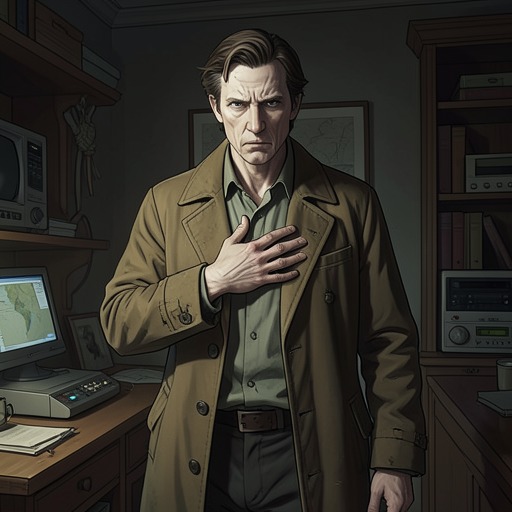
Ephraim Waite's Attempt to Take Edward Derby's Body
The Thing on the DoorstepEphraim Waite's Attempt to Take Edward Derby's Body is the occult threat that Edward Pickman Derby gradually identifies behind his changing control of his own body. In Derby’s account, Ephraim has already escaped death by exchanging bodies with his daughter, Asenath Waite; the being who appears to be Asenath then seeks to take Derby’s body in turn. The claim is delivered through a distressed and increasingly disjointed explanation, but its central fear is consistent: a method of survival through successive bodies may leave Derby dispossessed even after the apparent death of his adversary.
The Theory of Ephraim’s Survival
Derby’s account begins with the suspicion that Asenath has repeatedly taken control of his body, leaving him in hers and sometimes abandoning him at distant places. He believes these episodes are not isolated disturbances but stages in a larger attempt to make the exchange permanent. He describes himself as a person with an unusually developed intellect but a weak will, qualities that he thinks made him a suitable target. In his understanding, the body-taking is not simply an exercise of control: it is preparation for Asenath to displace him altogether and continue her life in his body.
The explanation changes when Derby identifies the apparent Asenath with her father. He says that her unguarded handwriting sometimes resembles Ephraim Waite’s manuscripts, stroke for stroke, and that some of her remarks seem to come from an older man. These details lead him to conclude that Ephraim, fearing death, exchanged forms with Asenath and took her body permanently. In this reconstruction, he then poisoned the body in which he had left her. The claim makes Derby’s present danger part of an earlier pattern: Ephraim found in his daughter a mind suitable for the exchange, and Derby fears that the same predatory search has now turned toward him.
A Precedent and Its Clues
Derby connects the supposed exchange to several disturbing details surrounding Ephraim’s final years. He recalls that people wondered whether Ephraim had been poisoned, and that the Gilmans whispered about his behavior during a period when Asenath confined him in a padded attic room. Derby asks whether the person imprisoned there was Ephraim’s soul, or whether the apparent identities of father and daughter had already been reversed. He also points to Ephraim’s reported frustration that Asenath was not a son and to his search for someone with a strong intellect and weak will. These observations are presented as clues assembled by Derby, not as an independently verified account of the exchange.
The Necronomicon gives Derby a possible occult framework for the theory. He believes Ephraim found a formula there that could break the link between a person and a body, and he describes the life-glow as capable of continuing briefly after bodily death. He associates that knowledge with Ephraim’s desire to avoid dying and with a successful prior demonstration. Derby does not disclose the formula or its page, and his explanation remains incomplete; he promises to provide more but repeatedly stops before doing so. The withheld detail makes the account feel both like a warning and like evidence that its speaker cannot fully organize or communicate what he believes he has learned.
The Threat to Derby
As Derby understands it, Ephraim’s earlier survival is the precedent for what is happening to him. The being he calls Asenath is, he insists, Ephraim himself, and its control over Derby’s body is part of an effort to repeat the exchange. The desired outcome, as Derby describes it, is for Ephraim to occupy a fully human male body while Derby is left in the body that had belonged to Asenath. He fears that the process will eventually become permanent, leaving him unable to return to his own body. This perceived threat gives the episodes of lost time and unexplained travel a common cause in his account: each is a consequence of an ongoing struggle over who inhabits him.
Derby’s fear does not end when he kills Asenath. In the letter he later sends to Daniel Upton, he says he had believed himself safe after the killing, but then felt the familiar pull in his mind. He understands the return of that sensation as evidence that a soul like Asenath’s—or Ephraim’s—can persist after the body dies, and can continue to act while that body remains. He reports finding himself trapped in Asenath’s corpse in the cellar, while believing that the entity had taken his body at the sanitarium. Since Hallowmass had passed, he fears that the exchange had become permanent even without Asenath’s physical presence at the ritual.
Warning and Narrative Significance
Derby’s final warning to Daniel Upton turns his theory into an urgent request for action. He asks Upton to destroy the entity occupying his body and have it cremated, believing that otherwise it could continue moving from body to body. He presents this as a last attempt to prevent the danger from extending beyond himself, while admitting that he cannot explain everything and that he has little time left to communicate. His letter thus links the alleged attempt by Ephraim to take Derby’s body to the possibility of survival after death: the threat is not confined to a single exchange or to the life of either body involved.
The relation is also shaped by uncertainty in the telling. Upton first hears Derby’s theory as part of a rambling account and considers the possibility that he is mentally unwell; the evidence reaches the reader through Derby’s suspicions, recollections, and final written warning. The account nevertheless establishes a deliberate pattern within Derby’s explanation: Ephraim’s fear of death leads to an earlier exchange with Asenath, and that precedent makes Derby’s own loss of bodily control appear to be the next stage of the same project. By the end, the question is no longer only whether Ephraim once took his daughter’s body, but whether the method Derby attributes to him can survive bodily death and claim another body afterward.