Diamond Studs
The Three MusketeersThe Diamond Studs are a set of twelve diamond ornaments, a gift from King Louis XIII to Queen Anne of Austria. They are first mentioned when the king, prompted by Cardinal Richelieu, insists that the queen wear them at a ball given by the aldermen of Paris on October 3, 1628. The queen, however, has already given them to her lover, the Duke of Buckingham, as a token of her affection. This act sets in motion a desperate race to recover the studs before the ball, a mission that falls to d'Artagnan and his three friends, Athos, Porthos, and Aramis.
The Queen's Gift and the Cardinal's Plot
The queen, having received the studs from the king, gives them to Buckingham during a secret meeting in her chambers at the Louvre. She places them in a rosewood casket with her cipher encrusted in gold, which she hands to the duke, saying, "keep this in memory of me." The cardinal, through his spy Madame de Lannoy, learns of this transfer. He then devises a plan to expose the queen's infidelity: he will have two of the studs stolen from Buckingham, and then, at the ball, the king will demand to see the queen wearing the full set. When she cannot produce them, her disgrace will be complete. The cardinal writes to his agent, Milady, instructing her to attend the first ball at which Buckingham is present and to "cut off two" of the studs from his doublet.
The Journey to Recover the Studs
D'Artagnan, having learned of the queen's peril from Constance Bonacieux, volunteers to travel to London to retrieve the studs from Buckingham. He sets out with his three friends, but their journey is fraught with ambushes orchestrated by the cardinal's agents. Porthos is delayed by a duel at Chantilly, Aramis is wounded at Crevecoeur, and Athos is arrested at Amiens. D'Artagnan alone reaches Calais, where he fights and kills the Comte de Wardes, a cardinalist agent, to obtain the necessary travel pass. He then sails to England and presents himself to Buckingham.
The Duke's Chapel and the Missing Studs
Buckingham, upon learning of the queen's need, takes d'Artagnan to a small chapel in his palace, where a full-length portrait of Anne of Austria hangs over an altar. There, he opens the rosewood casket containing the studs. To his horror, he discovers that two are missing. He realizes they were stolen by Milady, who had cut them from his doublet at a ball given by the king at Windsor. Buckingham, desperate, orders his jeweler, Mr. O'Reilly, to create perfect replicas of the two missing studs within two days. The jeweler is imprisoned in the palace to complete the task, and Buckingham places an embargo on all vessels in English ports to prevent the originals from being smuggled to France.
The Ball and the Queen's Triumph
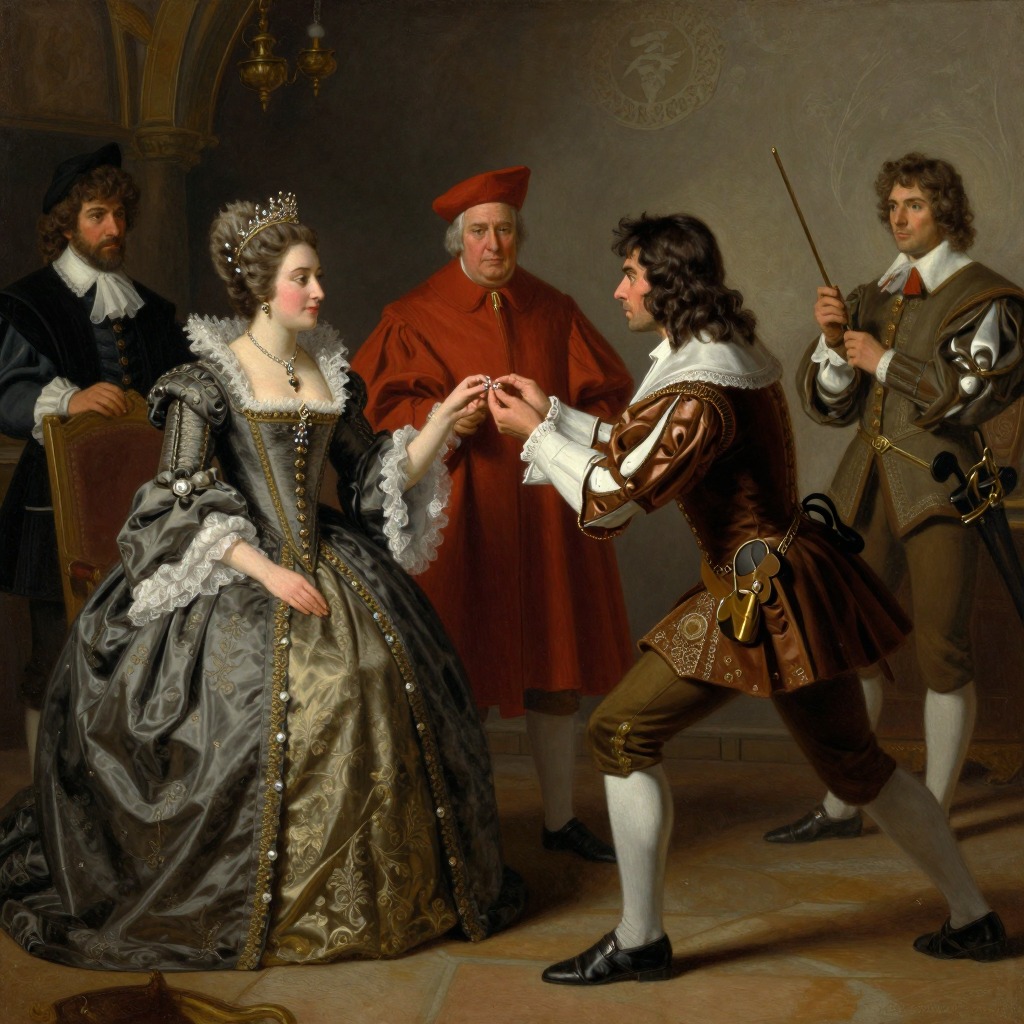
D'Artagnan returns to Paris with the twelve studs—the ten originals and the two perfect replicas—just in time for the ball at the Hotel de Ville. The queen appears wearing the studs, and the king, who had been prepared by the cardinal to expose her, is delighted. The cardinal, seeing the queen with all twelve studs, is forced to pretend that he had intended to give her the two missing ones as a gift. The queen's honor is saved, and d'Artagnan is rewarded with a diamond ring from the queen herself. The studs thus serve as the catalyst for the novel's central adventure, demonstrating the power of a seemingly small object to drive political and personal conflicts.