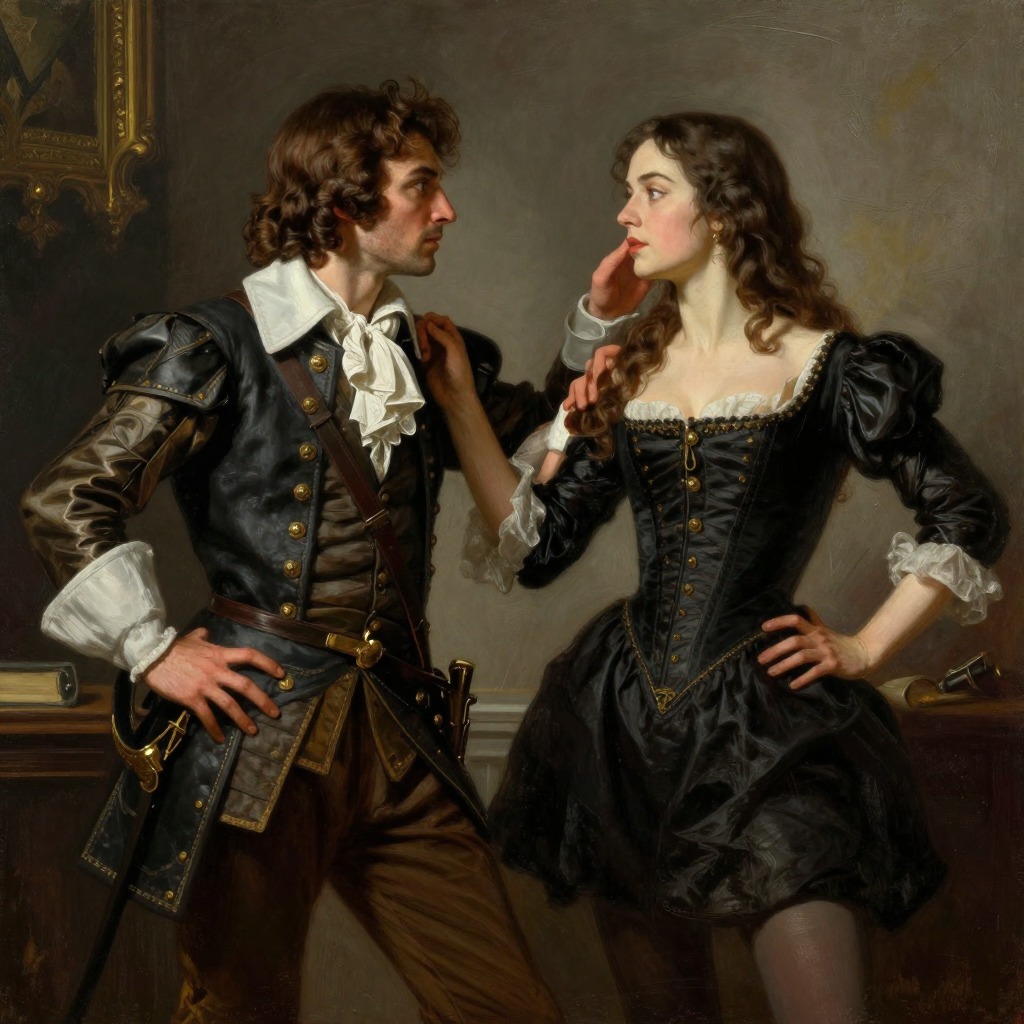
Duel with Comte de Wardes
The Three MusketeersThe Duel with Comte de Wardes is the decisive physical confrontation that clears d'Artagnan's path to England, transforming a desperate race against the cardinal's embargo into a personal and political victory. It is the moment when the young Gascon, having already lost his three friends to ambushes along the road, must rely on his own sword and wits to overcome a well-born enemy and obtain the official permission needed to sail. The duel is not merely a fight but a calculated act of substitution: by killing de Wardes and taking his identity, d'Artagnan turns the cardinal's own machinery of obstruction into his means of escape.
Background and Stakes
D'Artagnan had left Paris with Athos, Porthos, and Aramis on a secret mission for the queen, carrying a letter to the Duke of Buckingham. The cardinal, suspecting such an errand, had laid a series of ambushes along the road to Calais. By the time d'Artagnan and his lackey Planchet reached the outskirts of Calais, their horses were exhausted and their companions were scattered and wounded. At the quay, they found a gentleman who had just arrived with his own servant and who was inquiring about immediate passage to England. The shipmaster informed this gentleman that an order had come that morning forbidding anyone to leave without express permission from the cardinal. The gentleman produced a paper from his pocket, declaring, "I have that permission; here it is." D'Artagnan, who had no such document, realized that this stranger held the key to his entire mission.
The Confrontation in the Wood
D'Artagnan and Planchet followed the gentleman and his lackey at a distance of five hundred paces as they took the road to the governor's country house. Outside the city, the gentleman entered a little wood, and d'Artagnan overtook him. A tense exchange followed: the gentleman insisted he had traveled sixty leagues in forty hours and must be in London by midday the next day; d'Artagnan replied that he had covered the same distance in the same time and must be in London by ten o'clock that morning. When the gentleman refused to let him sail first, d'Artagnan declared bluntly, "I wish that order of which you are bearer, seeing that I have not one of my own and must have one." The gentleman drew his sword and sprang upon d'Artagnan, but the Gascon proved the stronger adversary. In three seconds d'Artagnan wounded him three times, crying at each thrust, "One for Athos, one for Porthos; and one for Aramis!" At the third hit the gentleman fell like a log.
The Killing and Its Aftermath
Believing his opponent dead or insensible, d'Artagnan moved to search for the order. But the wounded man, who had not dropped his sword, plunged the point into d'Artagnan's breast, crying, "One for you!" D'Artagnan, furious, nailed him to the earth with a fourth thrust through his body. This time the gentleman closed his eyes and fainted. D'Artagnan searched his pockets and took from one of them the order for the passage, which was in the name of Comte de Wardes. Meanwhile, Planchet had subdued the lackey, Lubin, binding him to a tree and gagging him. D'Artagnan, himself wounded but not dangerously—the sword point had touched a rib and glanced along the bone—left the two men in the wood as night was approaching, certain they would remain there till the next day.
Consequences and Significance
D'Artagnan then presented himself at the governor's house as the Comte de Wardes, showing the captured order. The governor, finding it "quite regular and explicit," countersigned the passport and delivered it to d'Artagnan, who thanked him and departed. He and Planchet made a long detour to avoid the wood, reentered the city by another gate, and boarded the vessel that was waiting to sail. They had scarcely sailed half a league when they heard the cannon that announced the closing of the port. The duel thus accomplished three things at once: it eliminated a cardinalist agent who was himself racing to England; it provided d'Artagnan with the official document he needed to bypass the embargo; and it gave him a wound that, though painful, did not prevent him from completing his journey. The encounter also deepened the personal enmity between d'Artagnan and the cardinal's faction, for the Comte de Wardes was a cousin of Rochefort and a man of the cardinal's inner circle. D'Artagnan's victory, however, was not merely physical; it was a triumph of improvisation and nerve, proving that he could outthink and outfight the cardinal's best agents even when alone and exhausted.