Escape of Milady from the Castle
The Three MusketeersMilady's escape from the castle of Lord de Winter is the hinge on which the second half of the novel turns, converting a defeated prisoner into a liberated instrument of destruction. The event is a masterpiece of psychological manipulation, in which Milady, through a calculated performance of religious martyrdom and feigned vulnerability, seduces the fanatical Puritan officer John Felton into becoming her rescuer and, ultimately, her assassin. The escape not only restores her freedom but also provides her with the means to execute the cardinal's most dangerous commission: the murder of the Duke of Buckingham.
The Prison and the Prisoner
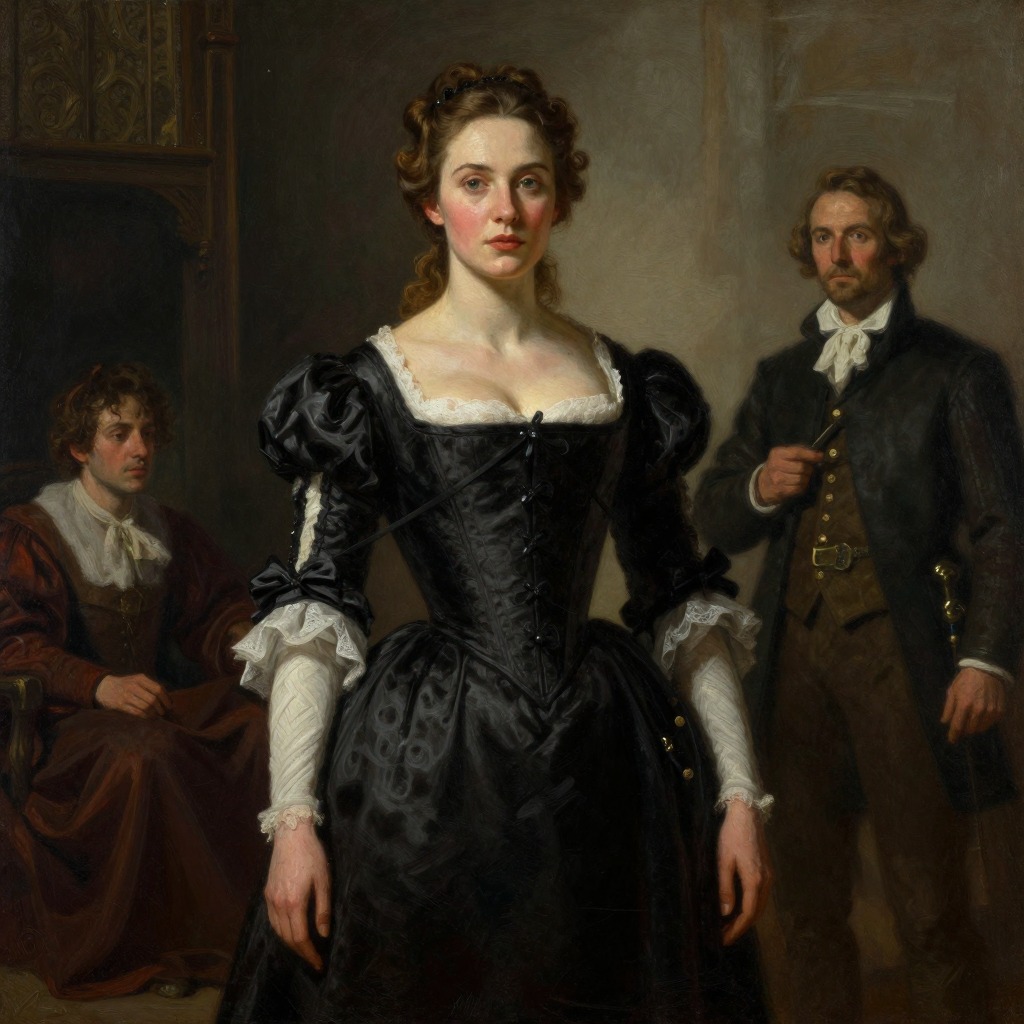
Milady's captivity was designed to be absolute. Lord de Winter, her brother-in-law, had confined her to a chamber in his isolated castle, a room whose furniture was "at once appropriate for a prisoner or a free man," but whose "bars at the windows and outside bolts at the door decided the question in favor of the prison" . The walls were thick, the doors strong, and the window opened directly onto the sea . A marine with a musket and an ax stood sentinel in the corridor . Lord de Winter had warned her that any attempt to escape would be met with gunfire, and that she would be transported to the colonies in the south, accompanied by a guard who would "blow your brains out at the first attempt you make to return" . Yet within this seemingly impregnable fortress, Milady's most potent weapon—her ability to read and exploit the human heart—remained untouched.
The Seduction of Felton
The key to her liberation was John Felton, the young Puritan lieutenant whom Lord de Winter had placed in charge of her. Felton was a man of austere virtue, "inaccessible to ordinary seductions" , a fanatic whose mind was "fermented" with religious and political zeal . Milady's strategy was to bypass his physical defenses and attack his soul. She feigned a fainting spell, then began to sing Puritan psalms with such fervor and beauty that Felton, listening at the door, "believed he heard the singing of the angel who consoled the three Hebrews in the furnace" . She then spun a fabricated tale of her own persecution, casting herself as a martyr to the Puritan faith who had been seduced, branded, and imprisoned by the villainous Duke of Buckingham (E07019, E07039-E07040). The story was a lie, but it was perfectly calibrated to Felton's worldview, transforming Milady from a prisoner into a sacred victim and Buckingham into the Antichrist. When she finally revealed the brand on her shoulder—the fleur-de-lis—Felton was overwhelmed. He fell to his knees, not in pity, but in adoration .
The Flight
Having secured Felton's absolute devotion, Milady orchestrated her escape on the night of a violent storm. Felton, who had been sent away by Lord de Winter but had secretly returned, scaled the castle wall using cramps he had fastened in the stonework . He then filed through the bars of her window . With a rope ladder, he descended from the window, carrying Milady in his arms. The descent was perilous; the storm raged, and a patrol passed beneath them, but Felton's sailor's skill and Milady's iron nerve saw them through . They reached a boat waiting on the shore, which took them to a sloop Felton had chartered (E07179-E07181). Once aboard, Felton gave Milady the bag of money she had provided and prepared to leave her, his own mission—the assassination of Buckingham—now paramount in his mind (E07203-E07204).
Consequences and Aftermath
The escape had immediate and catastrophic consequences. Felton, now a fanatical instrument of Milady's will, traveled to Portsmouth and, on August 23, 1628, assassinated the Duke of Buckingham . This act removed the most powerful English ally of the Huguenots of La Rochelle, directly contributing to the city's eventual surrender. For Milady, the escape was a temporary triumph. She fled to the convent at Bethune, where she encountered and poisoned Constance Bonacieux, d'Artagnan's beloved (E07883-E07885). This final act of cruelty, however, sealed her own fate. The escape from the castle, therefore, was not a liberation into safety but a release into a final, fatal spasm of violence that would consume both her victims and, ultimately, herself.