Journey to England
The Three MusketeersD'Artagnan's journey to England stands as the most audacious and consequential undertaking of his early career, a desperate race against time to retrieve Queen Anne of Austria's diamond studs from the Duke of Buckingham before a court ball exposes her secret gift and destroys her honor. The mission, conceived in the wake of the queen's peril and the cardinal's machinations, transforms the young Gascon from a provincial Guardsman into a key player in the highest affairs of the kingdom, forging his bond with the three Musketeers through shared sacrifice and mortal danger.
Background and Planning
The journey was born from a crisis. Cardinal Richelieu, suspecting the queen's attachment to the Duke of Buckingham, had maneuvered King Louis XIII into demanding that the queen wear the very diamond studs she had given to the duke at a ball at the Hotel de Ville. The queen, realizing she was trapped, confided in Constance Bonacieux, who in turn sought d'Artagnan's help. D'Artagnan, newly in love with Constance and eager to serve the queen, immediately volunteered for the perilous trip to London. Recognizing the cardinal's reach, Monsieur de Treville, the captain of the Musketeers, warned d'Artagnan that he would be assassinated before reaching Bondy if he went alone. He therefore secured leaves of absence for Athos, Porthos, and Aramis, and the four friends, united by their oath of "All for one, one for all," devised a plan to travel together, knowing that some of them might not survive the journey.
The Ambushes and Sacrifices
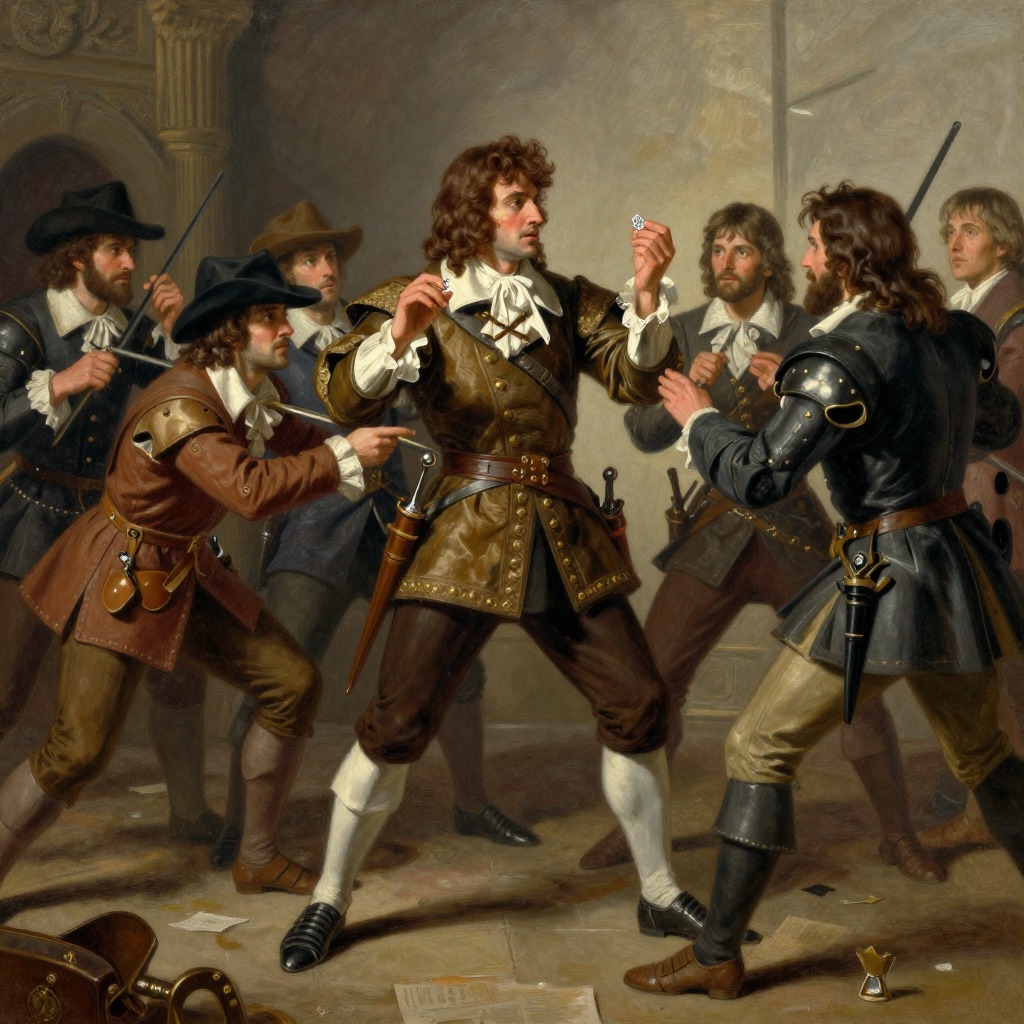
The journey was a gauntlet of premeditated attacks, each designed to stop d'Artagnan. At Chantilly, a stranger provoked Porthos into a duel, forcing him to stay behind. At Crevecoeur, a group of laborers ambushed the party, wounding Aramis in the shoulder and forcing him to remain. At Amiens, the innkeeper, acting on orders, accused Athos of passing counterfeit money, leading to a fight in which Athos was captured. Each of d'Artagnan's friends was systematically eliminated, leaving him and his lackey Planchet to continue alone. The attacks were not random; they were a coordinated effort by the cardinal's agents to ensure the queen's secret would never reach Buckingham.
The Final Obstacle and Arrival in London
Reduced to himself and Planchet, d'Artagnan faced his final test at Calais. A gentleman, the Comte de Wardes, possessed the cardinal's express permission to sail for England. D'Artagnan, needing that permission, challenged him to a duel. In a fierce fight, d'Artagnan wounded de Wardes three times, but the count, feigning death, stabbed him in the chest. D'Artagnan, though wounded, killed de Wardes with a fourth thrust, took the pass, and, after a brief deception with the port governor, secured his passage. He and Planchet sailed just as the port was closed behind them. Arriving in London, d'Artagnan, knowing no English, wrote Buckingham's name on a piece of paper and was guided to the duke's hotel. He was taken to Windsor, where he found Buckingham hawking with the king, and delivered the queen's urgent letter.
Consequences and Aftermath
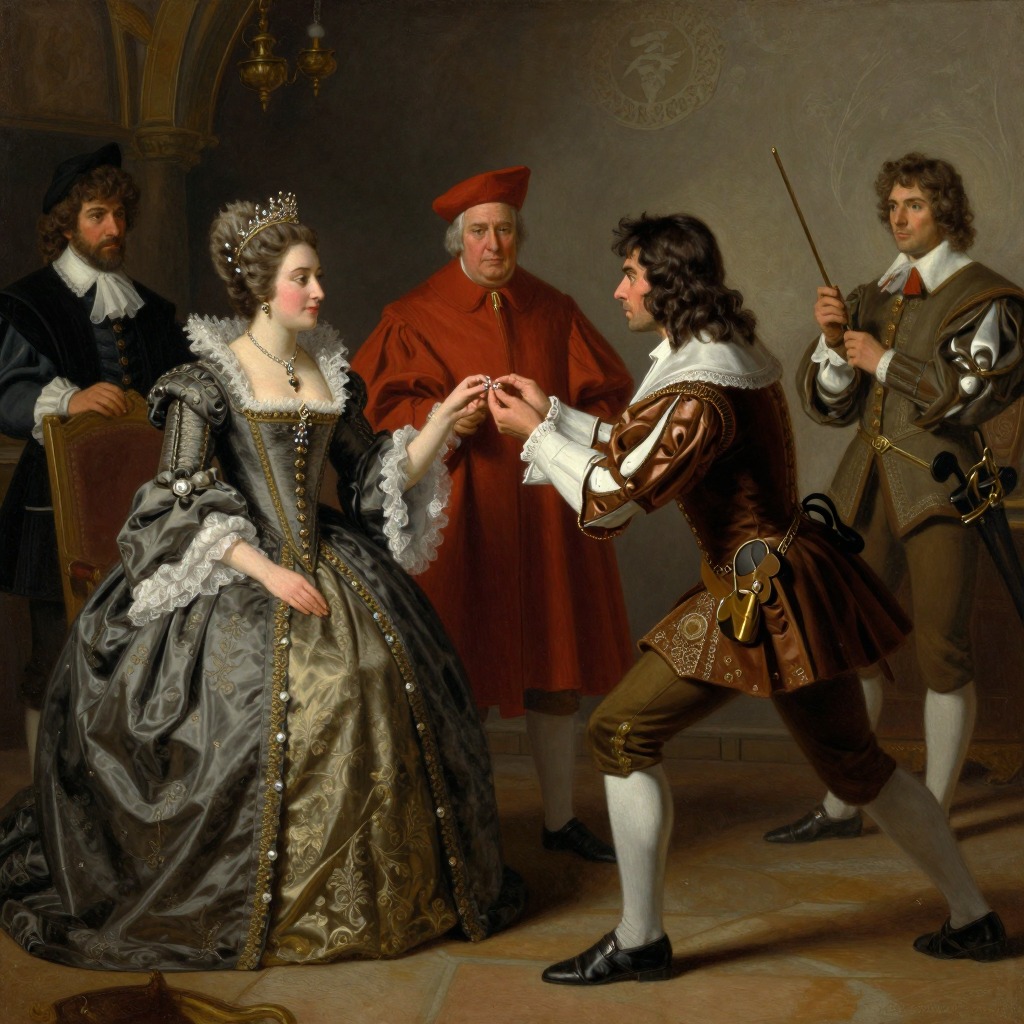
The journey's immediate consequence was the salvation of the queen's honor. Buckingham, upon reading the letter, realized the studs were to be worn at the ball. Discovering that two of the twelve studs had been stolen by Milady, an agent of the cardinal, he ordered a complete embargo on all English ports to prevent their departure. He then commissioned a jeweler to create perfect replicas within two days. D'Artagnan returned to Paris with the twelve studs, arriving just in time for the ball. The queen appeared wearing them, and the cardinal's plot was foiled. The journey also cemented d'Artagnan's reputation as a brave and resourceful agent of the queen, earning him her gratitude and a diamond ring. It deepened his bond with the three Musketeers, who had sacrificed their freedom and safety for his mission, and it marked the beginning of his deadly enmity with Milady, who would seek revenge for her failure.