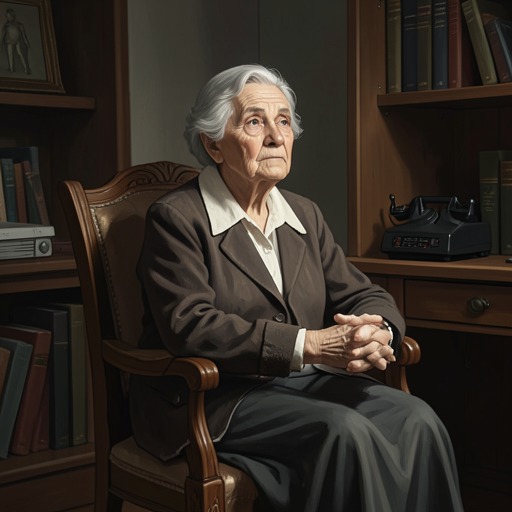
Aging, mortality, and time
The Thursday Murder ClubAging, mortality, and time form a continuous pressure in the novel: the present is measured against remembered lives, while small lapses and losses make the future newly uncertain. Rather than treating old age as a single condition, the narrative places changing memory, companionship, routine, and responsibility beside one another. Its characters encounter time both as a long interval in which secrets remain hidden and as a limited span whose ordinary pleasures cannot be assumed to last.
Memory and the Uneven Present
Elizabeth’s daily practice of opening her diary to a date two weeks ahead and answering a question she set herself earlier gives memory a practical form. She treats the routine as an early warning system: it lets her test whether her recollection is holding steady rather than relying on confidence alone. That care acquires particular force when she and Stephen discuss Emily. Stephen worries that Emily is too thin and wishes she would visit more often; Elizabeth agrees to speak with her. The conversation seems ordinary until the narrative clarifies that Emily was Stephen’s first wife, who died nearly twenty-five years earlier, and that Stephen has no children. The scene turns a familiar domestic exchange into evidence of how the past can enter present conversation without announcing itself. It also distinguishes a moment of confusion from a sweeping claim about either character: the mistake matters because of its specific emotional and temporal dislocation.
Memory in the novel is not only a faculty to be tested; it is also how lives are pieced together. Joyce records events in a diary, including her encounters with the police and Elizabeth’s explanation of the idea of plausible deniability. Her writing catches the texture of an ongoing present, while later entries look back on the consequences of earlier events. The contrast between Elizabeth’s deliberate memory checks and Joyce’s record-keeping suggests two different ways of holding on to what is happening: one tests recollection, the other preserves it in writing.
Routine, Companionship, and Change
Matthew Mackie’s account of his settled life makes routine a form of shelter. His home, garden, pension, neighbours, and familiar trips to the sea give his days a rhythm. He hears children playing nearby, and local people stop to ask after him or talk about minor ailments. These details do not erase his unhappiness, but they describe a life made manageable through repeated habits and ordinary contact. After police interviews and renewed worry disrupt that pattern, he fears that peace will not return. The change is registered through the absence of the everyday sounds and encounters that had helped keep the past at a distance.
The novel also uses remembered beginnings to measure the distance travelled. Matthew recalls meeting Maggie after he had been at the chapel for about a month. Their early exchanges over cleaning and work develop over several weeks from formal greetings into familiarity. Later, their first silent meeting in the confessional becomes, in his account, the moment they both understood the significance of their attachment. The recollection places a brief scene inside a much longer life: what began in small, repeated encounters remains important when Matthew is old and looking back. The past is not simply over; it continues to organize what he can say about himself and what has been lost.
Old Histories in the Present
A conversation about the early 1970s shows how the passage of time links people who have remained in place with events nearly half a century earlier. Joyce and her companions seek out Gordon Playfair because he is among the few people they can think of who were present locally then and are still there. They hope he may remember something useful about the period surrounding Ian Ventham’s murder. His continued presence makes the past approachable, but not automatically clear: recollection must still be sought out and interpreted.
John Gray’s account of Matheson likewise reaches back to the early 1970s, when John had been working as a vet since 1967. He remembers visiting Matheson at Greyscott, a sheep farm, after a foal had died and its mare was distressed. John treated the mare, then stayed for tea with Matheson, whom he understood as lonely and struggling to keep the farm going. In recounting the visit decades later, John explains the decision that led to Matheson’s death. The novel thus allows an old act to surface within a present-day investigation, where the passage of years has not removed its moral weight. Time conceals the event for a long period, but telling it changes what the living can understand about the past.
Mortality and the Measure of a Life
Elizabeth’s thoughts as she goes out into the evening place mortality within the calendar of ordinary seasons. Autumn approaches; she wonders how many more years she will have to walk among the leaves and see the daffodils return by the lake. The image does not make nature a promise of personal continuity. The flowers may come back, while any one person’s time to see them is finite. That contrast turns a familiar seasonal cycle into a measure of what cannot be repeated for an individual. At the same time, Elizabeth remains occupied with the case and with the people beside her. She notices Ron Ritchie approaching, grim-faced and concealing his limp, and recognizes his friendship and steadfastness. Awareness of mortality sits beside attention to another person, rather than replacing it.
The bedside of Penny Gray gives this awareness a quieter, more immediate form. As Elizabeth, Ron, and their friends sit with John, the electronic beeps beside Penny mark the diminished presence of a person who had shaped the lives around her. Elizabeth then gives John a practical next step: go home, sleep, write any letters he needs to write, and return with the police in the morning. She also leaves space for him to say goodbye to Penny. The scene joins care with the recognition that a relationship is nearing its end; the friends step outside, and Elizabeth watches John hold his wife before looking away.
Death, Love, and What Remains
Joyce’s later account places Penny and John’s deaths within the aftermath experienced by their community. Their funeral is quiet and rainy, with some of Penny’s former colleagues present. News coverage draws attention to the couple and to Ron’s connection with Penny, but Ron refuses to entertain a tabloid reporter. The public story is incomplete, while the people closest to the case know the choices and concealed history behind it. Joyce also notes Elizabeth’s absence from the funeral and wonders whether she had already said goodbye. The uncertainty preserves a limit on what Joyce can know even as she tries to make sense of the loss.
The history Joyce sets down links deaths across generations of consequence. Penny killed Peter Mercer for murdering Annie Madeley, kept that secret from John for years, and dementia eventually broke her silence. Once John knew, he killed Ian Ventham in order to protect her. Joyce reads this chain through love and protection, while also wishing peace for Penny, John, and Annie and condemning the harm Peter caused. The novel does not present time as a force that automatically settles the past: a hidden act can shape a marriage and lead to another death many years later. What time does provide is a changing community of witnesses, each with partial memories, loyalties, and judgments. Joyce’s diary preserves her account of these lives as they continue to change, while its reflections make clear that no record can undo loss or restore the years that preceded it.