Bernard's death and final letter
The Thursday Murder ClubBernard Cottle’s death and final letter bring a private crisis into the open: before dying, he tells Joyce that he intends to end his life and confesses what he has done with some of Asima’s ashes. The letter is at once a farewell, an apology, and an attempt at repair. Its intimate details—the pills beside his bed, a bottle of saved whisky, Joyce’s flowers in a milk bottle—make his despair inseparable from the friendship and grief that have shaped his final days.
Discovery and reading
Joyce approaches Bernard’s flat and initially stalls outside, imagining ordinary explanations for his silence. Once inside the block with a spare key fob, she climbs the stairs and finds an envelope Sellotaped to his door. Bernard has addressed it to her by name, with a smiley face drawn inside the O. The small flourish preserves the familiar uncertainty of his manner even at the threshold of his death: Joyce knows the letter is serious, but its first mark is recognizably his.
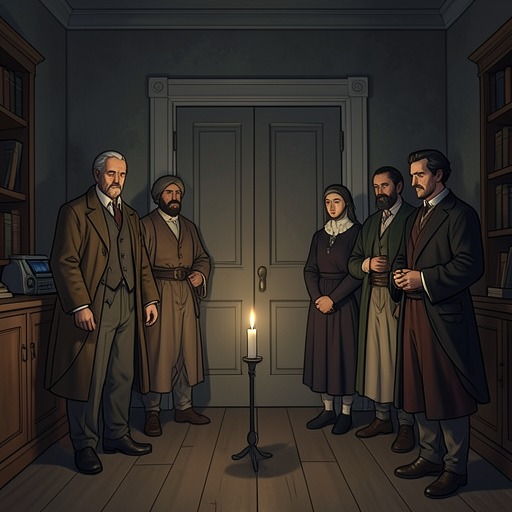
When Joyce begins to read, the scene becomes a shared act of witnessing. Ron places a hand on hers and tells her to take her time; Elizabeth, Ron, and Ibrahim remain silent as she reads. Joyce’s wavering voice and the friends’ restraint frame the letter not as a private document encountered alone but as a message carried into the company of people who care for her and knew Bernard.
Bernard tells Joyce that he has bolted the door, a precaution he says he has never used since moving in. He expects to be lying on the bed and leaves it to the ambulance attendants to decide whether he will look peaceful. He also imagines Joyce might wish to say goodbye, but recognizes that she may not be permitted to do so because she is not family. Joyce later reports that she was not allowed to see him, and gently corrects his expectation: the attendants were women, not men. The detail gives the farewell a painful, matter-of-fact limit. Bernard can anticipate the separation, but he cannot control its terms.
The planned farewell
Beside Bernard are the pills he intends to take and a Laphroaig he has been saving for a rainy day. His description of the lights going out around him turns the ordinary progression of evening into an image of approaching death. The scene is not made remote by grand declarations: the saved whisky, the bed, and the flowers Joyce bought him keep it domestic and particular.
The flowers are in a milk bottle because Bernard knows Joyce understands his dislike of vases. That makes them more than decoration. They register an established familiarity between the two friends, and their presence beside the pills puts companionship and planned solitude in the same frame. Before he dies, Bernard says, he must tell Joyce the whole story. The letter’s movement from farewell toward confession changes its purpose: it is not only an account of what he plans to do, but an attempt to disclose what he has been unable to put right.
Confession and the failed attempt at repair
In the letter, Bernard recalls that the immediate pain passed and that he came to understand the enormity of what he had done, describing it as selfish and entitled. He considered digging up the tea caddy, taking it by bus to Fairhaven, releasing some of Asima, and keeping some with him. He could not bring himself to tell Sufi what he had done, but imagined that returning some of her mother to the waves might at least bring her closer to the place Sufi believed people returned to. The plan would have been incomplete, but Bernard regarded it as the best remedy available to him.
That possibility disappears when Bernard walks up the hill and finds workmen laying a concrete foundation for a bench. They have dug the ground, though not far enough to find the tin, and filled the hole with cement. The foundation is laid in half an hour. Its permanence is accidental rather than malicious, but it closes off Bernard’s intended way of recovering the hidden tea caddy. The practical fact of the cement gives his remorse a physical form: what he buried cannot simply be retrieved, and his wish to correct the concealment has become harder to act upon.
Afterward, Bernard continues walking up the hill and speaking to Asima when no one is listening. He tells her his news, how much he loves her, and how sorry he is. His final admission to Joyce is that he has run out of whatever is needed to carry on. The letter thus links the concealed ashes to his despair without presenting confession as an easy absolution: telling the truth arrives only after the practical chance to undo his action has been blocked.
Aftermath and significance
Joyce finishes reading and keeps her finger moving across the ink. She attempts a smile, but it gives way to tears and then shaking sobs. Ron leaves his chair, kneels before her, and holds her while she weeps for Bernard, Asima, Gerry, and the women who had gone to Jersey Boys and shared canned G&Ts on the way home. Her grief gathers several losses and memories together rather than isolating Bernard’s death from the life around it. Ron’s embrace gives her immediate comfort where the letter could offer only explanation and farewell.
The scene’s emotional force comes from the distance between Bernard’s carefully imagined ending and the aftermath he cannot witness. He anticipates being judged by ambulance attendants and perhaps denied a goodbye; Joyce confirms that she was kept from seeing him, while his letter nevertheless reaches her and is heard by her friends. His confession does not undo the concealment or the failed attempt to recover the ashes. It does, however, make his remorse available to those left behind. The letter gives Bernard a final voice, and Joyce’s reading turns that voice into shared knowledge, held alongside grief rather than mistaken for a resolution.