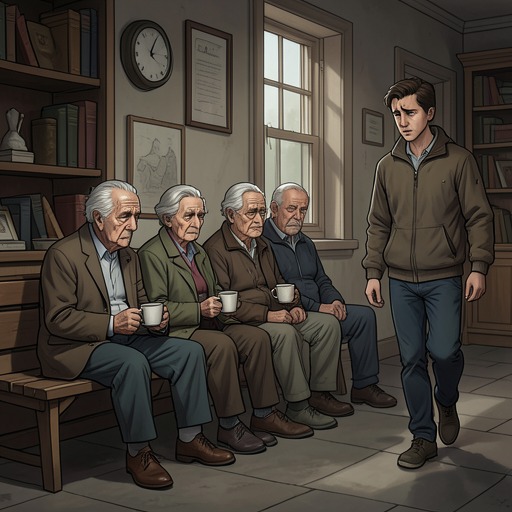
Bernard’s grief and shame
The Thursday Murder ClubBernard Cottle’s grief for his wife Asima drives him to preserve her ashes in secret, but the act that keeps her physically near him also deepens his shame and separates him from their daughter’s understanding of her mother’s farewell. In his final letter to Joyce, grief is neither a feeling that simply passes nor a private sorrow without consequences: it becomes an action, a concealed object beneath a hilltop bench, and a burden Bernard says he can no longer bear.
Loss and the secret substitution
Asima died shortly after she and Bernard moved to Coopers Chase. Bernard describes the loss as an injury that left him expected to continue ordinary life without the person who had given it meaning: waking, eating, and putting one foot in front of the other. He says he never found an answer to the question of what life was for after her death. The bench on the hill, where the couple had sat when they first moved there, became a place where he could feel close to her. His walks there carried another purpose too, one that he later names as a source of profound shame.
Asima had long wished for her ashes to be scattered on the Ganges, a wish their daughter had grown up knowing. Two days after the funeral, the daughter and her husband travelled to Varanasi to carry it out. Bernard’s account reveals that they did not scatter Asima’s ashes. He had kept the urn at home after the funeral, unable to accept that Asima would be carried away as luggage and then dispersed. He stresses that his explanation does not excuse what he did; the distinction matters because his grief is presented alongside his recognition that his daughter, too, had lost Asima.
The tea caddy and the burial
The object Bernard chose to hide Asima’s ashes already belonged to the history of their marriage. Years earlier, he and Asima had seen an antique tea caddy shaped like a tiger. Bernard returned to buy it as a Christmas surprise, only to discover that Asima had independently bought it for him. They kept it as a private token, giving each other affectionate tiger names. In his bereavement, Bernard poured the ashes from the urn into this tea caddy and put it back in a cupboard: a shared keepsake became a concealed substitute for the public farewell Asima had wanted.
He filled the urn with sawdust and bonemeal, which he says looked convincing, and sealed it again. Their daughter took that urn to Varanasi and scattered its contents on the Ganges, believing she was carrying out her mother’s wish. The deception thus protected Bernard from an immediate separation while withholding the truth from the person who shared his loss. He recognizes that he had forgotten Asima was his daughter’s mother as well as his wife, and calls his act selfish and entitled.
The day after the ashes were scattered, Bernard waited until after dark, took a spade from the allotment shed, and climbed the hill. He lifted the turf from beneath the bench, dug a hole, buried the tea caddy, and replaced the turf. He knew even then that the burial could only be temporary. Yet nobody noticed the disturbed ground, and he returned to sit on the bench, greeting passersby and speaking to Asima when no one was listening. The repeated visits kept his attachment alive, but also made his secret part of his everyday routine.
Shame, failed repair, and despair
Bernard’s remorse does not arise only from the deception being at risk of discovery. He believes he has betrayed his daughter and cannot make amends, even while acknowledging that overwhelming pain shaped his actions. As the immediate intensity of grief receded, he says, he began to grasp the scale of what he had done. He considered digging up the caddy and taking it by bus to Fairhaven, where he could release some of Asima’s ashes into the sea while keeping some with him. That imagined compromise would have brought at least part of her ashes into the natural dispersal her daughter believed had already occurred, but Bernard still could not bring himself to tell the truth.
The possibility of repair closed when he found workmen laying a concrete foundation for the bench. They had dug into the ground without reaching the tin, then filled the hole with cement; the work was completed in half an hour. The bench, once a place associated with the couple’s early life at Coopers Chase and Bernard’s continuing conversations with Asima, now also marked the physical obstruction that prevented him from retrieving the tea caddy. He describes the result as final: there was no easy way to dig it out.
Afterward, Bernard continued climbing the hill and speaking to Asima when he was alone, telling her his news, his love, and his regret. The repetition offers the shape of continued companionship, but not reconciliation: Asima cannot answer, and Bernard cannot undo the deception or reach the ashes. In the letter, he says that he has run out of what is needed to carry on. His despair is tied to grief, guilt, and the practical permanence of the caddy’s concealment, rather than to a claim that the loss itself has ended.
The letter as confession and witness
Bernard’s account reaches the others through Joyce, who reads his final letter aloud. She pauses for water during the reading, and the listeners respond as the revelation unfolds: Ibrahim sits forward when he understands what Bernard concealed. Joyce finishes, traces the ink with a finger, and tries to smile before breaking into tears. Ron kneels in front of her and holds her as she weeps for Gerry, Bernard, Asima, and other losses. The scene makes Bernard’s private shame something witnessed by his friends, even though the letter cannot restore the truth to Asima’s daughter or free the ashes from beneath the concrete.
The confession gives Bernard’s conduct its full emotional sequence without converting it into an excuse: love and bereavement lead him to conceal the ashes; the concealment harms his daughter and becomes a source of shame; his attempted repair is blocked; and his continuing visits end in an admission of despair. The tiger-shaped tea caddy concentrates that contradiction. It began as a mutual gift, a sign of a marriage’s affectionate recognition, and became the container for Bernard’s refusal to let Asima go. His grief remains an act of attachment, but the secrecy that preserves it also leaves him isolated with the consequences.