Black Bridge
The Thursday Murder ClubBlack Bridge is a Fairhaven pub whose importance lies less in its ordinary role as a meeting place than in the violence and silence attached to one night there. A young drug dealer was shot dead, the taxi driver who identified Tony Curran as the gunman later disappeared, and Curran avoided prosecution. As the investigation into Curran’s own death advances, the pub becomes a point where old associations, missing witnesses, and uncertain identities converge.
The shooting and its aftermath
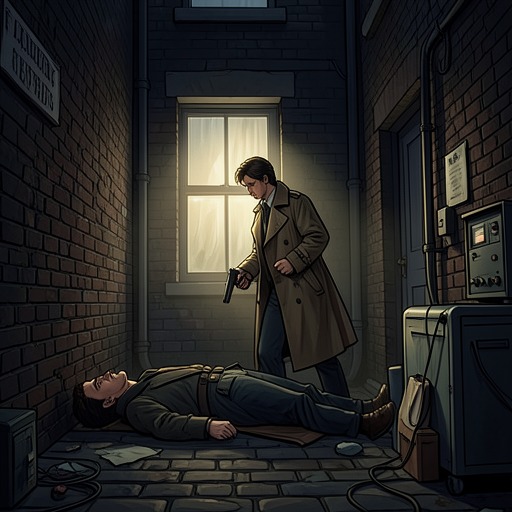
The central event associated with Black Bridge took place years before Chris Hudson’s time in Fairhaven. A witness identified Tony Curran as the person who fired the fatal shot at a young drug dealer in the pub. Fairhaven CID brought Curran in for questioning, but the interview record that Chris later reads is marked by a repeated refusal to comment. The case did not produce a conviction.
The witness was a local taxi driver. Soon after the shooting, he disappeared. The account leaves open whether he was frightened into leaving or suffered something worse; it establishes neither what happened to him nor where he went. His disappearance nevertheless deepens the pub’s association with the case: the shooting was followed not only by the failure to prosecute Curran, but also by the loss of the person whose testimony might have challenged that outcome.
Chris understands the incident as part of Curran’s wider history in Fairhaven. Curran had been central to the local drug trade and had made substantial money from it. His police file contained numerous earlier offences, but the Black Bridge shooting stood apart as the episode that suggested how much more serious his influence could be. After 2000, his record was largely quiet, with a speeding ticket in 2009; that later lull did not resolve the unanswered questions left by the pub shooting.
A photograph reconnects the old circle
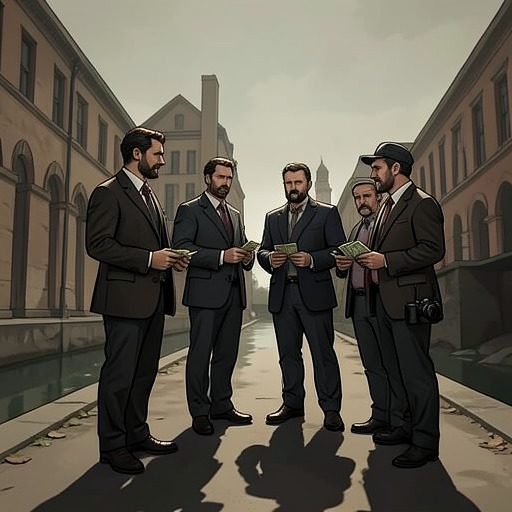
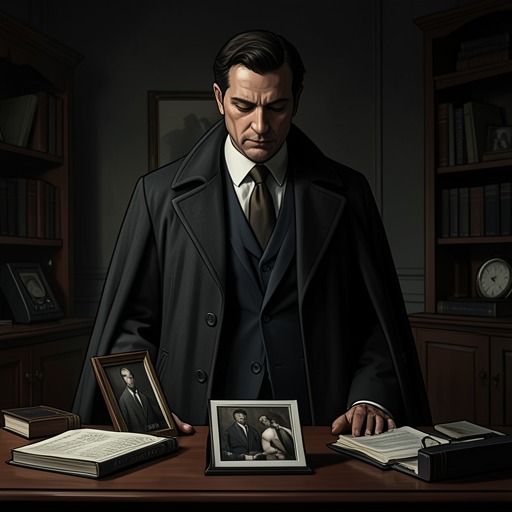
An old photograph found beside Tony Curran’s body gives the past a new, tangible form. It shows Curran with two men: Bobby Tanner, a local dealer once employed as muscle, and Jason Ritchie, an ex-boxer. The men are pictured smiling with beers and banknotes. Chris places the image around 2000, close to the period of the Black Bridge shooting, and recognizes that it links Curran’s later murder investigation to the pub’s earlier criminal history.
Chris considers the possibility that the photograph might interest newspapers, but rejects the idea of selling it. Its value to the investigation is not merely that it records three men together; it supplies a reason to revisit their connections. Bobby’s whereabouts are unknown, while Jason is accessible. The image therefore turns an old social scene into a lead, while also showing how little a photograph alone can establish about what each man knew or did.
When Donna De Freitas and Chris speak with Jason, he presents his connection to Curran as slight: he had seen him in a pub and heard gossip through other people. Asked specifically whether he drank at Black Bridge, Jason pauses briefly before saying he had been there once or twice, years earlier. The hesitation does not prove a deeper role, but it gives the pub question a pointed place in the interview. Black Bridge is a detail Jason cannot quite treat as incidental, even as he minimizes his familiarity with Curran.
The investigation returns to the pub
Years later, Chris learns that Gianni Gunduz had fled the country in the early 2000s after a tip-off that he had murdered the taxi driver connected with the Black Bridge shooting. The information redirects attention to the pub: in Chris’s assessment, separate strands of the old case keep leading back to that night and that location. He wonders whether Gianni has returned to town, but the evidence presented at this point does not answer that question.
The investigation also carries the photograph to Bobby Tanner, who is living under the name Peter Ward in Folkestone. Elizabeth and Joyce meet him in a café and show him the image. Bobby recognizes Black Bridge and recalls spending a few nights there. He has not received a copy of the photograph. Elizabeth explains that one was sent to Jason and another was found by Curran’s corpse; Bobby’s absence from the distribution has two possible implications. The killer may not know where Bobby is, or Bobby himself may be Curran’s killer. Elizabeth states the alternatives without settling them, and Bobby’s response that Curran’s death was overdue remains a reaction, not proof of responsibility.
Memory, return, and unresolved meaning
Black Bridge persists in the narrative through recurring recollection rather than a complete account of what happened inside it. The old shooting is known through police transcripts, a missing witness, the photograph, and the later movements of men connected to the pub. Each return adds a new association without making the original case fully transparent. The pub’s history is therefore both specific and unresolved: Curran was identified as the shooter, but escaped prosecution; the taxi driver disappeared; and Gianni’s alleged role in that disappearance prompted his flight.
The later gathering at Le Pont Noir, associated with Black Bridge, is described as lunch that feels like old times while also being unlike them. That contrast gives the pub’s remembered social life a changed meaning. What once connected the men through shared company and criminal dealings now survives as a picture, an uneasy recollection, and an investigation into deaths and disappearances. Black Bridge matters because the past is not simply over: its unresolved consequences continue to determine whom the investigators seek and how they interpret the people who return to its story.