Donna De Freitas
The Thursday Murder ClubDonna De Freitas begins as a young constable who imagines police work as a chase after serial killers, but finds herself far from that ideal in Fairhaven. Her path from routine public reassurance to consequential investigative work is marked by impatience, self-doubt, and a growing ability to turn curiosity into action. Her work with DCI Chris Hudson and the Thursday Murder Club gives her an arena in which her initiative matters.
Identity and Introduction
At twenty-six, Donna is still early in her career and knows that the dramatic police work she imagines—pursuing serial killers and solving dangerous cases—will have to wait. Her immediate circumstances are more prosaic: she eats lunch at 11:45 in the morning with four older people she has only recently met, after delivering a home-security talk. The contrast establishes both her ambition and her willingness to do work that seems small beside it.
Her talk is a familiar assignment, delivered repeatedly to audiences of older residents. It covers window locks, checking identification, and refusing to give personal information to cold callers. The police also expect her to offer reassurance in a world perceived as threatening. Donna understands that purpose, but appreciates a practical benefit too: volunteering takes her out of the station and away from paperwork. Fairhaven Police Station feels quieter than the environment she is used to, and the talk offers a welcome change of scene. Despite her impatience with routine, she finds the lunch that follows unexpectedly enjoyable.
Ambition, Transfer, and Private Discontent
Donna’s ideal of police work is vivid and cinematic: dangerous pursuits, a fresh wound, whisky, and a dramatic partnership. The fantasy underscores how far her actual duties fall short of what she wants, but it does not make her indifferent to the people around her. Her early contact with the older residents is fun, and later relationships with them become one of the first positive developments in her life in Fairhaven.
Her transfer there is tied to Carl, an ex-boyfriend whose rejection still affects her. She has made a habit of checking his Instagram feed and that of his new girlfriend, whom she calls Toyota. Donna no longer thinks she loves Carl, and suspects she may never have loved him; what persists is the feeling of having been belittled by his rejection. It weighs on her even as she mocks his prospects with his new partner.
The resentment also exposes a less controlled side of Donna. After a shoplifter struggles during an arrest, she uses her baton harder than she believes was warranted. She recognizes that the force came partly from a desire to hit something, not simply from the demands of the arrest. Her self-awareness does not undo the action, but it shows that she can judge her own conduct harshly rather than presenting herself as invariably right.
A date with Gregor brings another measure of her isolation. At Zizzi’s, he spends much of the evening describing his protein-shake routine; when Donna asks about books and challenges his claim that he does not believe in them, he dismisses her by calling her Diana. The evening leaves her close to tears from boredom. Its small humiliations sit alongside the larger wound of Carl’s rejection, helping explain why the new company she finds in Fairhaven matters to her.
The Tony Curran Case and Chris Hudson
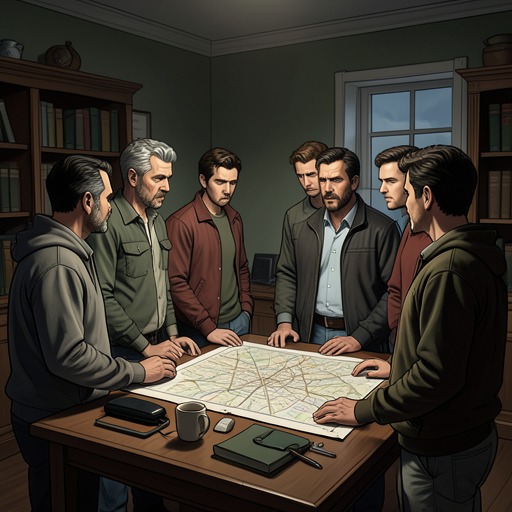
Donna’s professional prospects change when Elizabeth’s efforts lead to her being assigned to the Tony Curran case as Chris Hudson’s shadow. The arrangement is presented as a Kent Police mentoring initiative, though Donna is unsure what its official rationale amounts to. She is much less uncertain about the file: at first, it feels like proper police work, recalling the murder and drugs cases she loved in South London. She imagines finding a small overlooked clue that could crack a decades-old mystery. The fantasy is playful, but it also reveals a serious appetite for investigative work and a desire to prove herself to Chris.
When Ian Ventham’s call reaches Fairhaven Police Station one morning, Donna overhears the words Coopers Chase while drinking a carton of cranberry juice. She volunteers to go and texts Chris, who is off duty but would not want to miss the development. The quick decision shows her moving beyond the passive role of a newly assigned shadow: she listens, recognizes that the call may matter, and acts to bring her partner in.
Donna’s involvement is not limited to following Chris’s lead. As he is leaving the station, she catches up with him and says she has a change of plan for him. The available account does not specify the details of that plan, but the exchange places her in the position of redirecting his attention rather than simply receiving instructions.
Independent Breakthrough and Investigative Relationships
Donna’s clearest independent success comes in the investigation of Father Matthew Mackie’s claimed priesthood. She conducts background checks, but nothing appears. Instead of treating the empty results as the end of the inquiry, she recognizes that they make no sense and spends time assembling the information herself before taking it to Chris. At the interview, the investigation turns on the repeated use of the title Father: Chris asks whether Mackie referred to himself that way at every stage. Donna’s work has helped bring the question into the room and make the absence of a record significant.
Her collaboration with Chris develops alongside her contact with the Thursday Murder Club. Joyce’s diary records a visit from the police, during which Elizabeth gives Chris and Donna a file. Elizabeth has kept Joanna’s name out of it, explaining that this helps preserve plausible deniability if the club’s activity proves unlawful. Joyce writes down the phrase, while also suspecting that what they are doing may indeed be against the law. The scene places Donna between official investigation and the club’s unofficial casework: she is a police officer receiving material from investigators who do not necessarily remain within proper boundaries.
Donna’s questions also help draw out testimony. During a later account of Matthew Mackie’s past, she asks whether there was only one Maggie among the chapel cleaners. The question is brief, but it prompts Mackie to identify Maggie as the woman at the centre of his story. Donna’s role is not to dominate the conversation; it is to notice the point requiring clarification and ask it.
Change and Narrative Role
Donna’s move to Fairhaven began as a frightened, impulsive response to Carl. Looking back, she calls the transfer a mistake and recognizes the danger in her habit of acting quickly: decisiveness helps when she is right, but becomes a liability when she has chosen the wrong direction. Her assessment is not a claim that she has lost that impulsiveness. Rather, the investigations give it a more useful object. She volunteers, follows an anomaly in a database search, brings her findings to Chris, and is willing to propose a change of plan.
Meeting the Thursday Murder Club is, in her own reckoning, the first good thing to happen to her in a long time; the Tony Curran murder is another. That response links personal renewal to professional purpose. Donna does not become the fearless action hero of her opening fantasy, but she does find a form of police work in which attention and initiative count. Her importance lies in that shift: a young constable initially bored by routine becomes an active investigator whose questions and independent follow-through help move cases forward.