Elizabeth and Donna De Freitas
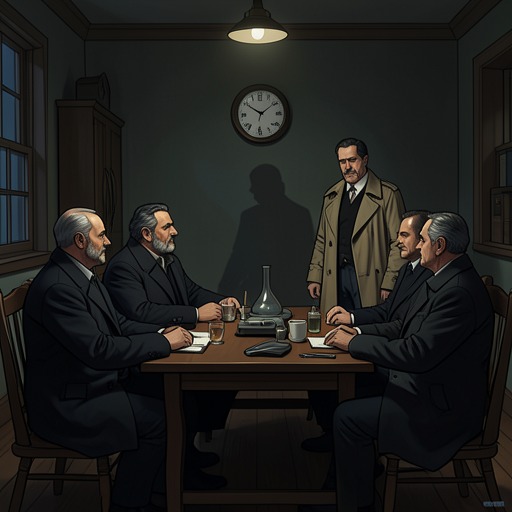
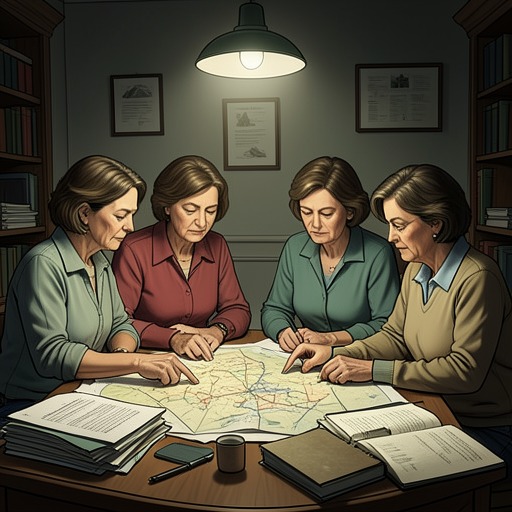
The Thursday Murder ClubElizabeth and Donna De Freitas build an investigative partnership across the boundary between police work and the Thursday Murder Club’s amateur inquiries. Elizabeth values Donna’s professional knowledge and finds ways to keep her involved; Donna welcomes the collaboration, but insists that friendship cannot shield Elizabeth or her associates when their investigation breaks the law. Their relationship is therefore both useful and affectionate, and repeatedly tested by the question of how far an informal alliance can go.
An Unusual First Consultation
Their connection begins with Elizabeth approaching Donna for a professional perspective. At lunch, Elizabeth asks Donna to consider a hypothetical knife wound, speaking quietly because other people are eating. She has a manila folder containing typed pages and what appear to be old photographs, and asks Donna to reason through the circumstances. The encounter establishes a characteristic pattern: Elizabeth introduces a problem as a request for expertise, but the preparation and case materials suggest that she is already working through an investigation of her own.
The relationship takes shape within the Thursday Murder Club’s established habits. Elizabeth and Penny Gray meet every Thursday in the Jigsaw Room, using a booking under the name Japanese Opera – A Discussion to avoid interruption. They review old cases and invite people with relevant knowledge to help answer specific questions. Their reach extends to specialists such as forensic officers, accountants, and judges. Donna’s involvement belongs to this wider practice of drawing on professional contacts, but her position is distinctive: she is not merely an occasional source of advice, since her police work connects the club’s private inquiries to active investigations.
Keeping Donna Involved
When Elizabeth wants Donna to consider complicated material about Ian Ventham, she deliberately gives her a folder that will take time to work through and prompt a follow-up call. Elizabeth explains that the arrangement keeps her involved and reminds Donna that the club can still be useful. She also admits that she wants to interfere, even while saying she does not want Donna to feel that the group is intruding. The exchange makes Elizabeth’s method unusually explicit: she sustains access not by waiting for an invitation, but by designing the collaboration so that Donna has reason to return to her.
The documents also reveal what Elizabeth can contribute that Donna cannot easily obtain through ordinary police procedures. Elizabeth says the folder contains material that might take weeks to locate and require warrants, and that Ian Ventham would not have allowed Donna access to some of it. The partnership thus works through unequal but complementary forms of access. Donna brings her investigative role and can pass information to Chris Hudson; Elizabeth can assemble records and leads from outside official channels. The evidence does not make their cooperation a formal police appointment. Instead, it shows an informal alliance in which Elizabeth supplies material and Donna decides how to use it within her work.
Elizabeth is attentive to Donna’s place in that work. When Donna remarks that she will tell Chris about a useful lead, Elizabeth asks who Chris is, then expresses pleasure that Donna calls him their expert rather than Joyce’s daughter. Donna recognizes this as a sign of Elizabeth’s loyalty and promises that the police will look into the matter. Elizabeth, in turn, asks Donna to meet Penny Gray on a future visit. Their exchange joins investigative usefulness to personal recognition: Donna is treated not just as a route to the police, but as a friend whom Elizabeth wants to bring into the club’s circle.
Collaboration on the Curran and Ventham Cases
The alliance becomes more consequential in the investigations surrounding Tony Curran and Ian Ventham. After Donna’s interview connected to the Curran inquiry, Elizabeth indicates that Ron Ritchie and Ibrahim Arif should already be taking care of the next step. Her confidence that the group can act alongside the police reflects the club’s ability to move through its own network, although Donna remains in the official investigation rather than simply acting as the club’s intermediary.
After Ventham’s death is identified as murder, Donna finds herself in the murder squad and credits Elizabeth with helping bring her into the thick of events. She considers the club members, all of whom had been around Ventham, as possible suspects, but cannot picture them actually committing the murder. Her response is neither blind trust nor automatic suspicion: she acknowledges their opportunity while judging that the people she knows do not fit the crime. She also decides she should visit them, carrying the police investigation back into the relationship rather than allowing the two circles to remain separate.
Friendship and the Limits of Trust
The sharpest rupture comes when Donna learns that Elizabeth and the others have secretly excavated a grave and failed to report the discovery of a human body. Donna steps forward to confront Elizabeth, distinguishing this conduct from a harmless deception and warning that the group faces a serious crime with consequences that could reach a courtroom. She is particularly wounded because she regards them as friends and believes they have treated her as someone to be deceived. The conflict exposes the cost of Elizabeth’s usual strategy: the same secrecy that enables the club to investigate also deprives Donna of the chance to judge the risks before the group crosses a line.
Elizabeth responds that she expected Donna and Chris to make a fuss, conceding that their reaction is understandable in the circumstances. Her response does not erase Donna’s anger, but it shows that Elizabeth understands the breach as more than a procedural objection. Donna’s rebuke is both professional and personal: she is protecting the integrity of an investigation while insisting that the friendship should have counted for more than a convenient police connection. The partnership endures in tension between those claims. Elizabeth continues to seek Donna’s help and to value her judgment; Donna remains willing to engage, but refuses to confuse closeness with permission. Their relationship gives the novel a human measure of the club’s methods: cooperation can make an investigation possible, while trust depends on knowing when assistance has become complicity.