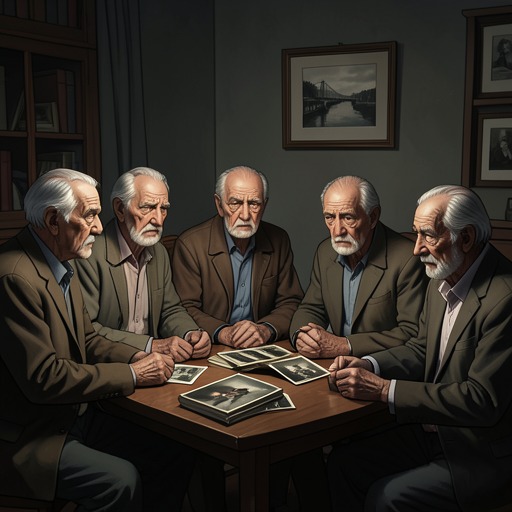
Elizabeth tracks down Bobby Tanner in Folkestone
The Thursday Murder ClubElizabeth tracks down Bobby Tanner in Folkestone by following a small, repeated clue: a flower-shop van seen at a cemetery on two significant dates. The discovery punctures the peaceful identity Bobby has built as a local florist, but it does not make him the answer to Tony Curran’s murder. Instead, Elizabeth’s careful investigation establishes who he is, tests what he knows, and gives him a route to bring evidence to Jason Ritchie and the police.
A new life in Folkestone
Bobby has become known in Folkestone as a greying, smiling florist whose shop brings colour to Pearson Street. The street had been worn down, with struggling shops and a boarded-up café; the arrival of The Flower Mill helped make it busy, friendly, and local. The shopkeeper seems to have made a settled life through good choices and quiet kindness. That impression is not false so much as incomplete: beneath the florist’s identity is Bobby Tanner, a former fighter and killer whose past Elizabeth has come to investigate.
The flowers are part of more than a respectable appearance. Bobby’s new life is sustained by a supply arrangement with a young man he once played cards with and hid in a sunflower field. A large lorry now brings flowers to Pearson Street, where Bobby unloads them and carries them into his shop before the driver continues back to Belgium. The contrast is consequential: Bobby has left his former life behind, and the ordinary work of running a flower shop has given him a measure of peace. As far as he knows, no one has come looking for him or examined the passport under which he has lived.
The trail from the cemetery
Elizabeth finds Bobby through surveillance footage from Woodvale Cemetery, obtained with the help of a mortician whose uncle she had once saved on a train. She had noticed that Bobby visited the grave of his brother on two occasions, then used the footage to look for a repeated detail. The dates were the twelfth of March, his brother’s birthday, and the seventeenth of September, the anniversary of his death. Those visits gave Elizabeth a reason to compare what appeared in the cemetery rather than relying on a name or a direct witness.
On the first date, a white van belonging to a Folkestone flower shop appeared at the cemetery. Its presence seemed unusual, though not impossible. When the same van turned up again on the second date, the repetition sharpened the clue into a lead. Elizabeth had initially hoped that the footage would reveal the same car on both visits, allowing her to obtain a number plate through an intermediary. She did not need to pursue that plan: the van itself carried its owner’s name, address, and telephone number on the side. Bobby’s ordinary, signwritten delivery vehicle had disclosed the identity that he had otherwise kept hidden.
The meeting at the flower shop
Elizabeth and Joyce meet Bobby in Folkestone and sit with him in a café near the shops. He appears at ease in his life as a florist, and the ordinary kindness of the street is part of what makes the encounter striking. Elizabeth places a photograph on the table. Bobby recognizes the Black Bridge, where he and his associates had spent several nights. Elizabeth explains that the photograph had reached Jason Ritchie and had also been found beside Tony Curran’s body. The image therefore connects Bobby to Curran’s circle while making the question of his present involvement unavoidable.
Bobby is not identified simply by the photograph. Elizabeth’s investigation has brought her to his current location, and the scar beneath his right eye and the build of his arms distinguish the former fighter from the mild-mannered shopkeeper he has become. The meeting turns on a question the evidence does not settle by appearance alone: whether the man who once fought and killed is still capable of violence, and whether he travelled to Fairhaven to kill his former boss. Bobby is wary of being found, particularly because he fears Gianni Gunduz may have returned to town and left photographs of him beside bodies. Elizabeth’s evidence makes concealment harder, but her manner gives him room to answer rather than treating the resemblance between past and present as proof of guilt.
Evidence, suspicion, and the next step
Elizabeth tells Bobby that she will not reveal where he is if he comes the following day and speaks with Jason and the police about what he has told her. Her offer is conditional: secrecy is exchanged for cooperation, not granted as a permanent shield. It places Bobby at a choice between continuing to protect the life he has made and helping the investigation examine the past he hoped to leave behind.
Bobby does cooperate with Elizabeth’s inquiry. He takes her to The Flower Mill and shows her the shop’s CCTV footage from the day Tony Curran was murdered. It shows Bobby behind the till, a concrete reason to rule him out as the person who killed Curran. He identifies Gianni as the more likely killer, reasoning that Curran had betrayed Gianni to the police and that Gianni had in turn stolen from Curran. The footage does not itself establish who committed the murder, and Bobby’s account remains an explanation to be tested; it does, however, separate his history with Curran from his whereabouts on the day of the killing.
The episode thus moves from identification to corroboration. Elizabeth’s attention to repeated dates and a plainly marked van exposes Bobby’s assumed identity, while the CCTV he supplies helps distinguish a former associate from a present suspect. The discovery neither restores Bobby’s anonymity nor resolves the murder by itself. It brings him into the investigation, where the life he built in Folkestone and the criminal past he concealed become two parts of the same evidence.