Fairhaven
The Thursday Murder ClubFairhaven is both a lived-in seaside town and a point of passage into the wider landscape around Coopers Chase. Its shops, seafront and police station give the novel’s older residents and investigators different reasons to come into town. For Joyce, Fairhaven offers routine, observation and the possibility of a small adventure; for Donna De Freitas and Chris Hudson, it is where investigative hunches are tested against official procedure. The contrast makes Fairhaven more than a backdrop: it is a meeting point between ordinary community life and the consequences of crime.
Setting and everyday life
The route out of Fairhaven towards the Kentish Weald establishes the town’s position in the landscape. Travellers heading along the A21 eventually pass an old working phone box on a sharp bend, continue towards the signs for Whitechurch, Abbots Hatch and Lents Hill, and cross the modest Robertsmere. Beyond a narrow turning and hedgerows, the road approaches Coopers Chase. The directions are practical and particular, presenting Fairhaven as the town from which the surrounding rural world can be reached rather than as an isolated centre in its own right.
Joyce’s Wednesday shopping trip gives Fairhaven a more intimate geography. She takes the residents’ minibus into town, preferring its younger atmosphere to Tunbridge Wells, the Monday destination. She enjoys seeing what people wear and hearing the seagulls. The driver, Carlito, is generally assumed to be Spanish, but Joyce learns through conversation that he is Portuguese. Her detail-oriented account turns a weekly journey into a small study of how easily appearances harden into assumptions—and how readily ordinary conversation can correct them.
The seafront also offers Joyce a recently discovered vegan café. She looks forward to mint tea and an almond-flour brownie despite having no intention of becoming vegan herself. Her interest is practical as well as playful: she has read about the prospect of mass starvation by 2050 if meat consumption does not change, but reflects that, approaching eighty, the future problem is unlikely to be hers. She hopes it will be addressed and imagines bringing her vegetarian daughter, Joanna, to the café. The proposed visit matters as a gesture of openness between mother and daughter: Joyce wants to make the unfamiliar feel natural by simply dropping in together.
A town reached by its residents
The minibus gathers people whose errands and circumstances give Joyce material for speculation. Peter and Carol, a couple from Ruskin, travel to see their daughter, who lives on the seafront; Joyce notes the absence of grandchildren and wonders about the family’s story. Sir Nicholas now takes the bus for a walk because he is no longer allowed to drive. Naomi’s unresolved hip problem and the friendly passenger whose name Joyce cannot quite recall belong to the same passing catalogue. These observations do not turn the passengers into fully known figures; instead, they show how a regular route can make a community visible while leaving parts of individual lives private.
Fairhaven’s everyday rhythms contrast with the more bounded world of Coopers Chase, where residents meet within a retirement village. The bus carries people between those settings, while the road out of town connects the village to the surrounding countryside. In this way, Fairhaven functions as a hinge: it provides access to shops and public services without dissolving the village’s distinct social life. Joyce’s willingness to follow Elizabeth away from the seafront and towards the police station also makes the town the setting for an unexpected departure from routine.
Fairhaven Police Station and the investigations
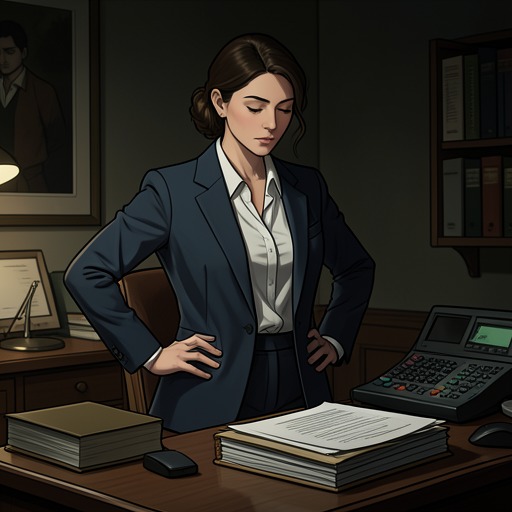
On Western Road, Fairhaven Police Station is marked by broad stone steps and automatic doors. Elizabeth brings Joyce there as they begin investigating a murder, explaining that they have no access to case files, witness statements or forensic material and will have to find a way to change that. Joyce follows, newly aware that their amateur inquiry is taking them into an institution to which she has never before been. The public reception area is reached through a security door; rather than the dramatic arrests she has seen in television documentaries, Joyce finds a desk sergeant at his computer. Elizabeth begins to cry, a striking change of register as the pair attempt to gain the assistance or access they need.
The station also anchors the official response to later killings. When Ian Ventham’s call comes through at around 7:30 in the morning, Donna overhears Coopers Chase mentioned while drinking cranberry juice. She volunteers to help and texts Chris, who is off duty. Her quick response places Fairhaven at the point where news from the village becomes police work. Chris’s team considers whether Ventham’s death and the Tony Curran case might be connected, and pursues leads involving a car, a photograph, a missing associate and a phone number. The station’s work is therefore shaped not by a single isolated case but by the possibility that several strands of the village’s business and criminal past overlap.
Donna and Chris later use Interview Suite B to question Father Matthew Mackie. Donna recognizes a parallel with an earlier interview involving someone posing as a nun: now the person before them is posing as a priest. In this instance, Donna’s breakthrough came from basic background checks, which brought the discrepancy into view. The station is not merely a place where evidence is delivered; it is where routine checking can unsettle an assumed identity and redirect an investigation.
The casework also extends beyond the interview room and beyond Fairhaven. Late one night, Donna and Chris remain at the station because they have nowhere else to be; Chris kneels to clear a jammed photocopier, an unglamorous interruption to a long investigation. They suspect Gianni Gunduz and consider a trip to Nicosia to seek further evidence. Later, an international warrant is issued for Gianni to be questioned over Tony Curran’s murder. The euros associated with the inquiry had been withdrawn at a bureau de change in Northern Cyprus three days before Curran’s death, but the address offers no realistic prospect of useful CCTV. Fairhaven is thus the local base from which the investigation reaches across borders, while its officers must distinguish promising suspicions from evidence that can actually be pursued.
The town as a narrative threshold
Fairhaven’s significance comes from the way it joins ordinary movement to consequential encounters. Joyce comes for shopping, sea air and a hoped-for café visit; following Elizabeth, she finds herself inside a police station and implicated in an inquiry. Donna’s transfer to Fairhaven follows a troubled period in London, and meeting the Thursday Murder Club becomes one of the first positive developments in her new life there. The town is associated with work, but also with the personal adjustments that make that work possible: Donna gradually spends less time preoccupied with her former relationship as the investigations take up her attention.
The novel also lets Fairhaven’s present-day police work reach backwards. Elizabeth and Joyce’s attention to old cases is supported by Penny’s practice of keeping copies of case files in storage, material that can become relevant long after the original investigations. That history complicates the boundary between a current crime and an older unresolved one. Fairhaven’s station supplies the institutional setting for interviews and leads, while the cases themselves travel between the station, Coopers Chase and places much farther away. The town’s narrative role is therefore connective: it is where routine journeys, local relationships and official inquiries cross, and where a seemingly contained village mystery can open onto a longer history.