Fairhaven Police Station
The Thursday Murder ClubFairhaven Police Station is the point where the residents’ informal investigation meets the procedures and personnel of law enforcement. Elizabeth and Joyce first enter by turning a false report of a stolen handbag into access to the building; later, Donna De Freitas and Chris Hudson use its interview suite and office facilities in the course of murder inquiries. Across these appearances, the station is both a practical workplace and a threshold: a place the amateur investigators must enter by improvisation, and one where official investigations take shape through checks, interviews, and reports.
Setting and First Entry
The station stands on Western Road, reached by broad stone steps and marked at the entrance by automatic doors. Elizabeth and Joyce arrive there after travelling to Fairhaven together. Joyce has not been inside a police station before. Her expectations, shaped by television documentaries, give way to the ordinary scene of a public reception area and a young desk sergeant apparently playing patience on his Home Office computer. The contrast makes the station less a theatrical arena than a working public office, with its own routines and controlled access.
The entrance is not simply open to the visitors. A security door buzzes them through to reception, and a further door separates the desk sergeant from the area behind him. Those barriers become part of Elizabeth’s plan. She has brought Joyce to the station because the pair need access to case information they cannot obtain as private citizens, but she presents a different reason to the staff: she says that her handbag has just been stolen outside Holland & Barrett. Joyce understands why Elizabeth arrived without a bag and supports her friend’s account, helping the performance succeed.
The desk sergeant responds by arranging for a constable, Mark, to take a statement and offering to make tea. The episode gives the women a way through the first layer of official procedure without suggesting that they have acquired lawful access to case files or forensic material. Elizabeth’s deception gets them inside and creates an opening for further contact, but the practical and ethical boundary remains clear: as Elizabeth has already explained to Joyce, the women have no official access to statements, evidence, or files. Their investigation begins by working around that limitation rather than by gaining police authority.
From Reception to Investigation
The station also becomes a point of contact between Elizabeth’s circle and the police. When the security door opens again, Donna De Freitas comes through and recognizes both Elizabeth and Joyce. Her arrival changes the encounter from a staged report of theft into a meeting with someone connected to the murder investigation. The scene places the women’s private initiative and the police’s formal work in the same space, while leaving their different positions intact: Elizabeth and Joyce have come seeking information, whereas Donna belongs to the institution whose records and procedures they lack.
The station’s role grows more explicit when a call from Ian Ventham comes through at about 7:30 in the morning. Donna hears Coopers Chase mentioned, volunteers her services, and texts Chris Hudson, who is off that morning but would not want to miss the development. The call makes the station a place where information about events outside it can redirect police attention. Father Matthew Mackie is also on his way there: after receiving a call from Maureen Gadd at seven, he gets dressed and waits for a cab by 7:30. His parallel journey brings him into the police investigation, though the available account does not establish that his call is made at the station.
These moments give the location a connective role rather than making it the site of every consequential event. Calls arrive from elsewhere; officers volunteer, send messages, and prepare to meet people. The station gathers those threads into an investigation. Its significance lies partly in that movement between the outside world and the controlled interior: a name heard on a call can prompt Donna to contact Chris, while an arrival at the building can lead to an interview and a closer examination of what someone has claimed to be.
Interviews and Questions of Identity
In Interview Suite B, Donna and Chris question Matthew Mackie. Donna has brought the matter forward after conducting background checks that returned nothing. The absence of any record makes no sense to her, so she spends time piecing together the information before taking it to Chris. Their work illustrates a different use of the station from the reception-area episode: here, access is not won through a story about a stolen bag but exercised through a police interview and the examination of a person’s account.
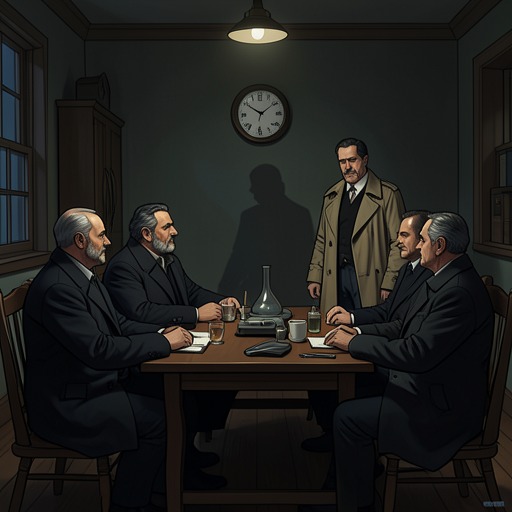
The interview turns on Mackie’s use of the title Father. Chris establishes that Mackie introduced himself as Father and repeatedly referred to himself that way. When asked to remove his dog collar, Mackie argues that he had been a priest for many years and considers the collar and the title his own business. Chris counters that the records checked by Donna and the Church provide no evidence that Mackie ever was a priest. He places this discrepancy in the context of a murder inquiry and asks Mackie to explain what he has concealed. Mackie does not provide an explanation; he says he would speak only if arrested and otherwise wants to go home. The station therefore contains a confrontation that exposes a false identity without immediately resolving the questions surrounding it.
The interview suite’s importance is also shaped by its parallel with an earlier police encounter: Donna recalls having sat in the room with someone pretending to be a nun, and now finds herself facing a man pretending to be a priest. That echo links separate deceptions through the same institutional setting. At the station, identities that might pass elsewhere are tested against background checks, records, and direct questioning. Yet the interview does not supply every answer. Mackie’s refusal to explain himself leaves the police with an unresolved lead, and Chris’s wider inquiry continues beyond the room.
Continuing Work and Investigative Limits
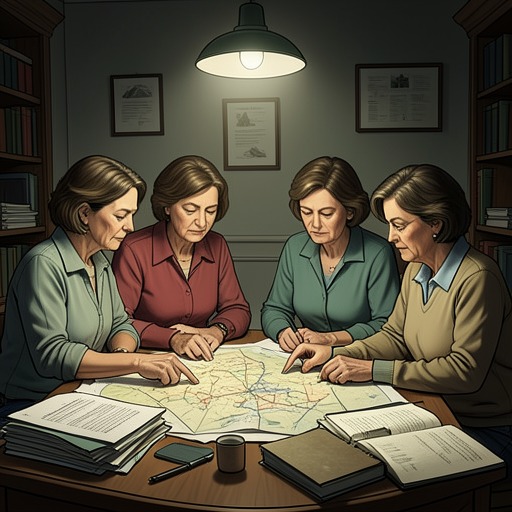
The station remains a workplace after ordinary hours. Late one night, Donna and Chris are still there, with nowhere else to be. Chris unblocks a paper jam in the photocopier, and Donna prints reports sent by the Cypriot Police Service. She offers to bind the copies to make them easier for him to use, but Chris tells her she is still not coming with him to Cyprus. Their exchange shows the inquiry continuing through unglamorous tasks—repairing a copier, reproducing and organizing documents—as well as travel and fieldwork. The reports become portable material for the next stage, while Donna’s offer and Chris’s refusal make clear that the two colleagues do not have identical roles in that stage.
Before leaving, Chris considers how the cases might connect. Gianni is one matter; Ian Ventham’s death is harder to reconcile with a murder from fifty years earlier. Chris has detectives trying to find nuns who might remember something, though he expects little from sketchy records and wonders whether the investigators are overlooking a simpler explanation. These are questions formed at the station, not answers supplied by it. The setting supports the labor of comparison and document handling, while the case’s unresolved links reach beyond its walls.
The station’s appearances thus trace a widening investigative process: Elizabeth and Joyce first use a carefully improvised story to get through reception; Donna’s police work brings Chris into an early-morning response; Donna and Chris later question Mackie and prepare records for inquiries involving Cyprus. The location does not itself solve the cases or erase the divide between amateur and official investigation. Instead, its doors, interview room, staff, and office equipment make that divide visible—and show how information moves across it, sometimes by procedure and sometimes by a deliberate breach of it.