Garden of Eternal Rest
The Thursday Murder ClubThe Garden of Eternal Rest is the former convent cemetery above Coopers Chase, a carefully ordered burial ground whose quiet continuity is disrupted when a development plan threatens to move the graves. Its rows preserve the history of the Sisters of the Holy Church, but the earth also conceals a burial that makes the site central to the novel’s investigation of hidden violence and the obligations owed to the dead.
Setting and Origins
The cemetery occupies a rise above the former convent, reached by a path that curves uphill through trees. Iron gates set into a brick wall open onto the grounds; the gates are wide enough for a vehicle, and the turning circle before them once served hearses before maintenance vehicles took their place. Inside, a central path leads to a large statue of Christ, with graves arranged in rows on either side. Beyond the statue and cemetery, beech trees rise towards open farmland. The older side wall is lower and much older than the newer wall at the entrance, marking the garden as a place shaped by successive periods rather than a single construction.
For more than a century, the convent below was home to the Sisters of the Holy Church. Its residents lived within a communal religious order, and the cemetery offered the final resting place for sisters whose lives had been spent there. Burial on the hill extends that institutional history into the landscape: the convent and its graveyard form a connected setting, with the graves looking back towards the community that had cared for and depended on them. The narrative presents the site as secluded and peaceful, while its walls and the convent’s long history also make it a repository for secrets.
A Landscape Marked by Time
The oldest grave is dated 1874 and belongs to Sister Margaret Bernadette. From that point, the headstones trace changes in the outside world through the lives and deaths of the sisters. The earliest stones are more ornate; later inscriptions become simpler and easier to read. The sequence passes through the Victorian era, the arrival of modern inventions, the world wars, and the subsequent transformations associated with television, popular music, supermarkets, motorways, and space exploration. The dates move forward, but the rows retain their neat arrangement.
The cemetery contains around 200 bodies. Its last recorded burial in the account is Sister Mary Byrne, dated 14 July 2005. Behind her headstone lies room for further graves, but none were needed: she was the last of the line. Her grave stands roughly a hundred yards from Sister Margaret Bernadette’s, connecting the end of the convent’s burial history to its beginning. The unchanged view of trees and fields reinforces the contrast between historical change and the continuity of this particular place.
The Proposed Removal
The Garden becomes vulnerable when Ian Ventham’s development plans include relocating the cemetery. Father Matthew Mackie objects not only on religious grounds but also on the treatment the remains require. He tells Ian that the graves may contain loose, scattered bones rather than intact skeletons, and argues that every fragment must be found, documented, and treated with respect. He presents this care as both basic decency and a legal obligation, and asks Ian to leave the sisters undisturbed.
Ian refuses. He maintains that he is entitled to move the cemetery and says the company will take care of the bones, offering Mackie the opportunity to observe the work. Their disagreement is more than a dispute over planning: Mackie regards the burial ground as the resting place of real people whose dignity survives their deaths, while Ian treats relocation as an acceptable part of development. Mackie warns that, if he cannot change Ian’s mind, he will make the process as difficult as possible.
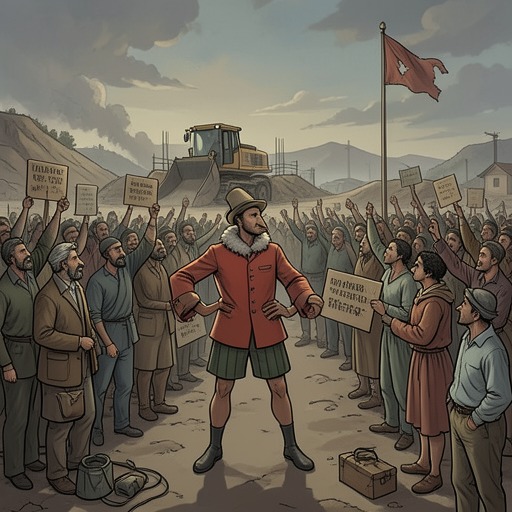
When the machinery arrives, the cemetery’s threatened removal draws Coopers Chase residents out early in the morning. The news spreads through the village, and residents gather as a low-loader carries equipment up the drive towards the Garden. The communal response makes the cemetery a public concern rather than a private matter between the developer and the church. The threat of rapid mechanical excavation also gives urgency to the question of whether the graves will be disturbed carefully.
Excavation and the Hidden Burial
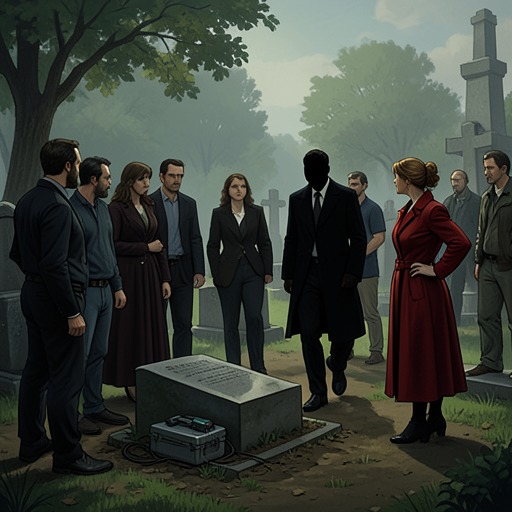
Before the machinery can do its work, Bogdan begins digging by hand at the top of the Garden, where the oldest graves lie in shade beneath trees. He expects the older coffins to be solid and intact, and chooses to work neatly rather than risk the damage that heavy equipment might cause. In one grave, however, his shovel strikes something that is not the coffin lid. He clears earth from a pale object and realizes that he has uncovered a bone. Rather than cover it again and leave the discovery to the diggers, he feels responsible for what he has found and continues carefully by hand.
The discovery becomes stranger when Bogdan realizes that he is kneeling on a solid oak coffin lid while the exposed bones lie above it. A body has therefore been placed in the grave on top of an earlier burial. When Elizabeth later joins him at the excavation site, she sees the bones and the coffin lid by torchlight. The grave does not yield the money she had imagined Bogdan might have found; instead, it exposes a concealed human presence within a cemetery already facing disturbance.
The find brings the Garden into the police investigation. Officers and forensic personnel later enter the site with spades, and the area is cordoned off. The careful sequence of hand-digging, discovery, and official examination contrasts with the proposed large-scale relocation: the grave is no longer merely one of many obstacles to a building project, but evidence whose contents demand investigation.
Burial, Memory, and Secrecy
The concealed grave is connected to an earlier secret burial. In a later account, a man explains that he knew the cemetery from visiting Gordon Playfair and chose it because it was secluded, away from farmland that builders might acquire, and unlikely to attract visitors. He drove there at night with his lights off, dug into a sister’s grave, and placed another body above the coffin before covering the grave again. Years later, he moved to Coopers Chase with Penny, partly so he could remain close to the place and watch in case the cemetery was ever threatened.
The Garden’s beauty and order thus coexist with an act of concealment. Its isolation made it seem a safe place to hide a body; its graves and walls later helped protect that secret from notice. Yet the same features that made the burial possible also made the site legible when the cemetery came under threat: the old rows, the identifiable headstones, and Bogdan’s attention to the ground revealed that its apparent stillness did not mean it held nothing more to tell.
The cemetery’s significance lies in this tension between continuity and disturbance. For generations, the sisters were buried in an orderly place whose landscape seemed to endure while the world changed around it. Development threatens to turn those graves into material to be moved, while the hidden burial shows that the ground contains histories beyond the visible inscriptions. The Garden is at once a memorial, a contested place, and the setting where an old secret rises into the present.