Ian Ventham
The Thursday Murder ClubIan Ventham is a prosperous care-home developer whose confidence in business and contempt for obstacles shape the conflict around Coopers Chase. He helped build his fortune with Tony Curran, then cut Tony out of a lucrative development deal just before Tony was murdered. Ian’s own death comes amid a cemetery blockade: John injects him with Fentanyl to prevent an old concealed burial from being exposed, turning Ian’s drive to push development forward into the danger he had underestimated.
Identity and Business
Ian’s fortune rests on a repeatable property strategy. He bought large, neglected houses; Tony gutted and subdivided them, fitted ramps and handrails, and prepared them for use as care homes. The business boomed, and Ian accumulated a portfolio by keeping some properties, selling others, and buying more. The partnership had worked for years, with each man contributing a distinct part of the process.
His confidence is accompanied by a habitual attention to advantage. At a Waitrose in Tunbridge Wells, Ian takes the last available disabled parking bay because it is nearest the entrance, despite not being disabled. The detail is small but characteristic: convenience is his reason, and the space’s intended use does not deter him. He also owes Bogdan £4,000 and has delayed repayment while hoping Bogdan will be deported. When Ian encounters him, however, he has a job for him and considers the situation resolved. His willingness to use Bogdan while postponing what he owes reflects the transactional cast of his relationships.
Ian cultivates the language of self-improvement and business success. On one drive he listens to a motivational audiobook about battlefield lessons for the boardroom; later, while running on a treadmill, he listens to Richard Branson’s business advice. He admires Branson’s achievements despite disagreeing with his politics and imagines writing a book himself, once he finds a title that rhymes. These ambitions sit beside a more practical calculation: he checks the time on his way to Coopers Chase and plans to finish a meeting before telling Tony unwelcome news.
Ambition and Expansion
The Woodlands is not the limit of Ian’s plans. After a consultation that he regards as successful, he treats the development as settled, confident that permits and procedure will protect it from opposition. He dismisses a vocal meeting attendee as someone who will exhaust himself and takes the presence of a priest as a sign of concern about the cemetery, not a serious obstacle. He has permits, he believes, and expects the project to proceed.
Ian is already looking beyond The Woodlands to Hillcrest, described as the final phase. The proposed development depends on adjoining farmland owned by Gordon Playfair, who appears unwilling to sell. Ian is not deterred by that resistance; he assumes he has ways to secure what he wants. The confidence that carries him from one acquisition to the next also leads him to treat other people’s objections as problems to manage rather than limits to respect.
The cemetery is the exception he recognizes as difficult, though not as a reason to abandon the project. Ian thinks about Father Matthew Mackie and does not want events around the graveyard to get out of hand. In the past, Tony could have spoken to someone on his behalf; with Tony gone, Ian decides not to dwell on the loss. The diggers are due to begin in a week, and he plans to have the cemetery dealt with first, as the hardest part before the rest becomes easy. His practical sequencing understates the human and historical stakes of disturbing the graves.
Tony Curran and the Broken Partnership
Ian’s relationship with Tony changes from mutually profitable collaboration to a source of serious conflict. Tony owns 25 percent of Coopers Chase, and the original arrangement for The Woodlands follows the same division: 75 percent for Ian and 25 percent for Tony. Ian changes the plan by using a new company that excludes Tony altogether. He signs the papers the day before the consultation meeting, which is also the day before his public row with Tony and Tony’s murder.
The exclusion would have cost Tony millions. Tony had reason to expect a substantial return from a development modeled on their existing arrangement; instead, Ian removes him shortly before the project is to go ahead. The timing gives Ian a powerful apparent motive in the investigation into Tony’s death. Ian privately tells himself that firing Tony did not mean killing him, treating that distinction as a point in his own favor. The contrast is revealing: his self-exoneration focuses on the literal act of murder, while the financial betrayal that helped provoke their final dispute remains his responsibility.
The Cemetery Conflict and Ian’s Death
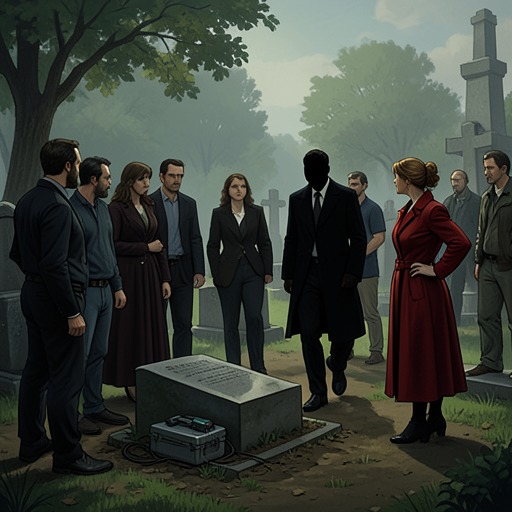
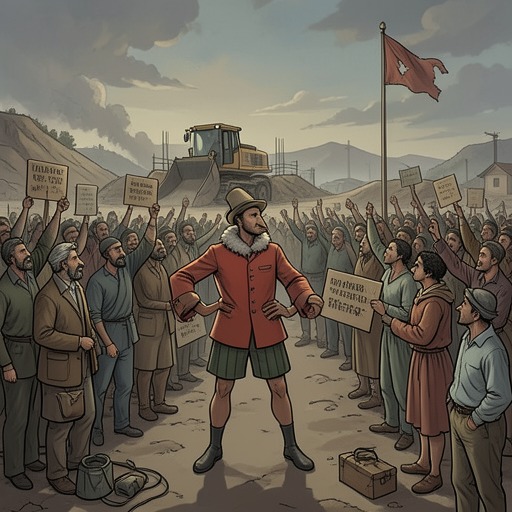
The plan to excavate the cemetery turns Ian’s development agenda into an immediate confrontation with Coopers Chase residents. Workers arrive at 6:30 in the morning to dig up the nuns’ graves, without warning or consultation. Ron addresses the gathering residents and workers, presenting the excavation as an intrusion into their community. Bogdan acknowledges that the diggers are there to do the work. Ian arrives in his Range Rover, sees the crowd, and sees Bogdan shrug. The scene places Ian face to face with opposition that cannot be dismissed as a troublesome voice at a meeting.
The excavation threatens more than the graves Ian expects to move. John later explains that he had persuaded Penny to retire to Coopers Chase so that he could keep watch over the cemetery, fearing that a grave might be dug up and a body found. By the morning of the blockade, John believes he cannot recover the body himself and cannot risk its discovery. As the residents hold Ian back amid the confusion, John slips a syringe into Ian’s arm. Ian is dead seconds later. John describes the act as unforgivable and says that he had been waiting to face its consequences; he had kept the Fentanyl for a long time in case Penny needed to be moved.
The death passage also briefly presents Ian in a state of fear as he approaches a clamped Range Rover that he has borrowed, worries about his father’s anger, and searches his pockets for change. He stumbles backward, reaches for support, and finds none; the narration states that he is dead before he hits the ground. The abrupt shift from a forceful developer arriving to press ahead with an excavation to a figure brought down in seconds gives his ending a stark physical finality. The later account establishes that John, not Father Matthew Mackie, killed him, and connects the death directly to the concealed burial Ian’s project threatened to uncover.
Narrative Role
Ian’s story links commercial expansion, personal betrayal, and the struggle to protect a burial place. His dismissal of objections and confidence in permits make the cemetery appear to him as a difficult stage in a project, but for John it is the one place where an old secret must remain undisturbed. Ian’s exclusion of Tony also shows how the same drive for control that built their business can destroy its partnership. His death does not resolve the larger history by itself; instead, it forces the investigation to ask whether the current crimes are connected to a much older murder and to reconsider who had the motive and opportunity to stop the excavation.