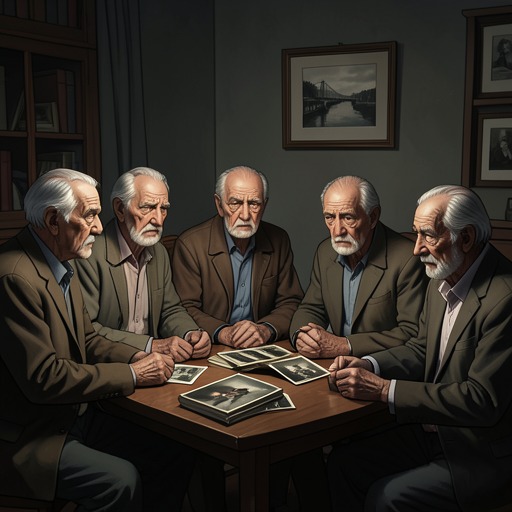
Jason Ritchie
The Thursday Murder ClubJason Ritchie is a former boxing champion whose enduring celebrity, connection to Ron Ritchie, and proximity to Tony Curran’s murder draw him into the Thursday Murder Club’s investigation. He moves between several roles: famous athlete, protective son, guarded subject of police questions, amateur investigator, and friend trying to repair an old relationship. The evidence links him to the case without establishing that he committed Curran’s murder; his importance lies in what he knows, whom he can reach, and how his attempts to find answers expose the limits of his own deductions.
Identity and Boxing Career
Jason’s fame dates from the late 1980s, when his fights made him one of the country’s best-known boxers. Public attention made his career feel like a continuing drama, with Jason sometimes cast as hero and sometimes villain. The stories around his bouts included well-known opponents, while his father, Ron, added another source of public interest as the outspoken figure known as Red Ron. Jason’s celebrity outlasted his active career: a television clip of him accidentally knocking out Terry Wogan while demonstrating a boxing move continued to earn royalties.
His public image joined physical force to personal charm. He was known as a brawler, with tattoos on both arms, but also as handsome and charismatic; the wear of his career altered his looks without erasing their appeal. The contrast between reputation and physical reality appears when Chris Hudson and Donna De Freitas watch him at an arena. The description of his prime emphasizes fluid movement, precision, and athletic grace rather than crude strength. In the present, however, he is trying to learn ice dancing and plainly cannot do it. The scene gently separates the famous boxer’s former command of movement from his awkwardness in an unfamiliar activity.
Jason’s fame precedes him even in ordinary social encounters. After Ron speaks at a consultation meeting, Dennis approaches to praise him and recognizes Jason as the champion. Jason responds politely, accepting the introduction without performing for the attention. Later, Donna’s father’s interest in boxing gives her a ready point of reference as she researches him. For the public, Jason is a familiar sports figure; for the investigation, that familiarity is useful but also risks obscuring the less celebrated details of his present life.
Connection to Tony Curran’s Murder
Jason’s relationship to the murder becomes more than a matter of celebrity gossip when Donna checks the call records. She identifies his number as the one that called Tony Curran three times on the morning Curran was killed. The discovery changes the detectives’ plan and makes Jason a person of direct investigative interest. The calls are concrete evidence of contact, though the supplied account does not disclose their content or establish what Jason intended by making them.
When Chris and Donna later question him at the arena, Jason is taking off his skates after his attempt at ice dancing. Chris asks what he was doing at Tony Curran’s house on the day Curran was murdered. Jason refuses to discuss it, and Donna presses him on whether he accepts that he was there. His answer is guarded rather than explanatory. The scene places an awkward present-day encounter beside a serious unanswered question: the celebrated boxer is being asked to account for his presence in the orbit of a killing.
Jason’s reluctance does not remain the only account of his response. After receiving a photograph hand-delivered on a Tuesday morning, he reflects that he probably knows what it means and has known all along, then calls Ron. Later, in a sauna, Jason checks whether his father is comfortable with what is happening. Ron tells him to tell the investigators everything and trust them to know what to do. These moments show Jason moving toward disclosure with his father’s support, but the available evidence does not specify the full content of his account. In retrospect, Jason thanks the club for helping him and Bobby reach the truth, adding that without their help he would probably have been imprisoned for this. His words confirm that the case carried personal legal stakes for him without resolving, by themselves, exactly what those stakes involved.
Family and Old Friendships
Ron is central to Jason’s personal life. Their connection is visible in small habits as well as consequential decisions: when Jason is around, Ron has a beer too, because he considers it important to be a role model. Jason calls him after contemplating the photograph, and later asks whether he is all right with Jason telling the investigators everything. Ron’s reassurance makes the father-son relationship a source of trust at a moment when Jason is under pressure. Jason’s fame may have been intertwined with his father’s public persona, but these scenes show the relationship operating privately as mutual consideration.
Jason’s reunion with Bobby Tanner supplies another strand of his story. After they have both left Coopers Chase, they meet for a drink at the Black Bridge, also known as Le Pont Noir. Jason remembers that they seemed to trust one another and felt they had both changed for the better over the years. Bobby does not explain what he is doing now, and Jason accepts that he is not obliged to. Their renewed trust matters because Jason credits the club with bringing them together and helping them get to the truth. His gratitude is expressed not only in words but in gifts from a sports bag, including Cuban cigars for Ibrahim Arif.
A Mistaken Theory About Karen Playfair
Jason’s attempt to solve another part of the mystery leads him to Karen Playfair. The match appears on her phone through a dating app, and they meet at Le Pont Noir for lunch. Their initial conversation seems like the start of an ordinary date: they order crayfish salad, while their different areas of knowledge give them little obvious common ground. Jason then turns the conversation toward Ian Ventham’s death, and Karen realizes that he has arranged the meeting to question her.
Jason’s theory is built from circumstances that seem to him to point toward greed. Karen had been present on the morning Ventham was killed, her father refused to sell his land to Ventham, and she had advised her father to consider selling. Jason infers that she might benefit financially and links her IT work to access to fentanyl obtained through the dark web. He presents this as the simple answer the police have overlooked, tying Karen’s presence, her family’s land dispute, and the possibility of money into one suspicion. His confidence makes the theory sound complete before he has established whether its assumptions are true.
Karen’s correction dismantles it. She is a database administrator at a secondary school, not someone with the access Jason imagines. She has also mistaken his mention of fentanyl for Ventolin, and she explains that although she would exchange the landscape for a million pounds, she would rather remain there with her father happy than move with him into a new executive home in Hove. Jason cannot produce a clever answer and recognizes that she is telling the truth. He apologizes and offers to leave; instead, they decide to make the best of the unexpected situation. The questioning gives way to a long, enjoyable lunch, with both of them laughing at the unlikely circumstances of their meeting. Jason’s wrong deduction therefore ends not in a confession or arrest, but in an exposed mistake and a human connection he had not planned.
Change and Narrative Role
Jason’s story repeatedly sets reputation against present conduct. The public remembers the formidable boxer, while the arena scene shows him struggling to learn a different physical discipline. His celebrity opens doors and makes him recognizable, but it does not make his judgments infallible. The same quick certainty that helps him construct a theory about Karen also carries him beyond what the evidence can support. When she answers him plainly, he accepts the correction rather than forcing his suspicion to survive.
His later thanks to the Thursday Murder Club marks a shift from being a guarded subject to acknowledging the help he received. He does not claim to have solved the case alone: he credits others with reconnecting him to Bobby and helping them reach the truth. That gratitude, his concern for Ron’s comfort, and his willingness to apologize to Karen complicate the old public image of the bruiser. Jason remains a forceful presence, but the account also gives him room for uncertainty, loyalty, and change. His place in the mystery is thus defined not by a fully disclosed criminal act, but by his contact with Curran, his exposure to suspicion, his effort to uncover the truth, and the relationships that make that effort matter.