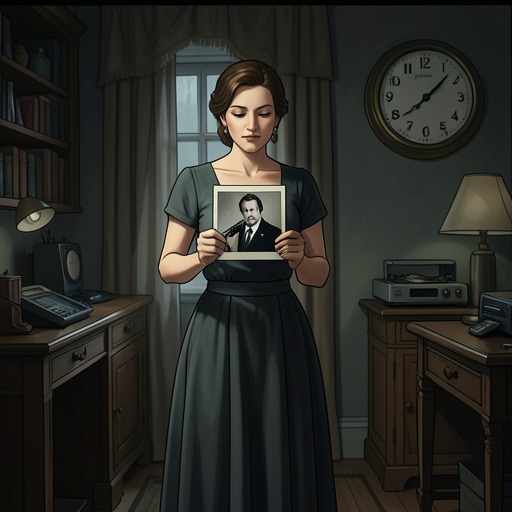
John and Penny's deaths
The Thursday Murder ClubJohn and Penny’s deaths are presented as a paired act of concealment and protection, with Elizabeth caught between loyalty to her friends and the justice she believes their choices require. John leaves to die rather than let Penny answer for her past, and the syringe Elizabeth saw in his hand signals that Penny, too, is near death. The acts themselves remain offstage; the story makes their meaning emerge through a private farewell and Elizabeth’s uncertain vigil at Penny’s bedside.
The Farewell and John’s Departure
The scene begins in quiet recollection. John remembers picnics with Penny on a hill, and wonders why they stopped. Their silence is broken only by the electronic beeps beside her bed, a small, regular sound that Elizabeth’s account later makes seem like the last signal of Penny’s presence. The memory of shared outings briefly places their long marriage against the immediate fact of Penny’s unresponsive condition.
Elizabeth proposes that the others take John home for the night. She tells him to sleep in his own bed and, if he has letters to write, to write them; she will come with the police in the morning. Her plan is both practical and deliberate: John is to leave Willows now, while she will return with the authorities once he is gone. She also makes room for him to say goodbye to Penny in private, rather than turning their final moments into a scene witnessed by the group.
The four friends step outside. Through the clear border of the frosted glass in Penny’s door, Elizabeth watches John hold his wife. She looks away. The window permits her to see enough to understand the intimacy of the moment but not to intrude upon it; her withdrawal marks the difference between witnessing a farewell and claiming it. When John puts on his coat, Elizabeth asks the others to see him safely home while she stays with Penny, then tells him it is time to go.
Protection, Justice, and the Unseen Death
Later, beside Penny in the low light of her bedside lamp, Elizabeth explains the consequences she expects. She believes John will die after returning home and taking a nightcap, and expects to take the police there in the morning, where they will find his body. She frames his choice as an attempt to protect Penny: he knows enough to make his death peaceful, and he has walked into the night because he wants to shield the woman he loves. The anticipated death is therefore not presented as an accident or a sudden discovery, but as a decision whose aftermath Elizabeth already expects to manage.
Elizabeth also confronts Penny with the choice that, in her view, has led to this ending. She understands why Penny acted and recognizes that Penny delivered her own form of justice, although Elizabeth does not agree with it. Her judgment does not erase her empathy: she admits that she was not present in the situation Penny faced. Instead, she asks whether Penny has escaped the consequences of what she did. If Penny can hear her, Elizabeth suggests, John’s death and the knowledge that he died to protect her may itself be punishment; if Penny cannot hear, she may have escaped that reckoning. Elizabeth cannot know which possibility is true.
The Syringe and Penny’s Imminent Death
The central revelation comes when Elizabeth states that she saw the syringe while John was holding Penny. From that observation, she concludes that Penny is going to die too, and says goodbye. The text does not describe the syringe’s contents, the precise act, or a medical outcome; its significance is conveyed through Elizabeth’s recognition and the finality of her words. John’s embrace, first seen from outside the room, is thus recast as more than a marital farewell: it is also the moment in which he acts to bring Penny’s life to an end.
The paired deaths remain morally distinct even as they converge. John’s expected death is his own choice, made to protect Penny from exposure; Penny’s impending death follows the act Elizabeth believes John performed while holding her. Elizabeth does not call Penny innocent, nor does she approve of the justice Penny took into her own hands. Yet she does not reduce her friend to that act. Her tenderness—stroking Penny’s hair, taking her hand, kissing her cheek—persists alongside her judgment, making the bedside conversation an intimate reckoning rather than a simple absolution.
Witness, Secrecy, and the Ending
Elizabeth’s vigil is shaped by what she can see and what she cannot establish. She saw John holding Penny through the frosted window, saw the syringe, and believes she knows what he did; she cannot know whether Penny hears her. That uncertainty gives her closing words two possible audiences: a friend who may understand the cost of John’s sacrifice, or a friend already beyond hearing. Elizabeth’s farewell accommodates both possibilities without pretending to resolve them.
Before leaving, Elizabeth discloses her own secret: Stephen is gravely unwell, and she feels she is losing him bit by bit. The admission does not make her experience equivalent to John and Penny’s crisis, but it places her beside them as someone already living with an approaching loss. She leaves Willows alone and walks into a dark, cloudless night, described in terms that make morning feel uncertain. John’s body and Penny’s death are anticipated rather than shown; Elizabeth’s departure closes the scene on the surviving friend, carrying what she has witnessed into the darkness.