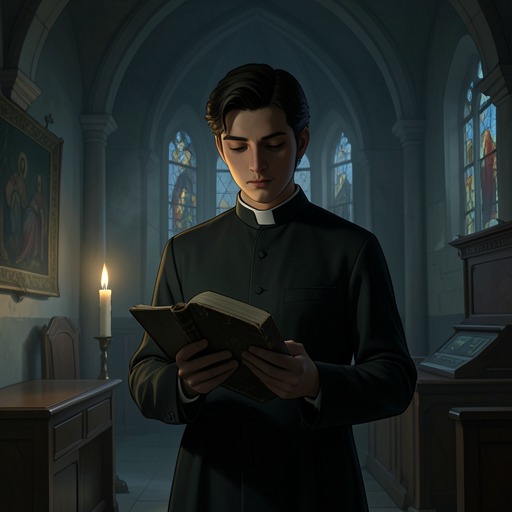
Matthew Mackie and Maggie
The Thursday Murder ClubMatthew Mackie and Maggie’s relationship was a hidden love between a priest and a nun, formed through ordinary conversations and private meetings within the religious institutions that also constrained their choices. Maggie’s death in 1971 ended their hope of building a life together, but not Mackie’s attachment: he arranged for her to be buried in the Garden of Eternal Rest, returned years later to live near her grave, and opposed its relocation as a final act of care for her and their child.
Identity and Circumstances
Mackie had entered the priesthood eager to do well and to please, afraid of being sent home. He recalled that his outlook changed after meeting Maggie, who was among four young women cleaning the chapel. She was the only Maggie. At first, their exchanges were formal: she addressed him as Father and he addressed her as Sister Margaret. Over several weeks, small greetings about the weather and questions about her work became a private familiarity. The courtship began inside the daily routine of the chapel rather than outside it; the roles that separated them were also the setting in which they came to know one another.
The relationship’s circumstances made even an initial acknowledgment difficult. About a month after Mackie arrived, Maggie came to confession. They sat separated by the wooden partition and neither spoke for a long time. Eventually, Mackie reminded her that she had work to return to, and she thanked him. He later described that silent meeting as the point at which both understood what had begun. In his account, the confession itself marked a transgression, and they both knew it would not be the last. The scene’s restraint matters: the relationship advances not through an open declaration but through silence, proximity, and the shared recognition that their formal roles could no longer contain their feelings.
A Love Made of Private Meetings
Mackie and Maggie continued to see each other while avoiding conversation in front of other people. He saw her every morning, but their more intimate conversations took place when he heard her confession. In the confessional, speaking through a grille, they sat on two wooden seats and fell in love. Mackie recalled their names together, as if the order itself could preserve a private life that could not be publicly acknowledged: Maggie and Matthew, Matthew and Maggie. His description of their love as doomed reflects how clearly its obstacles were present even as the relationship deepened.
They also arranged meetings at night in the gatehouse. Tuesdays and Fridays were the safest evenings for Maggie to slip away. Mackie used a candle in an upstairs room as a signal: its light meant he was available, while its absence meant she should not come because he had been called away or had guests. Maggie would come when the candle was lit, sometimes immediately and sometimes after he had waited. The signal gave their meetings a fragile regularity, but it depended on secrecy and could not protect them from events beyond their control.
Their plan was to leave. Mackie believed he could find work because he had completed his exams, while Maggie could work as a nurse; together, they imagined buying a home on the coast. Both had grown up by the sea, and Bexhill became the place he pictured for their future. Mackie said he intended to leave the priesthood. He thought Maggie would also leave the religious life, though it was harder for her because her faith remained important to her. He recognized that the social risk was unequal: in their time, he believed a young woman faced more to lose than a young man. Their imagined future therefore depended not only on love but on Maggie’s ability to make a more difficult break with her existing life.
Pregnancy, Separation, and Loss
Maggie became pregnant and confided in another young nun. Mackie never learned the confidante’s identity, but the nun told Sister Mary. After evening prayers, Sister Mary summoned Maggie and, as Mackie understood it, arranged for her to leave. Maggie was to spend one final night at the convent and be collected in the morning, with the plan that she return to Ireland. Mackie did not know exactly what Sister Mary had said to her; he inferred the circumstances from the arrangements that followed.
On March 17, 1971, Mackie lit the candle and waited for Maggie. As the evening wore on, he worried that she might have been caught leaving. He eventually put out the candle, laced his boots, and went to the convent to see what had happened. There, in the chapel, he found that Maggie had died by suicide. She had been pregnant, and her death also ended the life of their unborn child. The expected meeting did not take place; the candle that had so often signaled that she would come became part of the memory of the night she did not.
The Grave and the Life Afterward
Mackie said he and Sister Mary made an agreement after Maggie’s death. He would leave without telling anyone what had happened, and the Church would arrange for him to start again. He was sent back to Ireland, where he was given a job at a teaching hospital in Kildare. He said that records were destroyed and new ones made, keeping the circumstances of Maggie’s death—and their relationship—from becoming a public scandal. In return, he asked that Maggie be buried in the Garden of Eternal Rest. She would not have wanted to be sent home, he believed, and St Michael’s Chapel was the only other place she knew.
The next morning, the car that had been coming to collect Maggie took Mackie instead. He stayed in Ireland until he heard that Sister Mary had died. Then he left his job, packed a case, and returned to live as near to Maggie as he could. His later opposition to moving the cemetery was, in his own account, the only thing he could still do for her: he wanted her to have peace and a beautiful resting place. He also remembered the child as their son, Patrick, while acknowledging that he could not know whether the child had been a boy or a girl. The name gave form to the child he had carried in his thoughts, not certainty about the child’s sex.
Recognition and Continuing Bond
When Mackie recounted the relationship, he had not told the story for fifty years and had now told it twice in one day. The account exposed why the grave mattered to him and why his resistance to moving the bodies could be mistaken for a motive to kill Ian Ventham. Mackie denied killing Ventham, explaining that he believed such an act would have violated what Maggie would have wanted and compromised the life he hoped to meet her again with a clear conscience. His defense connected his refusal of violence to the same enduring loyalty that had shaped his decisions about her burial.
After the Garden of Eternal Rest was secured, Elizabeth invited Mackie to lunch and brought him to Maggie’s grave. He asked to visit it, then knelt beside the headstone; this was when he wept. Bogdan had carefully cleaned the inscription, “Margaret Farrell, 1948–1971,” and carved “Patrick, 1971” beneath it. The added name made visible the child whom Mackie had privately remembered for decades. Ron stayed with Mackie as he broke down, while the others waited nearby. Flowers were also placed on the grave, including some from Joyce. The relationship, once confined to a chapel, a confessional, and a signal candle, was finally acknowledged at the grave through the names and gestures of those who accompanied Mackie there.