Matthew Mackie's confession about Margaret Farrell
The Thursday Murder ClubMatthew Mackie’s confession turns a carefully staged test into a disclosure of the past he has carried for decades: his relationship with Maggie, her suicide while pregnant, and the secret arrangement that brought her to the Garden of Eternal Rest. The confession is both a revelation of concealed events and an account of how silence, institutional pressure, and the need to remain near the dead shaped the rest of his life.
The confessional test
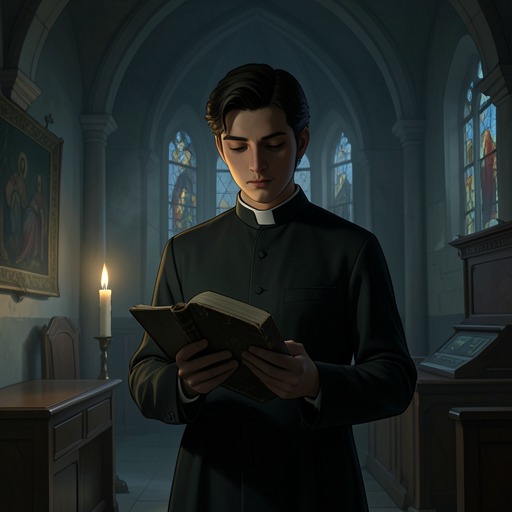
In the candlelit chapel, Elizabeth and Matthew Mackie sit inches apart inside the confessional. Elizabeth offers what sounds like a deathbed confession of her own: she says that she killed a man long ago, presenting the killing as self-defence and saying that she wants a witness rather than forgiveness. Matthew invites her to continue, but when she finishes, he says that he does not believe her. Elizabeth presses the point by recalling the detail in her story and his reaction when she mentioned the Garden of Eternal Rest. The supposed confession is a provocation, not the truth she has come to hear.
Matthew’s resistance shifts when he admits that he would like to talk and invites Elizabeth to show her real purpose. His willingness to speak does not arrive as the reward for a successful interrogation so much as a choice to use the moment: he is at home in the church, and he wants a conversation. The confessional’s traditional demand for a confession is thus unsettled. Elizabeth has staged a false one to open the door, while Matthew decides that he is ready to bear witness to what actually happened.
Matthew’s life at the convent
Matthew recounts that he came from Ireland in 1967, aged twenty-five, looking for adventure rather than a particular mission. He took a post at a convent with a busy hospital, where about a hundred Sisters lived and worked. He had rooms in the gatehouse, separate from the Sisters’ quarters, and served as a priest through sermons, confessions, and the ordinary work of sharing people’s happiness and sorrow. He remembers himself as young and inexperienced, and recalls that his position as a man seemed to matter more than wisdom.
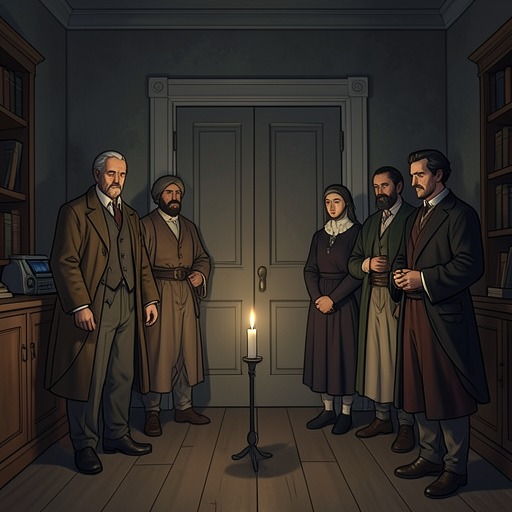
That setting becomes the frame for his account of Maggie. His story, told later to the group in the Jigsaw Room, begins with a religious community that was peaceful on the surface but governed by rules and authority. The movement from the intimate confessional to the group’s meeting room also changes the circumstances of his testimony: Elizabeth initially draws him out alone, but later Chris Hudson and Donna De Freitas take charge of the questioning, with Elizabeth stepping back. The Thursday Murder Club and the police are no longer listening to an abstract mystery; they are hearing the history behind it from the person who lived it.
Maggie’s death and the bargain
Matthew reveals that Maggie was pregnant. She had confided in another young nun, whose identity he never learned. That nun told Sister Mary, who summoned Maggie after prayers and sent her away: she was to spend one last night at the convent, then be collected and returned to Ireland. Matthew believes Maggie could slip out of the dormitory, but that night she did not come to him. Instead, she went to the chapel and hanged herself. Matthew says that she took the life of their unborn child as well.
The institution’s response did not make the loss public. Matthew says that he and Sister Mary were the only people who saw Maggie’s body hanging. A deal was made: he would leave without speaking to anyone, while Maggie would be allowed to rest in the Garden of Eternal Rest. The Church authorities destroyed the old records and made new ones, and the account circulated about Maggie’s death concealed the priest, the baby, and the suicide. Matthew says that the burial place mattered because Maggie would not have wanted to go home, and St Michael’s Chapel was the only other place she knew.
Sister Mary also had a reason to agree. Matthew explains that his sudden departure, paired with Maggie being sent away for burial, might have prompted questions and exposed what had happened. The arrangement protected her as well as him. The car that had been due to collect Maggie instead took Matthew; they travelled through the day to Holyhead, and he returned to Ireland without telling anyone.
Return and the need for a witness
Matthew stayed in Ireland and worked at a teaching hospital in Kildare. He remained away until he heard that Sister Mary had died. Then he left his job, packed a case, and returned to stay near Maggie. Sister Mary was buried in the convent graveyard, where Matthew says her headstone can be recognised by its cherubs. His return makes his attachment to the place more than a matter of memory: it is the nearest he can live to the woman he lost.
The delayed telling gives shape to the confession’s central burden. Matthew’s account joins Maggie’s hidden burial to a life organized around departure, silence, and eventual return. The bargain preserved a place for her in the cemetery, but it also sealed the circumstances of her death from the people who might have asked what happened. In telling the story, Matthew does not ask Elizabeth or the group to undo that past; he finally lets others bear witness to it. The Garden of Eternal Rest is consequently both a burial ground and the repository of a history that its official records were made to conceal.