Memory and the past
The Thursday Murder ClubMemory and the past shape the novel as more than a record of what has happened: they are forces that alter present relationships, expose concealed histories, and make old places newly legible. Personal recollection can falter, as it does for Stephen and Penny, while photographs, diaries, and shared stories preserve fragments that individuals can no longer reliably hold. The past persists not as a finished account but as something repeatedly recovered, revised, and interpreted.
Memory as a fragile practice
Elizabeth treats memory as something that can be tested rather than simply trusted. She opens her diary to a date two weeks ahead and writes herself a question, then answers a question she set herself earlier. The routine is an early-warning system: small failures might reveal a larger change before she can otherwise recognize it. A fortnight-old number plate becomes a test she is pleased to pass. The procedure gives her a way to observe her own mind over time, but its very care acknowledges that memory cannot be taken for granted.
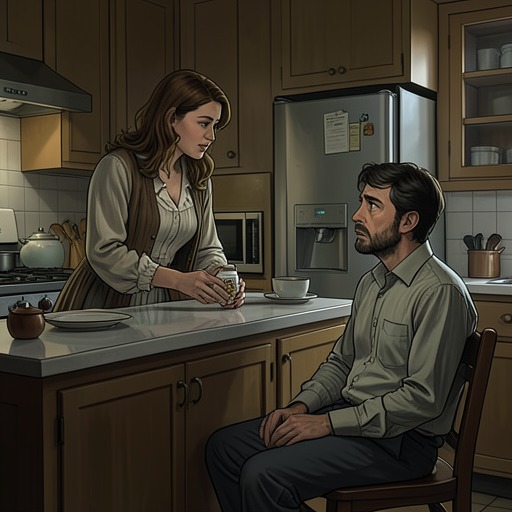
That vigilance enters the life she shares with Stephen. During one conversation, he worries about his daughter, Emily, and wishes she would visit more often; Elizabeth agrees to speak with her. Yet Emily was Stephen’s first wife, who died nearly twenty-five years earlier, and he has no children. His present confusion does not erase the emotional reality of the relationship he remembers. Instead, it brings the past into the room as though it belonged to the present, making Elizabeth’s ordinary conversation an act of accommodation as well as correction.
Stephen’s mistaken recollection also makes the difference between remembering a person and accurately locating that person in time painfully visible. Elizabeth knows the facts, but she does not treat his error as a mere puzzle to solve. She recognizes the worry behind it and responds to the wish that Emily should visit. In their marriage, memory is therefore not only a store of accurate information; it is part of the daily care required when one person’s sense of the past begins to shift.
Repetition, loss, and what stories can hold
Penny’s illness gives memory a different, more severe trajectory. Her mini-strokes begin gently, but the changes accumulate: the present grows indistinct and her mind moves further back toward familiar experiences. She tells John stories from childhood and from the early days of their relationship. He has heard many before, including recollections of police work and the small rule-bending practices they once laughed about. Rather than stop the repetitions, John keeps her talking. One story leads to another, and then back around to the first.
The circuit of familiar stories becomes a form of companionship. John understands that the repeated telling helps Penny stay with something recognizable when the surrounding world has ceased to make sense. Their shared past gives him a way to remain beside her, even when he cannot restore her to the present. The stories are not simply evidence of what she has lost; they are still a means of connection between them.
Then the pattern changes. Penny begins telling John things he has never heard before: secrets she has apparently forgotten that she once disclosed. One is a small bribe she took because others had taken one too. She no longer distinguishes a funny old story from a secret. John imagines a final lock holding back the worst truth, something that took all her remaining strength to protect. The novel leaves that withheld knowledge charged with significance: memory’s decline loosens some secrets while making the most guarded one seem harder to reach. What is remembered and what is concealed are not stable categories, especially when the mind that once maintained them is changing.
Places and objects as collective memory
The history embedded in Coopers Chase makes memory communal as well as personal. The old convent dominates the retirement village, with three modern residential developments radiating from it. For more than a century it housed the Sisters of the Holy Church, whose routines of work, prayer, and mutual care gave the building a life distinct from its later use. The former convent’s chapel, dormitories, and corridors belong to a remembered institution; the swimming-pool complex, created by glazing the west-facing side, belongs to the present. The change is visible in the architecture, but the older history has not vanished with it.
The nearby Garden of Eternal Rest extends that history into the landscape. The convent community’s dead lie beneath simple stones on the hill, overlooking the building and the surrounding countryside. The graves make the past physically present: the site is not an abstract reminder but a place where generations are buried. When the cemetery faces removal for development, the dispute over its future also becomes a dispute over whether that history will be preserved or treated as an obstacle.
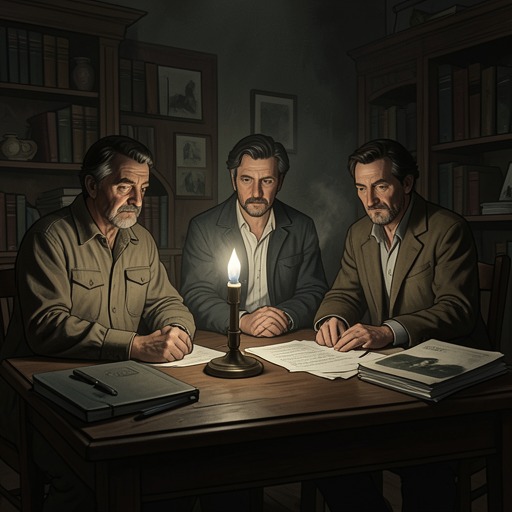
Photographs make another kind of archive. While examining Gordon’s albums, Joyce and the others look for images taken on trips to the convent decades earlier. The album wanders through wedding photographs, a baby, and page after page of sheep before ending with six black-and-white photographs from a Christmas gathering at the convent. In the fifth, a group photograph prompts everyone to look again and agree that they have found evidence. Its importance depends on collective recognition: no single viewer’s first glance is enough, and the image becomes meaningful through shared scrutiny. A photograph that once recorded an occasion now helps the investigators connect the present case to people and events decades in the past.
Recollection becomes testimony
The past also returns through telling. Father Matthew Mackie walks up the hill after Tony Curran’s death, hoping the killing might end the need for further action. When Ian Ventham confirms that the development will continue and the cemetery will go, Matthew must make another plan. His response is shaped by remembered history: the threatened burial ground is bound to the convent and to the lives that unfolded there.
Later, Matthew is unsettled by the prospect of returning to the confessional at St Michael’s Chapel. The stall is not merely a setting in his recollection; it is the place where, in his understanding, his life broke in two. He knows he has never truly left it. When he tells the Thursday Murder Club about arriving from Ireland in 1967, he recalls a convent of about a hundred Sisters, quiet but busy with the work of its hospital. He remembers giving sermons and hearing confessions as a young man, before he had much wisdom or experience. The account leads to Maggie, who cleaned the chapel, and to their growing familiarity. His memories turn a hidden history into testimony, while the location that holds the wound also becomes the place from which the story can be told.
Evidence, recognition, and the past in the present
The novel repeatedly makes recognition a process rather than an instant. A photograph is studied twice before the group agrees on what it shows. A remembered story can circle familiar ground, then suddenly disclose something new. Elizabeth works through the case step by step, combining a photograph Karen Playfair had seen with the final piece Ibrahim brings back. Only after those fragments have been fitted together does she conclude that the case is solved and that justice remains.
These patterns give memory a double force. It can fail, confuse a dead spouse with a living child, or return the same story until the present seems to disappear. It can also preserve what would otherwise be lost: a face in an old photograph, the history of a convent, the familiar cadence of a marriage, or a secret that has waited decades to be spoken. The past does not arrive intact. It is pieced together from places, objects, repetitions, and testimony, and its meaning changes as those fragments meet.