Penny and John’s marriage
The Thursday Murder ClubPenny and John’s marriage is presented not as a complete account of their life together, but through the habits and loyalties that endure when Penny can no longer respond. After fifty years together, John continues to visit her every day at Willows, returning each evening to their shared flat and its photographs and holiday souvenirs. Their bond is also bound up with secrets: John eventually gives Elizabeth information about the day Tony Curran was killed, then confesses that he killed Ian Ventham and had kept fentanyl in case Penny was ever moved. The marriage is therefore both a record of sustained companionship and the personal stake behind John’s most consequential choices.
A life measured in shared habits
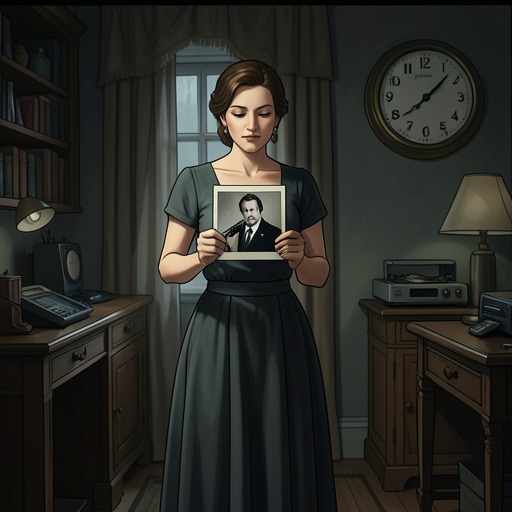
The small domestic details establish a long common history. John returns to the flat he and Penny had lived in together, surrounded by the mementos and photographs of their fifty years. The objects do not explain the marriage; their force comes from their familiarity and from the fact that John still returns to the life they made there, even while spending most of each day at her bedside.
John’s routine at Willows is strikingly consistent. He arrives at seven each morning and leaves at nine each evening. Elizabeth sees him beside Penny, with his book put down when she approaches, but apparently open to the same page each time she returns. The repeated detail suggests how little the book commands his attention while he is there. His days are organized around Penny, not around the ordinary progress of reading or the end of a visit.
Their closeness is visible in a gesture rather than a conversation. Elizabeth notices the fading white prints of John’s hand on Penny’s. He replaces his hand with the book when she enters, and Elizabeth understands that he talks to Penny when she is not present. The nurses say Penny cannot hear, but the account leaves open what she might perceive. That uncertainty does not undo John’s daily practice: he comes, stays, and speaks to her without assurance of an answer.
Penny’s illness and John’s vigil
Penny is in Willows, the nursing home, and is described as hearing nothing; the account also presents her as unable to respond. These limits shape how their marriage can be shown. Its visible expression is no longer a reciprocal exchange in the room, but John’s presence, the hand he places on hers, and the private conversations Elizabeth believes he continues when alone with Penny.
Elizabeth is careful not to interrupt their time together. She kisses Penny on the forehead, asks John how he is, and then leaves the two of them alone. Her actions recognize both the friendship she shares with Penny and the space John occupies as her husband. John’s answer to Elizabeth is brief, but she tells him that he always knows where she is. The exchange reveals an intimacy that extends beyond the bedside: Elizabeth regards him as someone who has long understood her movements and presence, even as she sees the particular grief of his vigil.
Penny’s condition also makes John’s continued attention consequential rather than merely ceremonial. The account does not establish what Penny understands or whether she can hear him. It does establish that John behaves as though conversation and touch still matter, while Elizabeth observes the pattern and chooses to leave them together. Their marriage is thus represented through care that persists in the absence of a clear response, without resolving the question of what Penny herself experiences.
A guarded disclosure
For much of the time, John does not speak to Penny while Elizabeth is in the room. Later, however, he begins speaking more openly to Elizabeth as well. One conversation starts with his account of watching Escape to the Country with the sound down, because it is not Penny’s sort of programme. He explains how he watches couples looking at houses and tries to see which partner truly wants to move and which is going along with it for a quiet life. The detail gives Elizabeth a way to recognize that his apparently casual observation has a purpose.
John then discloses that on the day Tony Curran was killed, he had watched the programme until it ended at three. He got up to fetch a Lucozade Sport and saw Ian Ventham’s Range Rover driving away from the top of the hill. He says he wanted Elizabeth to know because the programme ends at the same time each day. The precise routine supplies a time and a sighting that may matter to the investigation; it also shows John choosing to bring his observation to Elizabeth rather than leave it unspoken.
This disclosure does not erase his reserve. Instead, it marks a change in how much he is willing to tell her. Elizabeth recognizes that he has not made a habit of speaking without a reason, and asks where the story is heading. Their exchange shows how attention to John’s silences and carefully chosen details becomes part of the way Elizabeth understands him. Within the marriage, too, silence has a place: John keeps his private conversations with Penny for moments when Elizabeth is absent, while beginning to share consequential information with Elizabeth.
The protection John claims, and its cost
John’s account of his earlier life places a more troubling history beside his marriage to Penny. In the early 1970s, while working as a veterinarian, he visited Greyscott, a sheep farm, where Matheson was a lonely farmer with little help and dwindling money. After treating a mare that had lost her foal, John gave Matheson an injection, describing the act as ending his distress. The account does not make this past choice part of the marriage itself, but it becomes crucial to what John later does: Matheson’s body was secretly buried, and John feared that excavation would expose it.
John says he and Penny retired to Coopers Chase because he wanted to keep an eye on the cemetery. He had persuaded Penny that it would be a lovely place to retire to, and later explains that he wanted to be nearby in case the graves were disturbed. His account makes their home a shared setting shaped in part by a purpose he had not disclosed: watching over the burial place and the secret it contained. The evidence does not say what Penny knew of that purpose.
When the cemetery was threatened, John says he could no longer dig Matheson’s body back up and could not risk it being found. In the chaos of the blockade, he injected Ian Ventham with fentanyl, and Ventham died seconds later. John calls the act unforgivable and says that he had been waiting to face its consequences. He also says he had kept the fentanyl for a long time in case it was needed if anyone ever wanted to move Penny. His explanation links the violence to both the secret burial and his fear of Penny being moved, but does not make the act an ordinary extension of care: John himself describes it as unforgivable.
Marriage under the pressure of secrecy
The marriage’s significance rests in the contrast between its enduring routines and the concealed choices made around them. John’s daily visits, the shared flat, and the remembered objects attest to a life built together; his watchfulness over the cemetery and his concealed actions show that he has also made decisions whose consequences reach into that shared life. Penny is not shown knowing about the secrets, so the account leaves the extent of her knowledge unresolved.
John’s devotion is neither detached from consequence nor presented as a simple explanation that settles it. He says he wanted to protect Penny from being moved, while acknowledging the gravity of what he did to Ventham. The same marriage that gives his actions their personal stakes cannot by itself resolve their moral cost. In the scenes at Willows, his care takes the form of staying, returning, and speaking without knowing whether Penny can hear. In his confession, his claim of protection is bound to secrecy and a death. Together, these details make Penny and John’s marriage a portrait of loyalty under conditions where love, private knowledge, and responsibility do not neatly coincide.