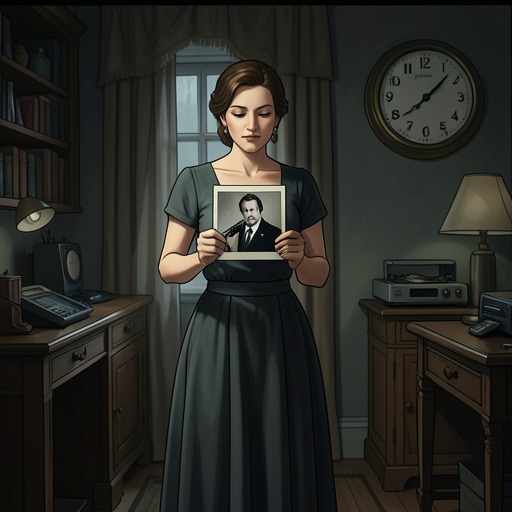
Penny's murder of Peter Mercer
The Thursday Murder ClubPenny Gray’s killing of Peter Mercer closes a case that had remained officially solved and morally unresolved for nearly fifty years. Mercer had been treated as the boyfriend who fled after Annie Madeley’s death; the later investigation exposes how Penny, then involved in the original police inquiry, eventually found him and killed him. The truth surfaces not through a conventional confession from Penny, but through the patient reading of old files, a clue in Mercer’s military history, and John’s account of what Penny told him when she could still communicate.
The original case and its false resolution
In 1973, Annie Madeley was stabbed during what the police concluded was a burglary in Rye. Broken glass on the floor seemed to show where the intruder had entered, but nothing had been stolen. The official account held that a burglar had been surprised by Annie, panicked, used a kitchen knife, and fled. The case was closed on that explanation, despite the absence of a convincing theft.
Penny was among the officers who attended the case. Mercer, Annie’s boyfriend, had been present when she died and was initially treated as a suspect: he was being taken to a police interview in Penny’s squad car when he bolted and disappeared. He had also assaulted Penny. The escape meant that he was never brought to justice for Annie’s murder, and the passing years hardened the appearance of an unsolved crime concealed beneath an official conclusion.
Ron Ritchie had doubted the burglary story. A midday break-in on a busy estate, when people were at home, made little sense to him; in his view, the supposed intruder’s timing did not fit the circumstances. The Thursday Murder Club could not simply reopen the case or compel a prosecution, and Penny and Elizabeth had previously been able to solve cases only to their own satisfaction. Yet the old account had never fully convinced those who knew its details.
Reconstructing what happened
The renewed inquiry began with a physical question. At lunch, a few months before the confrontation with John, Elizabeth brought Joyce a manila folder and asked her to consider a hypothetical knife wound. Elizabeth kept the conversation quiet out of consideration for people eating nearby. The exchange reflected her effort to test the medical account of Annie’s wound against the explanation on file, rather than accept the case’s official narrative as conclusive.
Penny had kept copies of files from her old cases, although she was not supposed to retain them. Elizabeth explains that the copies could help catch a killer many years later. After Karen Playfair recognized John, Elizabeth returned to the archive and checked the Rye file. She found the record of Annie’s death and connected its account to the question she had first put to Joyce. The old papers, preserved outside the proper system, made it possible for the club to examine a case that had otherwise been left behind.
Elizabeth then asked Ibrahim Arif to investigate why Mercer had been invalided from the army. The answer was a gunshot wound to his lower leg. When Elizabeth put the question to John, he independently identified that injury as the reason Mercer had left the army, and Elizabeth confirmed it. The clue did not itself explain how Mercer died, but it linked the fugitive’s past to the inquiry and showed that the club had found a detail Penny and John recognized.
Penny’s later act and John’s confirmation
Elizabeth tells John that Mercer murdered Annie, vanished, and was believed to have escaped the consequences. She then identifies the reversal: years later, Penny paid him a visit, and he did not escape justice. Elizabeth presents the killing as Penny’s answer to a crime that had gone unpunished, and asks whether she had grown tired of such cases and of not being listened to. The scene makes clear what Penny did without supplying an unsupported account of the encounter itself.
John confirms the disclosure that makes the reconstruction personal. He recalls that Penny was already in the hospital and that, on one of the last occasions he remembers her sitting up, she recognized him and asked what they were going to do. He had not understood her question at first. Penny then told him what she had done, matter-of-factly, as though she were asking him to retrieve something from storage. John says he could not let other people find out and had tried to protect her secret. His recollection establishes both that Penny told him and that he knowingly concealed her responsibility.
Delayed justice and the limits of the record
The event is revealed through evidence gathered after the killing, not staged as a direct account of its circumstances. The first crime is reconstructed from an old case file and the doubts it left behind; the later killing emerges through Elizabeth’s deductions and John’s belated confirmation. Mercer’s army discharge supplies a precise, consequential clue, while Penny’s preserved copies and her conversation with John bridge the decades between the two crimes.
The case therefore unsettles the distinction between an official ending and a just one. Annie’s file had been closed, Mercer had vanished, and the people who suspected the account could not make the legal system deliver an answer. Penny ultimately acted outside that system, but the novel does not turn that act into a procedural resolution: the evidence presented here reveals her deed and its concealment, while leaving the details of Mercer’s death unstated. At Penny’s bedside, Elizabeth’s investigation makes the hidden past speak at last, and John’s tears mark the cost of having carried its secret.