Ron Ritchie
The Thursday Murder ClubRon Ritchie is a veteran labor activist and an outspoken member of the Thursday Murder Club at Coopers Chase. Once known in the newspapers as Red Ron, he carries the habits of public protest into old age: he distrusts easy explanations, challenges authority face to face, and gravitates toward the underdog. Yet his role is not simply to supply noise or bluster. His scepticism helps the group question received accounts, while his long-standing instinct to help people gives his defiance a practical and protective side.
Identity and Background
Ron’s political life was formed through years of industrial conflict. He stood with the workers at British Leyland, witnessed the decline of the dockers, joined the Wapping picket, and saw the printers’ defeat. He led Kent miners north on the A1 and was arrested at Orgreave during the final resistance of the coal industry. Newspapers regularly placed his photograph beside reports that talks between opposing sides had collapsed. The record establishes a man accustomed to confrontation, but also to losing causes: he repeatedly stood with groups whose defeats marked changes in working life.
Ron can read that history as a run of bad outcomes, but he does not retreat from it. He loves being the underdog; when he finds himself on the stronger side, he will turn the situation around until he occupies the weaker position again. That self-conscious allegiance is more than a pose. He has quietly helped people who needed money at Christmas, a suit, or a solicitor for court. The same person who can dominate a confrontation has also made himself a champion for those without the means to answer one alone.
Suspicion and the Investigations
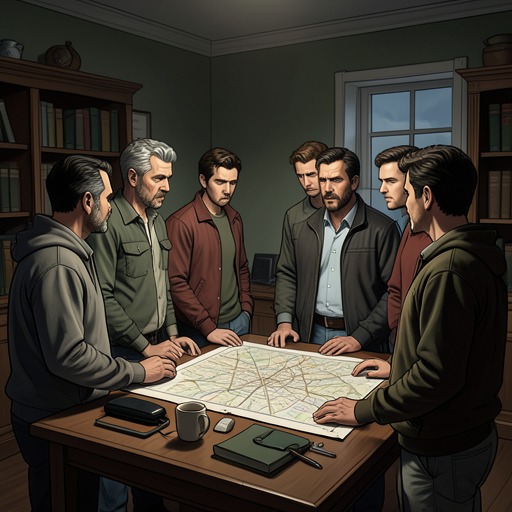
Ron’s entry into the Jigsaw Room begins with disbelief. He had not accepted the explanation that the room’s Thursday gathering was about Japanese opera, so he walked in to find out what was really happening. Elizabeth recognized the usefulness of his suspicion and invited him to examine a police file about a scoutmaster found burned to death in woodland off the A27 in 1982. Ron’s defining investigative strength, as Elizabeth sees it, is that he does not believe a single word anyone tells him. Reading police files on the assumption that the police may be lying becomes, in her view, an unexpectedly effective method.
That disposition also shapes his response to Ian Ventham’s plans. In a meeting, Ron points to the wording of his lease, which reserves the possibility of further residential development on the site in consultation with current residents. He challenges Ventham with the developer’s own contractual language rather than relying only on indignation. His voice remains forceful, but the lease and Ron’s shaking finger disclose the cost of delivering that challenge: his hands tremble, and he waves the document to conceal it.
At another point, Ron’s attention returns to the murder of Tony Curran. Before sleep, he imagines himself back in the political limelight, addressing a television panel and making the room listen. The fantasy falters as he wonders whether his old methods would still work and whether he has lost some of his pace. His suspicion then turns to the case: Ventham seems an obvious possibility, but Ron asks himself whether that explanation leaves something out. The scene makes his investigative instinct continuous with his political one, while allowing him to doubt his own confidence rather than merely perform certainty.
Public Resistance at Coopers Chase
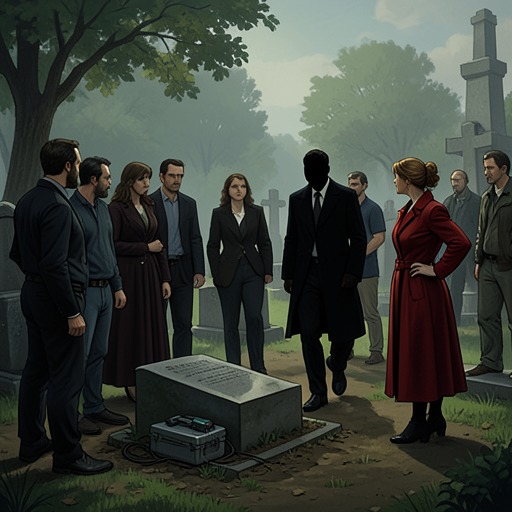
When workers arrive early to begin digging in the cemetery, Ron treats their presence as an opportunity to gather and address the residents. He notices his friends in the crowd, including Ibrahim, Joyce, Bernard Cottle, Elizabeth, and Stephen, as well as John Gray on his way to visit Penny Gray. He also recognizes the moment as a chance to speak publicly. His awareness that he has not visited Penny for some time brings a private pang into the larger confrontation.
Ron climbs onto the gate to address the gathering, nearly loses his balance, and decides to return to solid ground before continuing. He frames the excavation as Ventham’s group arriving without warning or consultation to dig up the nuns, then turns to Bogdan Jankowski, who confirms that digging is indeed the workers’ task. Ron’s protest is performative in the deliberate sense: he sees an audience and uses the occasion to make the dispute visible. But the scene also sets his command of a crowd against his changing body, as he adjusts his position rather than risk the climb becoming the story.
The confrontation grows into a scrum as residents try to restrain Ventham. Joyce observes that Ron, Bernard, John, and Ibrahim are diminished compared with the strength they must once have had, even though their willingness to act remains. Chris Hudson is the one able to hold Ventham back. Ron’s history of picket lines and arrests is therefore recalled in a setting where age has altered what his body can do, but not erased his readiness to take a side.
Friendship and Mutual Support
Ibrahim Arif is one of Ron’s closest companions. Their friendship is expressed not through grand declarations but through shared time and frank conversation. Ron acknowledges that a question that might have made him laugh and leave a few years earlier now holds his attention; Ibrahim jokes that he has successfully changed him. The exchange suggests a real shift in Ron’s willingness to stay with a question rather than rely on his old reflex to dismiss it.
In a quiet conversation over whisky, Ron drops the rehearsed responses he thinks he is supposed to give. He reflects on the people who did not survive and on the unlikely company of two men who made it through: a boy from Egypt and a boy from Kent, sharing a drink made in Scotland. He finds meaning not in a political victory but in being with a friend, in a place where there is something to talk about. The moment offers a more intimate counterpoint to his public appetite for attention: companionship matters even when no audience is watching.
Ron’s loyalty extends across the group. When Joyce reads a letter at her flat, Ron tells her to take her time and briefly places his hand on hers. Later, Elizabeth sees him approaching with a grim expression, concealing his limp and keeping his pain to himself. She thinks of him as a fine friend with a generous heart. These small acts and observations give his solidarity a personal register: the man who once helped others find a solicitor or a suit is also present for friends facing grief, uncertainty, and difficult work.
Age, Change, and Narrative Role
Ron’s body makes time visible without making him passive. His tattoos are fading, his hands shake, and he hides a limp; his imposing frame recalls the physical strength he must once have possessed. He also wonders whether his old political performance would still command attention. Yet his doubts do not end in withdrawal. He continues to question Ventham, address the residents, and work alongside his friends. His development is less a conversion than a widening: he can recognize the limits of his old tactics and still find new reasons to participate.
Within the Thursday Murder Club, Ron brings a kind of scrutiny shaped by labor politics and public conflict. He assumes that official accounts may conceal as much as they explain, challenges powerful people in their own language, and turns a gathering into a platform when the moment allows. The novel also complicates the image of the loud campaigner by showing his tenderness toward friends, his guilt about a neglected visit, and his uncertainty about whether anyone would still listen. Ron’s continuing importance lies in the combination: suspicion without indifference, defiance with practical kindness, and a stubborn wish to remain present even as age changes the terms of action.