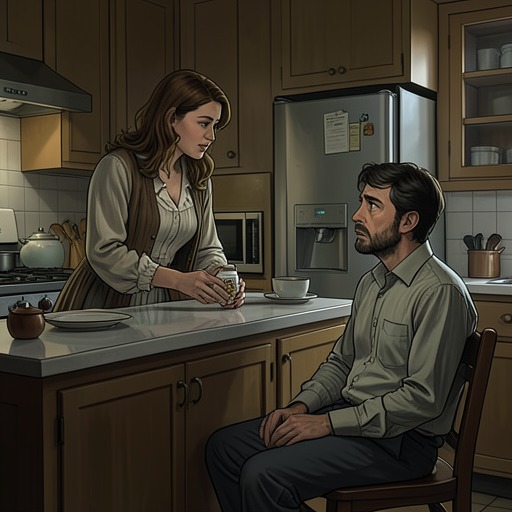
Stephen’s cognitive decline
The Thursday Murder ClubStephen’s cognitive decline alters the ordinary routines of his marriage to Elizabeth: people and memories become confused, everyday independence narrows, and Elizabeth takes on the work of managing his care. Yet his abilities do not vanish uniformly. He continues to write, plays chess with formidable skill, and can delight in a well-laid trap, so the condition emerges through uneven changes rather than a simple erasure of the person he has been.
Identity and Earlier Life
Stephen is an expert in Middle-Eastern Art, with a career that included living in Tehran and Beirut during the 1960s and 1970s. Years later he returned to the region to trace looted masterpieces for exiles in west London. This history establishes a life shaped by scholarship, travel, and sustained intellectual work, against which his later confinement to the home becomes especially marked.
He and Elizabeth met in 2004, when Stephen picked up a glove she had dropped outside a bookshop in Chipping Norton. They married six months later. His first wife, Emily, had died nearly twenty-five years before the events described here. Stephen’s memories of her remain active in his writing and conversation, but his ability to place those memories in time and relation has become uncertain.
Memory and Confusion
One revealing mistake occurs when Stephen worries about Emily as though she were his daughter and wishes she would visit more often. Elizabeth goes along with the conversation, even agreeing that she will speak to Emily. The mistake is not merely a failure to recall a name: Stephen has no children, and Emily was his deceased first wife. A shared domestic concern therefore opens onto a much larger rupture between his present understanding and the history Elizabeth knows.
The confusion is not confined to Emily. When Elizabeth enters the living room with Bogdan, Stephen’s way of identifying her prompts her to explain that he gets things wrong and to supply the name Marina instead. She repeats that name while trying to preserve the moment for him. The exchange shows the practical intimacy of her response: she does not correct him bluntly, but adjusts the conversation to meet his immediate understanding. It also makes clear that his confusion can affect how he recognizes the person closest to him.
Writing, Routine, and Care
Stephen still writes every day, sometimes for hours, and keeps his work locked away. Elizabeth reads it from time to time. Some pages reproduce the same newspaper passage repeatedly; others tell stories about Emily or are written for her, in handwriting Elizabeth regards as beautiful. The contrast is sharp: writing remains part of Stephen’s daily life, but the material he produces can circle around repetition or a past relationship whose place in the present has become confused.
His former intellectual routines have largely ended. There will be no more trips to London to meet his academic agent, see exhibitions, or consult the British Library. At home, ordinary activities have also become less dependable: Stephen does not cook or go to the shop, restaurant, or pool. Elizabeth knows the household will not burn down while she is away, but sometimes returns to signs of a poorly managed flood or urgent washing. These details give the decline a practical scale, extending it beyond memory into the management of daily life.
Elizabeth chooses to keep Stephen at home and to manage the situation herself for as long as she can. She understands that a fall or another serious sign of illness could bring him before a doctor who would recognize how much help he needs. In the meantime, she gives him medication, including temazepam ground into his tea. Her actions arise within a strained caregiving arrangement: she is trying to preserve their life together while also making decisions about his treatment and concealing the extent of his condition from outside scrutiny.
Retained Abilities and Change
Chess provides a counterpoint to the episodes of confusion. Elizabeth once played well enough to astonish the Russian chess grandmaster Yuri Tsetovich while she was watching over him in a safe house near the Polish–West German border. She has lost none of her skill, but Stephen still beats her, and she admires the elegance of his play. They play less often as his illness advances, leaving Elizabeth to wonder whether a familiar pleasure has reached its end. The question is not answered by the scene that follows: it shows that chess remains possible, even as its recurrence grows uncertain.
When Elizabeth later returns home, the open curtains in Stephen’s study alarm her because they are normally closed against the morning sun while he writes. She considers whether he has broken his routine, collapsed, or been visited by an intruder. Instead, she finds him playing chess with Bogdan. Stephen has just been checkmated and is delighted by the trap; he retraces the endgame while Bogdan and Elizabeth smile at him. The episode does not undo the evidence of decline, but it reveals a capacity for concentration and pleasure still present within it.
Bogdan has also repaired the study light, and Stephen speaks appreciatively of him. The visit brings an ordinary kindness into the household at a moment when Elizabeth expects trouble. Watching Stephen bent over the chessboard, absorbed in the position, she feels her love for him renewed. The scene holds both truths together: he sometimes misidentifies her, yet remains a husband whose skill and delight can make her fall in love with him again.
Narrative Significance
Stephen’s condition is presented through contrasts among memory, routine, and retained skill, not as a single decisive break. Emily can be misremembered as a daughter, Elizabeth’s name can become unstable, and writing can repeat itself; at the same time, Stephen continues to write, appreciates chess, and recognizes a clever defeat. These details resist treating cognitive decline as the disappearance of a person’s whole identity.
The account also places the burden of uncertainty on Elizabeth. She watches for changes, adapts her speech, manages medication, and tries to control when the outside world will see how much Stephen has changed. The opened curtains turn a small departure from routine into a possible warning, while the chess game that follows offers no cure or reversal—only a vivid instance of ability and connection persisting alongside dependence. His decline is therefore both a change in Stephen’s life and a pressure on the care, privacy, and shared history that sustain their marriage.