Stephen’s worsening illness
The Thursday Murder ClubStephen’s worsening illness is shown through the small, disorienting failures of memory that alter ordinary conversation, and through Elizabeth’s growing awareness that she is losing her husband gradually. The clearest early sign is his insistence that Emily, his daughter, should visit more often: Emily was his first wife, dead for nearly twenty-five years, and Stephen has no children. Later, Elizabeth describes his condition as increasingly poor, while a final domestic scene turns care into a series of restrained gestures rather than a cure or resolution.
Early Signs and the Emily Confusion
On the morning Elizabeth plans to go to London with Joyce, Stephen is deeply concerned about Emily, whom he believes is his daughter. He thinks she is becoming too thin and wishes she would visit more often so they could keep an eye on her. Elizabeth disagrees about Emily’s weight but accepts that a visit would be reasonable and says she will speak to her. The conversation proceeds as if Emily were alive and their daughter, making the mistake more than a misplaced name: Stephen has supplied her with a present-day condition and a reason to return.
The correction is stark. Emily was Stephen’s first wife, and she died almost twenty-five years earlier; Stephen has no children. The episode establishes the distance between the remembered person and the life Stephen believes he is describing. Its quiet domestic setting makes the lapse especially unsettling: Elizabeth is responding compassionately within the conversation before the facts reveal that its premise is impossible.
Two Different Early-Warning Systems
The novel places Stephen’s confusion near Elizabeth’s own anxiety about memory, but distinguishes their experiences. Elizabeth opens her diary to a date two weeks ahead, writes herself a question, and answers it two weeks later, using the routine as an early-warning system for changes in her recall. She has also tested herself with a number plate from a fortnight earlier and is pleased when she remembers it. These checks belong to Elizabeth, not Stephen; the contrast shows a household in which the possibility of cognitive change is monitored, but not in the same way by both partners.
Stephen’s episode is not presented as a diagnosis or explained medically. Instead, the remembered Emily enters an ordinary exchange with enough specificity—the concern about her weight, the wish for more visits—that Elizabeth initially answers the person Stephen seems to be talking about. The reader learns the truth only afterward, turning a familiar expression of concern into evidence of how far past and present have slipped together.
Elizabeth’s Awareness and Care
By the novel’s final scenes, Elizabeth says Stephen is not at all well and that she is trying her best while losing him bit by bit. Her words place the illness within the work of ongoing care: there is no single moment that accounts for the loss, only a gradual change Elizabeth must keep meeting. She confides this to Penny as part of acknowledging that she, too, has secrets, making Stephen’s decline something Elizabeth has largely carried privately.
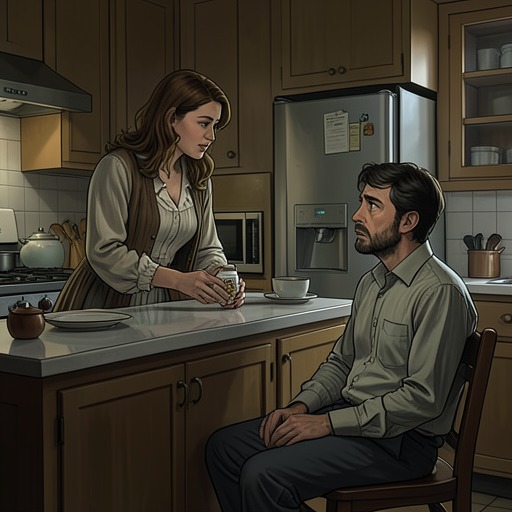
The closing scene gives that burden a physical shape without spelling out a medical explanation. In the kitchen, Elizabeth reaches for Stephen’s temazepam, then pauses and puts it back in the cupboard. She returns to him, takes his hand, and kisses him. Her remark that he should cut down on coffee is a modest, practical expression of concern; Stephen accepts her judgment. The gesture does not reverse his illness, but it shows their marriage continuing through attentiveness and trust.
Ending and Narrative Significance
Stephen sits with Bogdan and begins another game while Elizabeth turns back toward the kitchen. Neither man sees her tears. That final separation—Stephen absorbed in the game, Elizabeth privately grieving beside him—keeps the illness from becoming a public announcement or a neatly resolved plot point. The scene instead makes visible the unevenness of caregiving: Stephen remains present in the shared room, while Elizabeth is already mourning changes she feels happening within their life together.