The Coopers Chase cemetery blockade
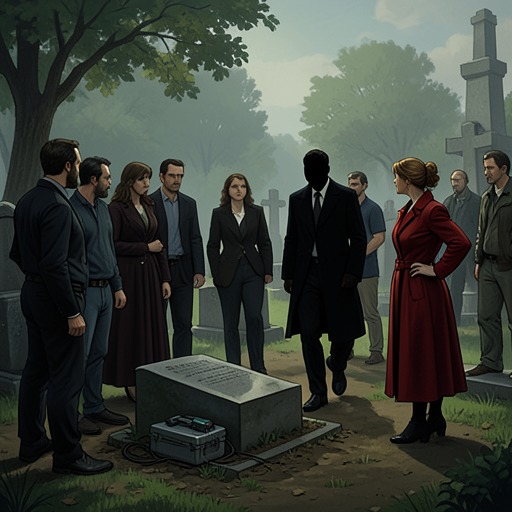
The Thursday Murder ClubThe Coopers Chase cemetery blockade is the residents’ improvised resistance to Ian Ventham’s attempt to begin excavation at the Garden of Eternal Rest. A predawn delivery of diggers becomes a village-wide confrontation: the cemetery’s gate is obstructed, the residents make their opposition visible, and Ventham’s claim to legal authority meets a community unwilling to let the work proceed without a fight. The immediate result is a halt to the machinery and Ventham’s retreat from the scene, though the blockade does not settle the cemetery’s future.
The predawn arrival and the alarm
The sequence begins at about six in the morning, when Ventham’s Range Rover turns off the road onto the track leading up to the Playfair farm. Edwin Ellidge, walking in the area, sees the vehicle but does not mistake it for the transport he is watching for. Around 6:20, the diggers pass him on a low-loader, nose to nose, as it slowly climbs the drive. Their destination is the Garden of Eternal Rest. At the entrance, Bogdan jumps down from the passenger seat and unbolts the heavy wooden gate so the load can continue along the narrow path.
The approach is meant to give the work an early start, but the village’s communications make secrecy impossible. By 6:21, word of two diggers coming up the drive has reached residents by phone; by 6:45 at the latest, the news has travelled across the village. The alarm moves through landlines rather than a messaging group: Ibrahim had tried to establish a WhatsApp group, but it had not caught on. Residents begin emerging and discussing what they can do. When Ventham returns down the hill at 7:30, he finds the village gathered outside. Karen Playfair is with him, on her way to give a breakfast lecture at Coopers Chase.
The gate becomes a barricade
Ron Ritchie intercepts Bogdan at the gate, asks what is happening, and points out that the gate leads only to the cemetery. Seeing a crowd assemble, he uses the moment to address it. Among those present are members of his circle, including Ibrahim with his swimming things, Joyce carrying a flask, and Elizabeth at the back beside Stephen, who has come out in a dressing gown. John is there too, still in his suit on his way to Willows. Ron notices him and feels guilty that he has not visited Penny in a long time, but remains frightened by the thought of what that visit means. The gathering is both a protest and a glimpse of the ordinary ties and anxieties that the sudden arrival has drawn into the open.
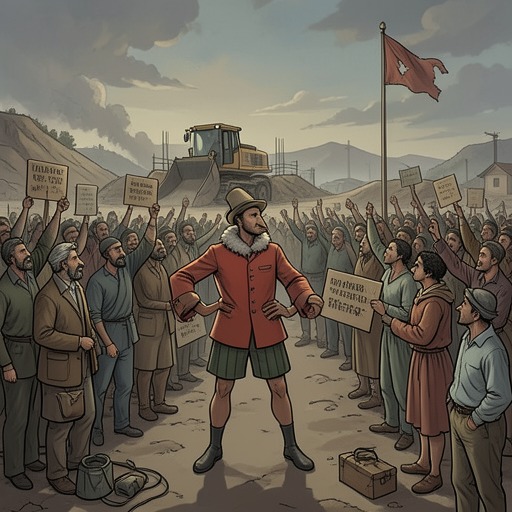
Ron briefly climbs onto a bar of the gate to speak, nearly loses his balance, and decides to return to solid ground. The gesture does not diminish the force of his appeal. He presents the residents as people with varied experience and capacities, from soldiers, teachers, and doctors to people who have crossed deserts, built rockets, or locked up killers. Colin Clemence adds insurance underwriters to the list, drawing happy applause. Ron’s point is that Ventham has not arrived among a helpless crowd: by sending the diggers in at half past six without warning or consultation, he has picked a fight.
The resistance takes physical form at the cemetery entrance. By the next chapter, twenty chairs stand in front of the gate, mostly sun loungers, with one dining chair included because of Miriam’s back. Trees crowd either side, leaving the gate as the only way up to the Garden of Eternal Rest. The arrangement is makeshift but effective: the route is occupied by residents, some stretched out in the morning sun and some taking the chance to nap, and the diggers cannot get through for a while. Ventham watches from his car while Karen stands outside vaping an apple-and-cinnamon e-cigarette.
The dispute over authority
Ventham answers Ron’s challenge by insisting that the dispute has already been decided. The residents, he says, made their objections and lost them; they had their consultation and their day in court. He argues that the land is his, that he has planned and is paying for the work, and that carrying it out will keep the service charge at its current reasonable level. His case is therefore not simply that the excavation is authorized: he frames it as an exercise of ownership and as a practical benefit to the residents. The protest contests the assumption that a legal victory and ownership end the community’s claim to the place.
Elizabeth is not at the barricade. After dropping Stephen at home, she takes a route through Blunts Wood and reaches the path to the Garden of Eternal Rest, where she sits on Bernard Cottle’s bench. The curve of the path hides the gathering below, though she can hear the disturbance. From this vantage, the public blockade is audible but out of sight. She waits there, and hears rustling in the trees before Bogdan emerges with a shovel over his shoulder. Her separate position at the cemetery’s approach places the blockade alongside another, quieter movement towards the same contested ground.
The confrontation and immediate outcome
The standoff grows more volatile when Ventham confronts Father Matthew Mackie. He advances on the priest, threatens to knock him out, and orders him off what he calls his property. Ventham shoves Mackie’s shoulder; Mackie reaches for balance and catches Ventham’s T-shirt, and the two men fall together. Donna, helped by a horrified Karen, pulls Ventham off the priest. Joyce, Ron, Bernard, and other residents restrain Ventham, while another group forms a guard around Mackie, who sits dazed on the ground. The blockade has become a physical confrontation, and the residents’ bodies now do what their chairs did: prevent the dispute from remaining an abstract argument about access and ownership.
Chris Hudson intervenes without making a public spectacle of the warning. He tells Ventham that Mackie stumbled after Ventham made contact with him, and that there may be witnesses if the matter goes to court. Chris makes clear that he could arrest Ventham for assaulting a priest, a charge that would not suit Ventham’s public image. He orders him to leave, and advises him to accept defeat for the day. Ventham protests that he did not touch Mackie, but eventually turns towards his car. As he passes the low-loader, he bangs twice on the cab door and signals the driver towards the exit.
The retreat is not a reconciliation or a final decision about the cemetery; it is the blockade’s immediate, limited success. Ventham still regards the residents’ action as a defeat he can reverse, and his thoughts turn to Bogdan and to what Tony Curran might do. At the Range Rover, he discovers that the car has been clamped. He becomes frightened and starts to cry, not wanting to go home. The abrupt shift from his threats and assertions of ownership to this private distress complicates the image of a man wholly in control, without undoing the coercive authority he has exercised at the gate.
The blockade’s force lies in that contrast. Ventham arrives with machinery, a vehicle, and the confidence of someone who believes the legal contest is finished; the residents answer with landline calls, chairs, and the collective occupation of a narrow path. Their action cannot erase the court ruling he invokes, but it interrupts the work and makes the burial ground’s value a visible matter of community rather than a line in a development plan. The cemetery remains contested when the scene ends.