The strength of the underestimated
The Thursday Murder ClubThe strength of the underestimated is the quiet power Joyce Meadowcroft finds in being treated as harmless and unimportant. At Coopers Chase, residents may notice the people with celebrated careers and forceful opinions, but Joyce understands how to work in the space their attention leaves open. Her modest self-presentation conceals neither a lack of judgment nor a lack of agency: she listens, intervenes when useful, and often helps resolve problems in ways that also benefit her. The concept rests on a telling reversal. Being overlooked makes it easier for Joyce to act.
How Joyce Is Seen
When Donna De Freitas asks Joyce for her story, Joyce presents her life as unremarkable: she was a nurse, then a mother, then a nurse again. Elizabeth immediately challenges that account, warning Donna not to mistake Joyce’s modesty for passivity and describing her as someone who gets things done. The exchange establishes the difference between Joyce’s public image and the ability her friend recognizes. Joyce does not claim special distinction; she calls herself organized and points to following through on ordinary commitments, such as going to Zumba when she has decided to go.
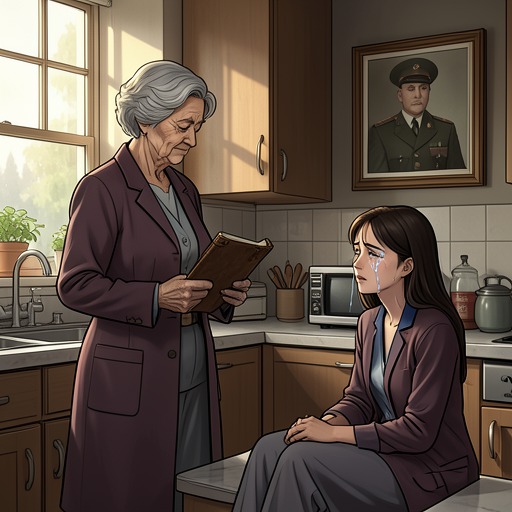
The impression of harmlessness is reinforced by the way Joyce is introduced: a small, white-haired woman in a lavender blouse and mauve cardigan, contentedly taking in the conversation, with bright, watchful eyes. The description joins quietness to alertness. She can appear to be simply observing while remaining attentive to what is happening around her. This makes underestimation more than a label applied by other people: it is a social position Joyce recognizes and can use.
Status and Invisibility at Coopers Chase
Joyce’s own account of the community makes clear why she expects to be overlooked. Coopers Chase contains residents known for notable achievements, while she sees herself as a nurse rather than a doctor. She also distinguishes her position from that of her daughter, Joanna, who runs a hedge fund and belongs, in Joyce’s eyes, among the accomplished and influential. Joanna bought Joyce’s flat at Coopers Chase, another detail that marks the difference Joyce perceives between her daughter’s standing and her own. Joyce describes herself as chatty and harmless, and believes the residents know she is not one of their celebrated company.
That hierarchy produces an irony central to the concept. The same residents who may not consider Joyce their equal depend on her when ordinary collective life becomes difficult. Her sense of being outside the group’s circle of distinction coexists with a practical intimacy with its problems. Joyce is not the person whose credentials command attention, but she is repeatedly the person who can help the community function. The text thus separates visibility from influence: the people most conspicuous in status or argument are not necessarily those most effective at resolving everyday trouble.
Mediation as Practical Power
Joyce gives concrete examples of the work that makes her useful. She steps in when the Catering Committee has a row, when the lake pumps cause a problem, and when one resident’s dog impregnates another’s and the resulting dispute escalates. These are different kinds of trouble, but each requires someone able to deal with competing claims rather than merely add another forceful opinion. Joyce lets residents grandstand, puff themselves up, and threaten legal action; she waits for the display of anger to subside before suggesting a route toward compromise.
Her method depends on the fact that other residents do not see her as a rival or a threat. They can calm down in her presence, and she can frame resolution in sensible, unthreatening terms. In the dog dispute, her reminder that dogs will be dogs helps make compromise possible. The outcome is not presented as a triumph over the community or as a dramatic assertion of authority. Instead, the problem is fixed, more often than not in a way that advantages Joyce as well. Her influence operates through intervention that appears modest enough to escape notice.
From Community Disputes to Investigation
Joyce sees the same quality as potentially useful beyond the residents’ everyday affairs. After watching Elizabeth at work on the investigation into Tony Curran’s killing, she hopes she can help Elizabeth catch the killer, perhaps in her own way. Joyce thinks her special skill is being overlooked or underestimated. She expects people to watch Elizabeth while she carries on quietly, as herself. The contrast does not make Joyce the public face of the investigation; it gives her a distinct position alongside her friend’s more visible activity.
The connection between dispute mediation and investigative usefulness is not that the tasks are identical. Rather, both make attention and perception important. Joyce has already described how she listens while others display their certainty, and how she waits until they have exhausted themselves before offering a way forward. She anticipates that being taken for gentle, chatty, and harmless may likewise allow her to contribute without being treated as a rival. The text supports her hope and her approach, rather than claiming that underestimation alone guarantees success.
The Meaning of Being Overlooked
Joyce’s account holds two truths together: being underestimated reflects a real status difference, and it can give her room to act. Her work at Coopers Chase is not merely a disguise for ambition; she presents herself as happy to listen and to settle disputes, while also noticing that the solutions often advantage her. That combination gives the concept its subtlety. Joyce can be generous in helping people reach a compromise without surrendering her own interests, and her neighbors’ failure to notice that advantage is part of how her influence works.
The strength involved is therefore neither loud authority nor a simple revelation that appearances deceive. Elizabeth sees Joyce’s effectiveness and names it; the residents’ routine dependence on her supplies the evidence. Joyce herself understands that people look elsewhere, and intends to let them do so while she continues in her own way. The overlooked person is not powerless merely because others misread her. In Joyce’s hands, low expectations create a practical opening: a chance to observe, steady a dispute, and shape an outcome without having to dominate the room.