Thursday Murder Club investigates Tony Curran’s murder
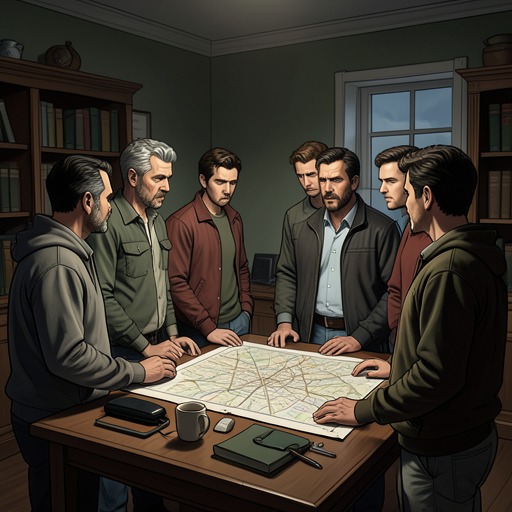
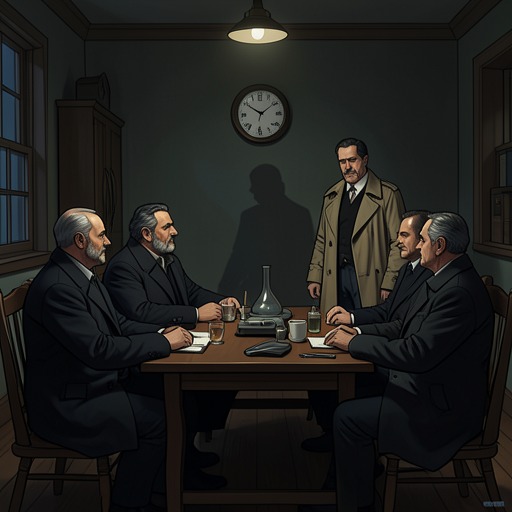
The Thursday Murder ClubThe Thursday Murder Club investigates Tony Curran’s murder by turning its members’ habits of inquiry toward a real, current killing. Elizabeth sets the club’s work in motion, enlisting Ibrahim Arif and Ron Ritchie and then asking Donna De Freitas to join the investigation. The case draws on more than new information: old police work, remembered failures, and Penny Gray’s copied files all become part of the club’s effort to make the past legible again.
A murder becomes the club’s case
Elizabeth brings Ibrahim a report of Tony Curran’s death: Curran was found in his kitchen by his wife, with fatal blunt-force injuries to his head. The information has travelled to her through a chain of intermediaries—Ron heard it from Jason Ritchie, who had heard it from a source not yet documented. That uncertain route matters. The club has a real corpse and a real killer to consider, but its first account is not a formal police briefing; it is informal intelligence that still needs to be tested.
Elizabeth gives Ibrahim a specific role alongside Ron and places him in charge of their task. The assignment immediately asks him to move beyond his accustomed routine of reviewing old case notes and seeing former clients. Ibrahim’s professional life has been shaped by responsibility and by the limits of what he could do for people; some clients still travel to Coopers Chase to consult him, while the memory of one man he could not save remains among the files he revisits. Against that reflective work, Tony’s death presents an urgent contrast: this is a current case, and the club may be able to act on it.
The first boundary Elizabeth asks Ibrahim to cross is explicit in substance: she needs him to lie to a senior police officer. Ibrahim accepts her confidence in him, and she answers by affirming that he has never let her down and is also valued for making good tea. The exchange gives the investigation a distinctive working arrangement. It depends not only on collecting facts but on trust within the club—and on a readiness to mislead an official when Elizabeth believes that doing so will help their inquiry.
Old violence and the limits of justice
The investigation’s frame includes an earlier case that Elizabeth discusses with Joyce. Over lunch, Elizabeth asks Joyce to consider what could be inferred from a girl’s knife wounds, using a manila folder containing typed pages and what appear to be old photographs. Elizabeth keeps the conversation measured because other residents are eating. The scene makes the club’s investigative method concrete: a past crime is approached through records and physical evidence, discussed carefully, and treated as a problem whose details may still matter long after the original investigation.
The earlier case had been familiar to Penny Gray’s squad. The girl’s boyfriend ran from Penny’s squad car while being taken to a police interview and was never seen again; he had also assaulted Penny. The account leaves no suggestion that the club can simply repair the case’s failure. Joyce recognizes that even if the boyfriend had not escaped, he might still have avoided punishment, reflecting how difficult it had been to secure justice in that period. Penny and Elizabeth had solved cases to their own satisfaction, but that private resolution was not the same as bringing an offender to justice through official channels.
That distinction sharpens the stakes of the Tony Curran inquiry. The club’s members have experience, memory, and access to old material, but they do not possess the authority or certainty of a police murder squad. Their investigation is therefore both practical and morally uneasy: they want to discover what happened, yet their methods may require concealment, and knowledge does not guarantee a public reckoning.
Bringing Donna De Freitas into the inquiry
Elizabeth approaches Donna in Interview Suite B, a windowless room with a bolted wooden table, after an earlier encounter in which Elizabeth had posed as a nun whose bag had been stolen. Donna is unimpressed by the performance and insists that Elizabeth get to the point. Elizabeth then asks whether Donna would like to investigate Tony Curran’s murder.
Donna’s hesitation is rooted in her position within the police. A qualified murder squad is already investigating the case, and she has recently been reduced to delivering tea to its members; she doubts there is a place for a constable who is usually assigned photocopying. She also challenges Elizabeth’s understanding of police procedure. The scene makes recruitment a negotiation rather than an easy enlistment: Donna must weigh her ambition to investigate against the institutional hierarchy and the limited role she has been given. Elizabeth’s invitation expands the club’s reach, but Donna’s response keeps the limits of that reach in view.
Files, deaths, and the return of the past
Later, Elizabeth explains to John Gray that Penny kept files in storage and made copies of her old case records, despite not being supposed to retain them. Joyce recognizes the possibility that those copies could help catch a killer many years later. After Karen Playfair recognizes John, Elizabeth has reason to check one final detail in a file. The passage links the club’s present investigation to a specific inheritance of unofficial police work: Penny’s habit of preserving records means that cases once thought closed or inaccessible can be examined again.
The inquiry’s wider narrative is also punctuated by Ian Ventham’s death. In a brief, abrupt sequence, Ventham stumbles backward, reaches for something to hold, and dies before he hits the ground. The account establishes the death but does not, in this passage, explain its cause or connect it directly to the evidence concerning Tony Curran. Its placement nevertheless underscores that the club’s investigation unfolds in a story where another death interrupts the pursuit of answers.
The investigation’s narrative role
The club’s inquiry moves between present-tense urgency and older records: Tony’s death is relayed through informal contacts, while Elizabeth’s discussion with Joyce and the later use of Penny’s files open a longer view of unresolved crime. The shift in scale is important. The investigation is not presented as a clean sequence in which each new clue immediately produces justice; instead, the club works with incomplete information, past failures, institutional obstacles, and records kept outside proper procedure.
These scenes also define the club through action. Elizabeth assigns work, tests the willingness of her friends to take risks, and seeks help beyond the group. Ibrahim accepts responsibility; Donna must decide whether to step beyond the duties allotted to her; and Joyce participates in re-examining evidence from a case whose official outcome was unsatisfactory. The investigation’s significance lies in that collective method: people underestimated or sidelined by formal structures use trust, memory, and preserved evidence to keep asking questions, even when the route from solving a case to securing justice remains uncertain.