Tony Curran’s murder
The Thursday Murder ClubTony Curran’s murder is the violent hinge between a business betrayal and the Thursday Murder Club’s first active investigation of a real killing. Curran is struck at home with a spanner after Ian Ventham has cut him out of a lucrative development deal. The scene leaves a photograph beside his body, while the investigation turns to the dispute, the timing of the decision, and people whose movements make them look suspicious.
Causes and Background
Curran and Ventham had been partners in The Woodlands development. The original arrangement allocated seventy-five per cent to Ventham and twenty-five per cent to Curran, but Ventham changed the terms and excluded his partner entirely. The loss was substantial: Elizabeth tells Donna De Freitas that Curran had expected to receive millions from the project. The development’s next phase, Hillcrest, promised an even larger conflict, according to the club’s expert.
The timing makes the exclusion especially consequential. Ventham signed the papers removing Curran from the deal before a consultation meeting; the meeting was followed by a mysterious row, and the account of the investigation places the murder immediately after that sequence. Curran had received the news of his exclusion on the day he was killed. To the investigators, the lost payday gives him a reason to threaten Ventham and gives Ventham a possible reason to fear retaliation. Donna raises the possibility that Ventham struck first, but this remains a theory rather than a conclusion established in the evidence here.
Before the attack, Curran considers waiting: nothing needs to happen that night, and he can let Ventham believe he has won before acting. The narration thus establishes that Curran has his own plan, but does not equate that plan with the murder that follows. The distinction matters: the business dispute supplies a plausible field of motive, not a proven answer to who killed him.
The Attack at Home
Curran is in his kitchen when he hears a noise too late to avoid the approaching spanner. The blow strikes his left temple, and he falls onto the marble floor. The birds in the garden briefly stop singing and then continue; the narration’s small pause sets the ordinary life outside against the sudden finality inside. Curran dies at the scene.
After the attack, the killer places a photograph on the worktop beside the walnut kitchen island. The image is not explained at this point, but its deliberate placement turns an otherwise private killing into a scene containing a conspicuous clue. The contrast between the domestic kitchen, the carefully placed photograph, and the blunt-force attack gives the investigators more than a corpse to explain: they must also determine why the photograph was left there and whom it implicates.
Discovery and Investigation
Curran’s wife finds him at home. News of his death reaches Ibrahim Arif through a chain of informal contacts: Elizabeth has heard from Ron Ritchie, who heard from Jason Ritchie, who heard from a source not yet documented. The early report identifies the essential facts as a death in the kitchen and blunt-force trauma to the head. Elizabeth then asks Ibrahim to take charge of a task involving Ron and to lie to a senior police officer, signalling that the club is prepared to work outside ordinary investigative rules as it pursues the case.
For Ibrahim, the case marks a break from the old files and private consultations that usually fill his morning. He understands that this is not an exercise in reviewing an unsolved historical case: there is a current victim and a killer somewhere beyond the club. The murder therefore gives the Thursday Murder Club a practical purpose, while Elizabeth’s request makes clear that its members’ inquiry may involve deliberate concealment from the police.
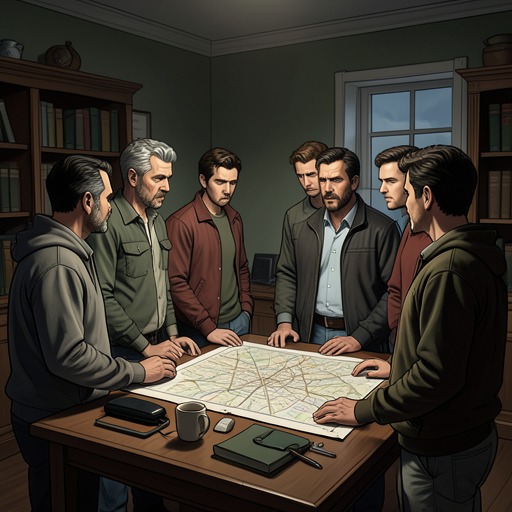
The financial documents sharpen the investigators’ reconstruction. Elizabeth directs Donna to the appendix explaining the original division of The Woodlands, then prompts her to ask when Ventham changed the arrangement. The answer links the signed papers to the consultation, the row, and the killing; the projected loss of millions gives the dispute a concrete stake. Donna’s suggested theory—that Curran threatened Ventham and Ventham retaliated—emerges from that chronology, but the evidence does not establish it as the solution.
A photograph also draws suspicion toward Jason. He acknowledges that police have a picture of him left by the body, as well as other evidence. He denies killing Curran, while telling Ron that he would admit it if he had done so and that Ron would understand there had been a reason. Ron asks whether Jason can prove his innocence. Later, Jason explains why the circumstances look incriminating: he had been to Curran’s home on the day of the death, received a photograph that morning, and learned through a WhatsApp group that Curran had been found dead that afternoon. He also knows that police have records of his call to Curran’s phone. The timing and scene photograph make suspicion understandable without establishing guilt.
Aftermath and Narrative Significance
Elizabeth eventually gives Chris Hudson and Donna the file assembled for the investigation. Joyce’s diary records that Joanna’s name has been left out of it, which Elizabeth says helps preserve plausible deniability if the club’s methods have crossed legal boundaries. This episode shows the group’s private inquiry moving into contact with the police, even as its members take precautions to conceal their involvement. Later, Elizabeth’s attention returns to Penny Gray’s stored files of old cases, which provide material for pursuing a killer many years after the earlier crimes; the murder of Curran belongs to a wider pattern of present investigations converging with unresolved pasts.
The event’s structure keeps motive, action, and proof distinct. The reader sees Curran’s death before the investigation can explain it, then encounters business records and testimony that generate competing possibilities. Ventham’s betrayal establishes a motive for conflict; the scene photograph and Jason’s movements supply grounds for suspicion; neither, by itself, identifies the killer. The murder matters both as a death in its own right and as the case that tests whether the club’s informal methods can turn fragments of timing, paperwork, and personal testimony into a defensible account of what happened.