Battle with the British cruiser at Labuan
The Tigers of MompracemThe Battle with the British cruiser at Labuan is a two-stage naval confrontation in which Sandokan’s small pirate fleet contests a British warship far larger and more heavily armed. The first exchange gives the pirates a chance to withdraw and repair their damaged vessel; the second turns their attempted escape into a desperate assault that ends with Sandokan diving into the sea as his ship is overwhelmed. The encounter sets the Tigers of Mompracem’s audacity against the British presence established to suppress piracy, while making the limits of courage and ingenuity visible in the material disparity between their ships.
Background and Forces
Labuan was a British foothold in waters where piracy had become a military and political concern. In 1847, the British occupied the island under orders to eradicate piracy. Its population was about a thousand, mostly Malays, alongside a European community of roughly two hundred. A recently built stronghold, Victoria Citadel, had large bastions intended to protect the island from the pirates of Mompracem, whose earlier raids had devastated the coast. The cruiser that blocks the river mouth thus represents more than an unexpected obstacle: it is part of a British effort to establish control over waters the pirates have long traversed.
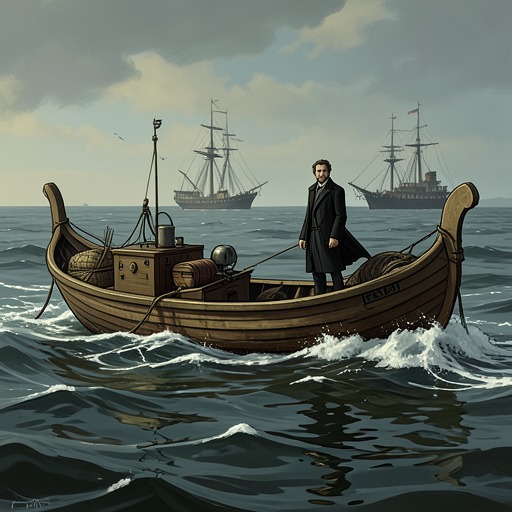
Sandokan and Yanez’s vessels were not ordinary prahus. Their narrow hulls and immense sails let them travel quickly; with a good southwest wind, the two ships reached more than twelve knots on the approach. The captains had modified their craft for speed and combat, retaining sails nearly forty metres long while strengthening the bows, adding bridges and spaces for oars, and removing features that could impede boarding. These changes offered maneuverability and made the ships useful for raids, but could not erase the difference between light wooden vessels and a heavily armed cruiser.
The two prahus sailed along Labuan’s coast and up a small, vegetation-lined river, anchoring beneath enormous trees where they would be hidden from cruisers patrolling offshore. When the crews later returned aboard and reefed the sails, Giro-Batol reported that the cruiser was blocking the river mouth. Sandokan chose to meet it at sea rather than remain trapped upriver. The crews answered his call to action with a unified show of confidence, even as the enemy’s size made the risks plain.
First Engagement and Withdrawal
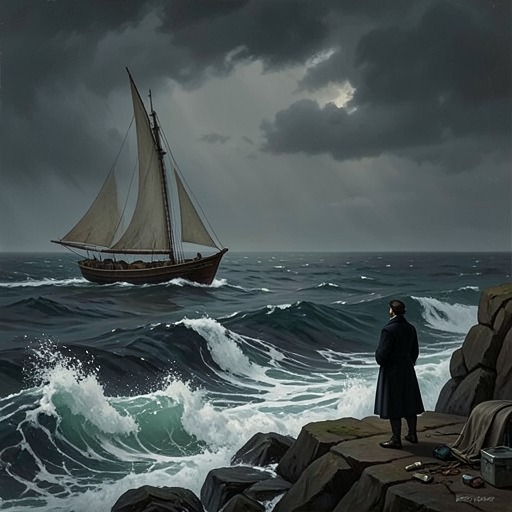
The cruiser, a vessel of fifteen hundred tons, patrolled about six hundred metres from the coast and barred the pirates’ westward route. Sandokan studied its size and armament; its crew was four times larger than his own. He ordered his men to the oars while the gunners prepared their weapons. Patan, one of the pirates’ most capable cannoneers, fired first. His shot struck the enemy bridge’s gangway and broke its flagpole. The cruiser then turned to bring its port-side gun ports to bear.
The British ship’s return fire soon battered both prahus. Sandokan ordered barricades built in front of the cannons, using spare masts, old cannon parts, barrels of cannonballs, and other wreckage. Twenty of the strongest men went below to row; the others took cover behind the improvised barriers, ready to continue firing. The choice combined protection with forward movement: the pirates meant to keep advancing, not simply endure the cruiser’s attack.
For about twenty minutes the two sides exchanged fire. The prahus were riddled with holes, their sails torn and their holds taking on water, yet their crews persisted in trying to reach the enemy’s bridge. Patan died at his cannon, and another gunner took his place. Giro-Batol’s vessel was also badly damaged, with its cannon disabled and its firelock close to failing. The cruiser eventually moved another six hundred metres away to avoid being boarded. Sandokan then reloaded a cannon himself, corrected its aim, and brought down the cruiser’s mainmast. As the British crew turned to rescue men in the water, the pirates used the pause to gather aboard Sandokan’s prahu.
Giro-Batol’s ship, which had been kept afloat despite its damage, was evacuated and abandoned. The pirates rowed for a nearby river and grounded their own waterlogged vessel on a sandbank. They had escaped immediate destruction, but not the consequences of the exchange: their ship was close to sinking, and the cruiser remained in the area. Their withdrawal was a tactical reprieve, not a victory that had ended the encounter.
Repairs and the Attempt to Break Out
The British commander did not send launches into the bay during the four hours the pirates spent repairing their prahu. Knowing he faced the Tigers of Mompracem, he avoided a land engagement and instead waited, expecting that the pirates might surrender or be driven back toward the coast if they tried to move. The pause therefore held two opposing strategies in balance: the cruiser relied on its command of the surrounding waters, while the pirates used the shelter and time available to restore their ship.
The work was rapid and practical. The crew raised two new masts, reinforced the bulwarks, sealed the holes, and repaired the rigging. They also built fresh barricades from tree trunks to protect the cannons and firelocks. By ten o’clock the prahu could sail and fight again. Toward eleven, after the sentries reported no launches patrolling the bay, Sandokan prepared to leave.
Darkness offered concealment, but made navigation difficult. The moon had not risen, and storm clouds obscured the stars; shadows under durian and palm trees and banana leaves limited Sandokan’s view of the riverbanks. The river itself was quiet as the prahu moved toward its mouth, until the vessel slowed and stopped just short of reaching open water. The precise cause of the stoppage is not established in the account, but the delay left the crew exposed to the possibility that the cruiser would discover them. When sparks appeared at the warship’s smokestack and a call for battle stations rang out, the pirates manned their weapons again.
Second Engagement and Outcome
Sandokan understood that the coming fight was unlikely to favor his side, but led the prahu toward the cruiser rather than turn away. He intended to storm the enemy deck. The cruiser advanced under power, while both vessels opened fire. The contrast in scale was stark: the prahu was a small wooden craft facing an iron warship whose size and armament gave it a decisive advantage in a direct collision. Still, the pirates fired rapidly, targeting the cruiser’s gunners and sailors on the rigging.
The renewed barrage soon left the prahu barely afloat. Its masts had fallen, its bulwarks had given way, and water was flooding the hold. Sabau’s weapon was destroyed, and half the crew had been killed. The surviving pirates nevertheless refused to surrender. As their ship became less able to shelter them, boarding remained their chosen chance to reach the enemy and continue the fight at close quarters.
With twelve pirates regrouped, Sandokan steered away from the cruiser’s attempted ramming course at the last moment, then turned toward its port wheel. The collision left his own vessel listing and filling with water. The surviving pirates boarded the cruiser and briefly held their position, but the larger crew surrounded them. Sandokan and four others tried to make their way back toward the bow; halfway along the deck, a bullet struck Sandokan in the chest. He rose and continued resisting, then reached the port bulwark and dived into the dark sea. The account ends with his disappearance beneath the waves, leaving his fate unresolved.
Significance
The battle’s repeated pattern—concealment, attack, withdrawal, repair, and renewed attack—shows how the river and the prahu’s design shape what the pirates can attempt. The first withdrawal succeeds because Sandokan exploits a brief interruption in the cruiser’s action; the second attempt fails as the warship’s greater firepower and crew close off escape. Repairs and tactical improvisation restore the prahu’s capacity to fight, but cannot remove the underlying imbalance.
The encounter also places two competing claims to force in the same stretch of water. Britain’s citadel and cruiser embody an organized campaign to suppress piracy; Sandokan’s fortified home, modified ships, and commands sustain a rival armed presence. The story does not make those capacities equal. Instead, the pirates’ refusal to yield gives their resistance dramatic force even as the material outcome turns against them. Sandokan’s final dive makes the battle’s conclusion both a defeat and an unresolved disappearance: the ship is lost, but the captain’s fate is not confirmed.