British cruiser at Labuan
The Tigers of MompracemThe British cruiser at Labuan is the principal British warship opposing Sandokan’s prahus in the coastal encounters described in the narrative. It represents the reach of Britain’s anti-piracy campaign: a large, heavily armed vessel able to patrol the coast and obstruct a river mouth. Yet it does not simply dictate the action. The narrow waterways, darkness, and pirates’ adaptations of their own ships repeatedly shape what the cruiser can control and how Sandokan answers its threat.
Setting and British presence
The cruiser’s role belongs to a broader effort to establish British control around Labuan. The island had been occupied in 1847 by order of the British Government, which sought to eradicate piracy in the surrounding waters. Its population was about a thousand, mostly Malay, alongside a European community of roughly two hundred. The British had recently built Victoria Citadel, with large bastions intended to protect the island from raids by the pirates of Mompracem, whose earlier attacks had devastated the coast.
The narrative sets this military presence against a pirate stronghold of its own. Mompracem is described as a base defended by trenches, ramparts, and embankments, with a red flag bearing a tiger’s head above a large hut. Sandokan’s anger at British activity in Labuan makes the conflict explicit: the cruiser is not merely a ship encountered at sea, but part of a force trying to constrain the pirates and their home territory. In this setting, armed vessels and fortified positions are competing means of exercising power over coastal space.
The sea and river approaches give that contest a practical geography. The two pirate prahus travel along Labuan’s coast before entering a small, vegetation-lined river. They proceed six or seven hundred metres upstream and anchor beneath enormous trees, where they are hidden from cruisers patrolling offshore. The concealment offers temporary protection, but the river also creates a bottleneck: a cruiser stationed at its mouth can block the way back to open water.
The cruiser blocks the river
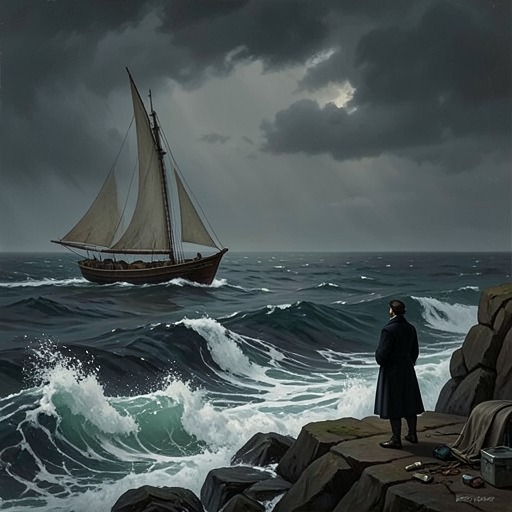
When the pirates return toward the river entrance, Giro-Batol reports that a cruiser is blocking it. The warship is about six hundred metres from the coast, patrolling slowly and barring the westward route. At fifteen hundred tons, it is a formidable opponent; Sandokan estimates its crew at four times the number of his own men. Shouted commands and drums signal that the British crew is preparing to fight.
The disparity in force is sharpened by the different designs of the vessels. Sandokan and Yanez have modified their Malay ships to make them faster and more powerful than ordinary prahus. Their long sails, elastic masts, and rigging of gamuti and rattan combine with a faster keel and reinforced bow. Bridges and openings for oars support movement and combat, while the removal of an outrigger and one rudder makes boarding raids less difficult. Against the cruiser’s size and armament, these changes offer mobility and tactical options rather than equal firepower.
During the first clash, Sandokan fires a cannon that brings down the cruiser’s mainmast. The British ship stops firing while its crew attends to men in danger, creating a brief opening. Sandokan uses that pause to gather Giro-Batol and the remaining men aboard his own prahu. Giro-Batol’s damaged ship is abandoned, and the pirates row into the nearby river. The cruiser’s advantage at the entrance has forced a costly retreat, but the river’s shelter allows the surviving prahu to escape immediate capture.
A renewed confrontation
The threat returns as Sandokan steers toward the river mouth at night. The moon has not risen, storm clouds obscure the stars, and the trees and broad leaves along the banks make it difficult to watch the shore. The quiet river passage ends when the prahu slows and stops. Later, sparks from the cruiser’s smokestack reveal that its engines are being stoked; a call to battle stations confirms that the danger has not passed.
Sandokan responds by turning the prahu toward the warship rather than abandoning the attempt to confront it. His crew trims the sails, and both sides open fire as the pirate vessel advances. Although the cruiser is vastly larger, the prahu attacks and continues firing. The exchange demonstrates the limits as well as the force of the cruiser’s position: it can menace the river exit, but its presence also gives Sandokan a specific target around which to organize a desperate counterattack.
Boarding and unresolved outcome
As the pirate ship takes on water, Sandokan orders grappling hooks launched. Two hooks catch in the cruiser’s ratlines, enabling thirteen pirates to climb up and reach the deck before the British can stop them. The boarding action turns the encounter from an exchange between ships into close combat aboard the warship. Sandokan leads his men forward, and the pirates press toward the stern.
The narrative does not provide the cruiser’s eventual fate. Sandokan is struck during the advance, but reaches the port bulwark and dives into the sea; the passage ends with him disappearing beneath the dark water. The British ship has been boarded, yet no result for the vessel itself is established in the account. That unfinished ending preserves the encounter’s central tension: the cruiser embodies organized imperial force, while Sandokan’s mobility and willingness to attack it keep that force from producing a simple, settled victory.