Ferocity and generosity side by side
The Tigers of MompracemFerocity and generosity side by side is a defining tension in Sandokan’s characterization: the same pirate who wages a fierce campaign against European power also protects vulnerable people, rescues strangers, and compensates a defeated adversary. The contrast is not merely between words and deeds. Yanez recalls a pattern of generous actions, while Sandokan’s own response after destroying a junk turns respect for an opponent into a concrete gift. His conduct makes vengeance and compassion concurrent parts of his identity rather than successive stages in a simple conversion.
Roots of the contrast
Sandokan explains his hostility toward Europeans through a history of political and personal loss. He says they conspired to take his throne because they considered him too powerful, and that they killed members of his family and the people he loved. In his account, he had not threatened them before they moved against him; his campaign of revenge is therefore presented as a response to an injury he regards as fundamental. He describes his vow as one made over his family’s bodies, a pledge he will not break. The scale of his declared retaliation is severe, encompassing Spanish, Dutch, British, and Portuguese Europeans rather than a single personal enemy.
Yanez places that explanation beside the consequences of Sandokan’s violence. He reminds his friend that years of raids have left traces along coasts, villages, towns, and European forts, and that ships sunk by the pirates lie at the bottom of the sea. The account does not erase the destruction or ask the reader to treat Sandokan’s revenge as harmless. Instead, the history of his grievance and the reach of his attacks occupy the same moral field: Sandokan sees himself as answering injury, while his methods have inflicted damage on a wide scale.
Mercy beyond the pirate cause
Yanez’s counter-evidence is specific. He says Sandokan has defended poor tribes against enemy raids, placing his force between exposed communities and their attackers. These rescues are not simply gifts to his own followers or allies; Yanez invokes people whose vulnerability, rather than political usefulness, explains why they needed protection. Such episodes qualify the image of the indiscriminate raider without cancelling the record of his raids.
Yanez also recalls captive women whom Sandokan sent back to enemy ports. The act required him to take the risk of interception by British cruisers, so his generosity is represented as something more than an easy display of wealth. He accepted danger to return people held in his power to ports belonging to his enemies. In Yanez’s account, Sandokan’s conduct toward captives sharply contrasts with his treatment of armed opponents: hostility to European forces does not prevent him from sparing those who have fallen into his hands.
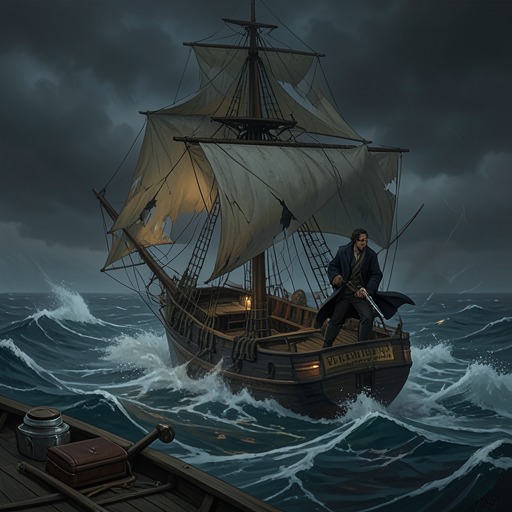
The same pattern appears in his treatment of shipwreck survivors. Yanez says Sandokan rescued people clinging to wreckage in terrible storms and gave them riches afterward. Rescue and reward are distinct parts of the remembered generosity: Sandokan first saves strangers in peril, then sends them away with wealth. Yanez argues that hundreds or thousands could remember such gifts. His testimony gives the concept a public dimension, presenting Sandokan’s kindness not as a secret exception known only to his closest companion, but as a reputation sustained by many beneficiaries.
Respect for a defeated opponent
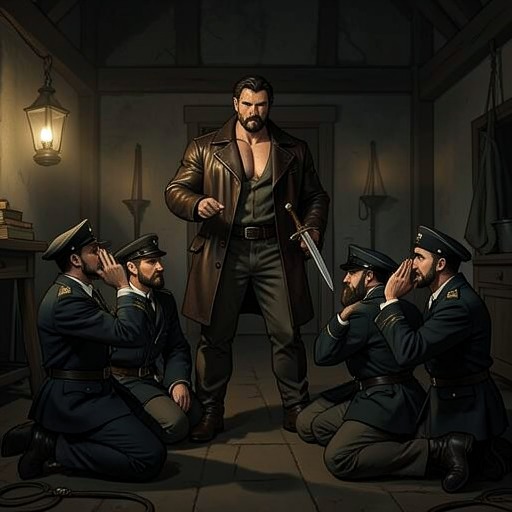
Sandokan’s encounter with the captain of a junk brings that principle into the immediate action of the story. After the vessel has been destroyed, he acknowledges the captain’s courage and the worth of his men. He then tears a string of diamonds from his own neck and offers it to the captain, regretting the loss of the ship and explaining that the jewels could pay for ten replacements. The gift is therefore both personal and practical: it is a costly transfer of wealth, explicitly connected to repairing the damage Sandokan has caused.
The moment does not make the captain a friend or end the conflict. Sandokan asks where the junk is headed; when told Sarawak, he instructs the captain to carry a future challenge to the ruler whose ships he expects to meet there. The challenge preserves the threat of further combat, while the diamonds recognize the captain as a brave adversary. Sandokan can intend another confrontation and still treat the person he has just defeated with respect. The scene makes the coexistence in the concept unusually tangible: a destroyed ship, a promised contest, an expression of regret, and a gift large enough to replace the vessel all belong to the same encounter.
Vengeance, loyalty, and command
This generosity does not soften Sandokan’s readiness to fight. When Yanez warns that England has set its sights on Mompracem and reports seeing the British cruiser at Labuan moving through their waters armed and manned, Sandokan answers with defiance. Yanez has also cautioned him against recklessness if he enters Labuan, the territory of his bitterest enemies. The exchange makes clear that Sandokan’s affection for his friend does not displace his commitment to confrontation; Yanez urges restraint precisely because he knows how readily Sandokan risks himself.
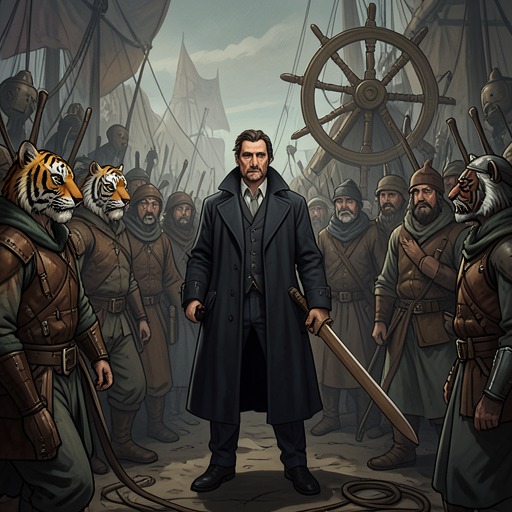
In the later battle, the two pirate ships face a larger and better-armed opponent but refuse to yield. Sandokan urges his men to continue, and they seek to reach the enemy’s deck even if they cannot win. This is the ferocious side of his leadership: he stands among the fighters and sustains their attack under overwhelming pressure. The episode also sets his generosity toward particular people against the organized violence of battle. His respect for a brave captain does not amount to pacifism, and his willingness to compensate one defeated enemy does not dissolve the conflict between his forces and European power.
Narrative significance
Yanez is essential to how the text establishes this dual nature. The friends greet one another as brothers, and their conversation permits Yanez to challenge Sandokan’s self-understanding without denying his loyalty. Sandokan wonders whether anyone might remember him as generous; Yanez answers with examples and with the scale of those who, he says, could testify. The contrast is thus developed through both self-assessment and a companion’s correction: Sandokan speaks from the wound that sustains his vengeance, while Yanez recalls the people who have benefited from his mercy.
The result is a character whose violence cannot be reduced to cruelty and whose generosity cannot be mistaken for renunciation of revenge. His protection of poor tribes, return of captives, rescue of survivors, and compensation of the junk’s captain coexist with raids, threats, and refusal to retreat. Those acts make the Tiger of Malaysia morally more complex than the single identity of pirate or avenger would allow. They do not settle whether his cause justifies every consequence; instead, they insist that his capacity for fierce resistance and costly kindness must be understood together.