Giro-Batol
The Tigers of MompracemGiro-Batol is a Javanese commander in Sandokan’s pirate force, entrusted with men and a prahu during an operation that turns from pursuit into an encounter with a British cruiser. His role is defined less by private history than by the practical responsibilities the narrative gives him: he leads a vessel, carries out Sandokan’s orders, reports the danger at the river mouth, and helps his crew leave their damaged ship. Through him, the episode shows how the pirates’ coordinated plans meet the greater firepower of Britain’s naval presence near Labuan.
Identity and Position
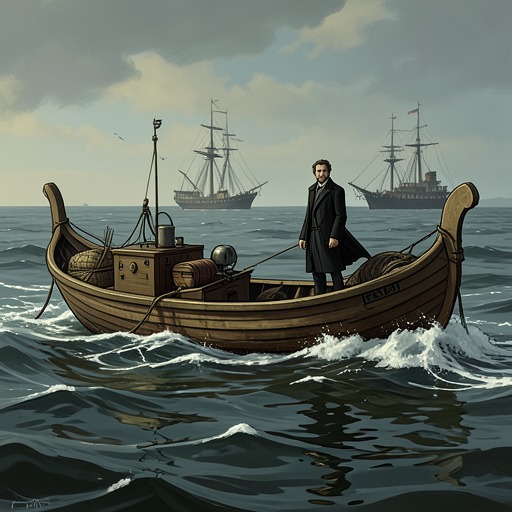
The narrative identifies Giro-Batol as Javanese and places him among the pirates of Mompracem. Sandokan assigns half of the available warriors to him and orders them to board the two prahus. The episode thereby establishes him as a field commander, responsible for a group of men within an operation directed by Sandokan. It does not provide further personal background or describe how Giro-Batol came to hold that position.
His command has a concrete place in the force’s organization. When a ship is sighted, Sandokan looks toward the vessel under Giro-Batol’s command before ordering battle stations. Later, as the target tries to escape, Sandokan directs Giro-Batol to cut off its route. These moments present him as a commander whose vessel is part of the plan, while making clear that the strategic decisions and orders come from Sandokan.
Assignment and Pursuit
The operation begins with the two prahus leaving Mompracem and searching the sea for a merchant ship. The morning passes without a visible vessel, and impatience spreads among the crews. After a lookout reports a ship to leeward, Sandokan orders the pirates to prepare for battle. The first sighting does not immediately settle the encounter: the prahus increase their speed, and the merchant vessel eventually spots them and tries to escape.
Sandokan responds by ordering Giro-Batol to cut off that escape. The two prahus then separate and approach the merchant ship from opposite sides. Their coordinated movement turns Giro-Batol’s assigned role into an element of the interception, rather than a separate action undertaken on his own initiative. The merchant vessel, unable to outrun its pursuers, stops and raises a large flag. The evidence establishes Giro-Batol’s part in the pursuit and the orders governing it, but does not specify any individual action by him during the merchant crew’s response.
The Labuan Approach
After the encounter with the merchant vessel, the two prahus sail toward Labuan. The island is described as a recently occupied British possession, taken in 1847 as part of a campaign to eradicate piracy in those waters. Its population is mostly Malay, with a smaller European community. This context places Giro-Batol’s voyage within a conflict that involves more than a single ship: Britain has established a presence on an island near the pirates’ base and is organizing its defenses against them.
The British have built a citadel named for Queen Victoria, with large bastions intended to protect the island from raids by the pirates of Mompracem. The prahus do not approach those defenses directly. They travel along the coast, enter a small river, and anchor several hundred metres upstream beneath large trees, where they are concealed from cruisers patrolling the coast. Sandokan sends men to watch the forest and the river mouth. This hidden approach gives way to a confrontation when the pirates return to the vessels and Giro-Batol reports that a cruiser is blocking their exit.
Battle and Withdrawal
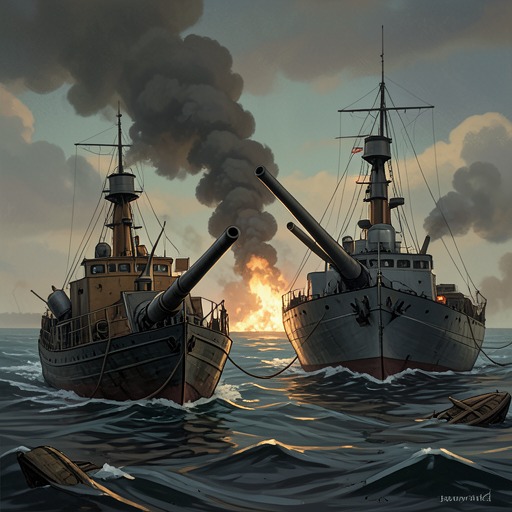
Giro-Batol’s report identifies the immediate danger: a British cruiser has taken position at the mouth of the river. Sandokan answers by preparing to meet it at sea, and the two crews respond with enthusiasm. As the prahus descend the river, the scale of the opposing force becomes clear. The cruiser is a large, heavily armed vessel of fifteen hundred tons, patrolling about six hundred metres from the coast, with a crew four times the size of the pirates’ combined force.
The battle leaves Giro-Batol’s ship in a precarious state. Sandokan fires a cannon that brings down the cruiser’s mainmast, interrupting its fire while its crew attempts to rescue men from the water. Sandokan uses this pause to order Giro-Batol and the remaining men to gather their weapons and board Sandokan’s prahu. Giro-Batol’s vessel, which has remained afloat only with difficulty, is evacuated and abandoned. The pirates row away and take shelter in the nearby river. The account thus ends this phase not with a victory over the cruiser, but with an organized retreat that saves the men by giving up their damaged ship.
Narrative Role
Giro-Batol’s actions trace the operational arc of the episode: assignment, pursuit, warning, and withdrawal. He is shown acting within Sandokan’s command structure, first leading an assigned group and vessel, then receiving a direct order during the interception, and finally reporting the cruiser’s position. The narration does not give him an independent strategy or an expressed personal view of the conflict; its focus is on his usefulness as a commander in a force that depends on coordinated movement and timely information.
His final appearance also connects the pirates’ earlier concealment with the limits of that advantage. The river had hidden their prahus from patrolling cruisers, but it could not guarantee a safe passage back to open water. When the British vessel blocked the exit, Giro-Batol’s report helped bring the danger into the open, and the response shifted from attack to evacuation. His part in that shift makes him a practical figure in the episode’s account of the confrontation: a subordinate commander whose vessel and crew are exposed to the imbalance between the pirates’ two prahus and the cruiser’s greater size and armament.