Labuan
The Tigers of MompracemLabuan is both a colonial outpost and the destination that draws Sandokan into direct conflict with British naval power. Its inhabitants, new citadel, jungle-covered interior, and narrow waterways give the island a dual role: it is a defended British position, but also a landscape where concealment and movement by sea and river shape the pirates’ plans.
Island and British Occupation
In the period depicted, Labuan was not yet the major naval base it would later become. British forces occupied it in 1847, when Sir Rodney Mundy, commander of the Iris, acted under orders from the British Government to eradicate piracy in the surrounding waters. The island had roughly one thousand inhabitants, most of them Malays, alongside a European population of about two hundred. These details establish Labuan as a settled community as well as a strategic possession; it is not simply an empty military outpost awaiting attack.
The British had recently built a citadel on the island and named it Victoria Citadel. Large bastions were intended to protect it from the pirates of Mompracem, whose earlier raids had devastated the coast. The defenses therefore embodied an attempt to impose British military control on waters where the pirates had already demonstrated their reach. The island’s political importance was visible in its fortifications, but the presence of those fortifications also testified to the limits of security: the threat they addressed remained close enough to shape British construction and naval policy.
Away from the citadel, thick jungle covered most of Labuan. Tigers still inhabited the interior, and only a few farms had been established on the island’s hills and plains. This sparse development contrasts with the concentrated defensive works of the British position. The terrain was not uniformly controlled or settled, and the island’s wooded interior and waterways offered a different kind of space from the exposed, fortified coast.
An Island Seen from the Sea
Labuan first matters to Sandokan as a destination. In his conversation with Yanez, he asks about the young woman with golden hair and presses to know whether Yanez has been to Labuan. Later, after an outburst of anger over British opposition, Sandokan says that he will sail there the next day: he feels drawn to the island and insists that he must see the woman. The journey is thus set in motion by a personal longing, even as the surrounding political and military circumstances make the passage dangerous.
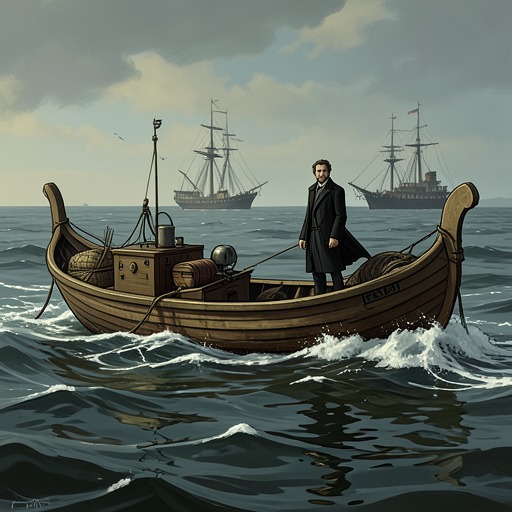
After the pirates’ encounter with a junk, the two prahus turn toward Labuan. Their ships can make more than twelve knots in a favorable southwest wind and calm sea, and their altered design gives them advantages in speed and strength. They retain immense sails, nearly forty metres long, and flexible masts; their gamuti-and-rattan rigging is strong and readily replaceable. Sandokan and Yanez have also enlarged the vessels, improved their keels and bows, added bridges and oar ports, and removed features that could hinder boarding. These choices make the approach to Labuan part of a wider contest in which the pirates’ mobility and the island’s British defenses are both material facts.
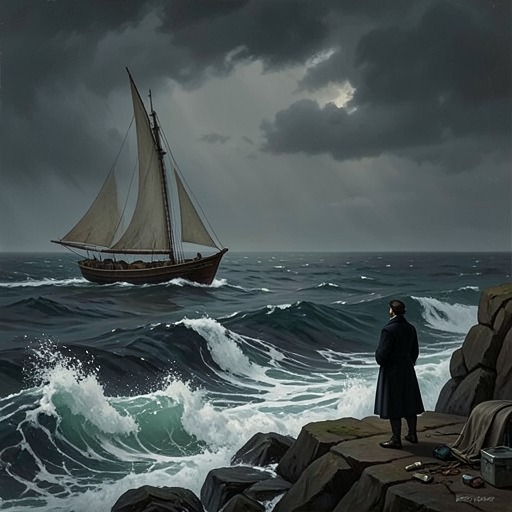
The prahus do not approach openly along the coast. After sailing beside Labuan for several miles, they enter a small river bordered by dense vegetation and travel six or seven hundred metres upstream before anchoring beneath enormous trees. From there, they are concealed from cruisers patrolling the coast. The river and its banks provide cover that the open sea cannot, allowing the pirates to hide close to the island while retaining access to the coast. Sandokan sends two teams to explore the forest and watch the river mouth against a surprise attack, while he and Patan go inland. The island’s geography enables concealment, but it also makes the narrow entrance a point the British can block.
Defenses and Confrontation
The danger becomes immediate when Giro-Batol reports that a cruiser is blocking the river mouth. Sandokan brings the prahus downriver toward the open sea. About six hundred metres from the coast, they face a heavily armed warship of fifteen hundred tons, whose crew is four times the size of the pirates’ combined force. Its position bars the westward way out. Labuan’s defenses are therefore not confined to the citadel and bastions: a British vessel can use the waters outside the island to control an approach or restrict departure.
The disparity in force shapes the encounter. Patan, described as an expert cannoneer, fires from the pirates’ side and smashes through the cruiser’s gangway, also breaking its flagpole. The warship then turns to present the gun ports along its side, where six cannons are positioned. Its return fire quickly puts the smaller vessels under pressure. Sandokan orders barricades built in front of the pirates’ cannons and commands the ships to advance at full speed. The crew uses available wreckage, spare masts, cannon parts, and barrels of cannonballs to form the barriers; twenty of the strongest men go below to the oars while the others prepare behind them. The sequence shows the pirates adapting their ships and labor to a local tactical problem, but it does not remove the cruiser’s advantage in size and firepower.
Concealment and Narrative Significance
The conflict around Labuan alternates between exposure and concealment. The British cruiser can make a conspicuous show of force outside the river, while the pirates use a wooded bank and a shadowed anchorage to approach unseen. Later, Sandokan steers a prahu toward the river mouth under a moonless sky. Storm clouds obscure the stars, and the vegetation makes it difficult for him to scan the banks. The quiet river and dark shoreline conceal movement, yet they also limit what Sandokan can see. As the prahu nears the mouth, it slows and abruptly stops. The account leaves that moment unresolved in the supplied episode, preserving the river entrance as a threshold between refuge and renewed danger.
Labuan’s significance rests on these intersecting pressures. It is a populated island under British occupation, a fortified response to pirate raids, a place Sandokan longs to reach, and a coastal landscape whose river can hide his ships while exposing them to blockade. The island turns private desire into a dangerous voyage and brings the competing claims of British authority and pirate power into direct contact at its shore.