Mompracem
The Tigers of MompracemMompracem is the island stronghold of Sandokan and his pirates, set a few hundred miles off the west coast of Borneo in the South China Sea. It is more than a refuge: its fortified shore, anchored fleet, and carefully adapted vessels give the pirates a base from which to move against ships and challenge the expanding British presence at Labuan. The narrative introduces the island through both its defenses and its vulnerability to the sea, making its geography part of the conflict rather than a mere backdrop.
Setting and Physical Character
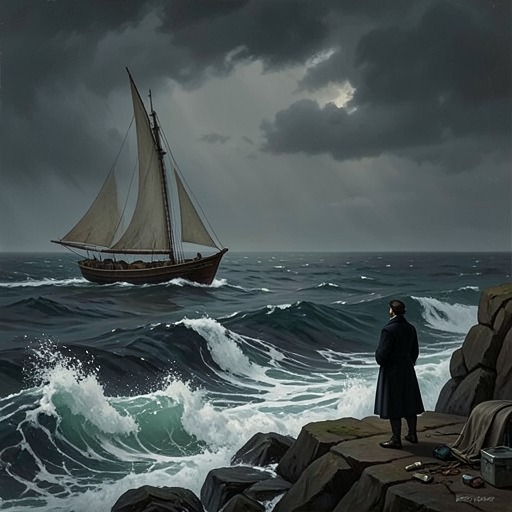
On the night of 20 December 1849, a violent hurricane rages over Mompracem. Storm clouds race across the sky, rain falls on the island’s dark forests, and waves break against the coast. Several ships lie at anchor in a bay protected by a reef. The shore and decks appear still, while two illuminated windows on a cliff offer a small sign of activity above the dark water. The opening contrast between a sheltered anchorage and the surrounding storm establishes the island as both a maritime refuge and an exposed position in a turbulent sea.
Beyond trenches, embankments, and ramparts stands a large hut marked by a red flag bearing a tiger’s head. Inside, the room is furnished with red silk hangings, worn Persian carpets, an ebony table inlaid with mother-of-pearl and edged with silver, and shelves holding the spoils of past raids. The detail presents Mompracem’s center of authority as a place where military readiness and accumulated plunder coexist. Its defenses are practical, but its flag and richly furnished headquarters also give the pirate settlement a visible emblem and a seat of command.
A Pirate Stronghold and Its People
Mompracem is identified as home to the most feared pirates in the South China Sea. Its fortified landscape conveys the need to defend that home: the approach to the main hut passes through barriers and defensive earthworks, while artillery protects the esplanade. When Sandokan leaves the headquarters with Yanez, they pass the ramparts and trenches to reach the bay, where more than a dozen prahus are anchored close to shore. The movement from the guarded interior to the vessels links the island’s land defenses directly to its maritime force.
The bay and settlement serve a community gathered under Sandokan’s command. Three hundred men stand ready near the longhouses, and the crew is described as drawn from many parts of the East, including Malays, Batavians, Dyaks, Cochin Chinese, Siamese, Indians, Bugis, Javanese, Tagalis, Filipinos, and Negritos. The island is therefore represented not as an isolated household but as the base of a large, diverse pirate force. Its organization is shown in the men assembling for orders and in the vessels waiting within reach of the shore.
Mompracem’s authority is also morally complicated. Sandokan explains his vengeance against Europeans by recalling the loss of his family and the seizure of his throne, while Yanez counters that he has defended vulnerable communities, returned captive women to enemy ports, and rescued and rewarded shipwreck survivors. These actions are spoken of in the island headquarters, making the base a setting for competing accounts of what Sandokan’s power means: retaliation against his enemies, protection for some people in peril, and a pirate enterprise sustained by raids.
Fleet, Routes, and Operations
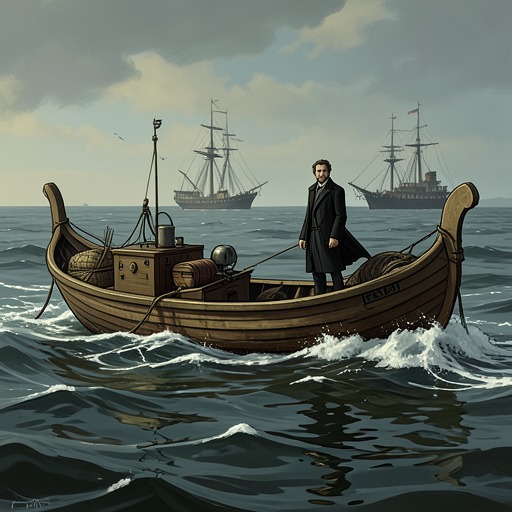
The island’s bay supplies a point of departure for fast, purpose-built ships. In a favorable southwest wind, two prahus leave for the Romades and quickly make more than twelve knots. Their speed is not attributed to wind alone. Sandokan and Yanez have modified their vessels, retaining immense sails, masts with some flexibility, and rigging made from gamuti and rattan, while giving the ships broader bodies, faster keels, and strong bows. They have added bridges and openings for oars and removed equipment that could hinder boarding. Cannons, firearms, ammunition, blades, and grappling hooks are readied on deck before the crews search for a target.
The journey from Mompracem also connects the pirates’ home waters to the contested coast around Labuan. When a junk displays the emblem of James Brooke, Sandokan recognizes its association with the Rajah of Sarawak, whom the pirates regard as a determined enemy. The encounter turns a prospective raid into a direct confrontation with a political and military opponent. Mompracem is not the scene of that encounter, but the expedition that reaches it begins from the island’s fleet and command structure.
Labuan and the Contest for Sea Power
The account sets Mompracem against a British foothold at Labuan. Occupied in 1847 by Sir Rodney Mundy, commander of the Iris, on the British Government’s orders to suppress piracy, Labuan has about a thousand inhabitants, mostly Malays, alongside a European population of roughly two hundred. The British have built a citadel named for Queen Victoria, with large bastions intended to protect the island from pirates whose earlier raids devastated the coast. Thick jungle covers much of Labuan, where only a few farms have been established. These details give the rival base a population, a stated colonial purpose, and fixed defenses, in contrast with Mompracem’s pirate fleet and fortified settlement.
After the ships are ordered toward Labuan, they travel along the coast and enter a small river, proceeding six or seven hundred metres before anchoring beneath enormous trees. The location offers cover from cruisers patrolling offshore. Later, as a heavily armed British ship blocks the route westward, the two prahus descend the river toward the open sea to meet it. Darkness, cloud cover, and the dense foliage along the riverbanks then hinder Sandokan’s effort to watch the shores as his crew attempts to escape. The sequence shows how coastal geography alternately shelters and constrains movement: the island provides a base, the river conceals ships, and the open sea exposes them to interception.
Narrative Significance
Mompracem gives the pirates a home from which they can act collectively, but it is not presented as beyond the reach of competing power. Its defenses, fleet, and command make it a substantial stronghold; the British fortifications at Labuan and the patrolling cruiser show that control of the surrounding waters is disputed. The narrative repeatedly connects place to capability: the sheltered bay holds the prahus, their design enables rapid travel, and the river offers concealment before a dangerous passage to open water.
The island also concentrates the story’s tension between protection and violence. Sandokan’s men acclaim him there, and Yanez recalls his generosity to people in danger; from the same base, the pirates prepare raids and answer threats with armed force. Mompracem thus functions as both a home and a military platform, while its location in the South China Sea makes it a point of contact between the pirate community and British efforts to impose order on the region.