South China Sea
The Tigers of MompracemThe South China Sea is the maritime world surrounding Mompracem, where the pirates’ voyages and conflict with British forces unfold. It is both a route between islands and a physical force in its own right: storms can make its waters perilous, while wind, vessel design, and concealed waterways determine the possibilities of pursuit, attack, and escape.
Geography and Pirate Waters
The narrative places Mompracem a few hundred miles off the west coast of Borneo, in waters feared for the presence of its pirates. During a voyage toward the Romades, Sandokan’s two ships cross an expanse bounded by Mompracem and the Romades to the west, Borneo to the east and northeast, and Labuan and the Three Islands to the north. The geography gives the sea a defined operational scale: the ships travel between known islands and coastlines, while the reputation of the waters influences where other vessels dare to sail.
That reputation has a practical consequence. Few merchant ships cross the area frequented by pirate vessels; many instead keep near the coasts, hoping to reach land if danger appears. The sea is therefore not an open, neutral passage. The risk of encountering pirates redirects commercial traffic and helps extend their influence beyond the immediate reach of their ships.
Conditions of Navigation
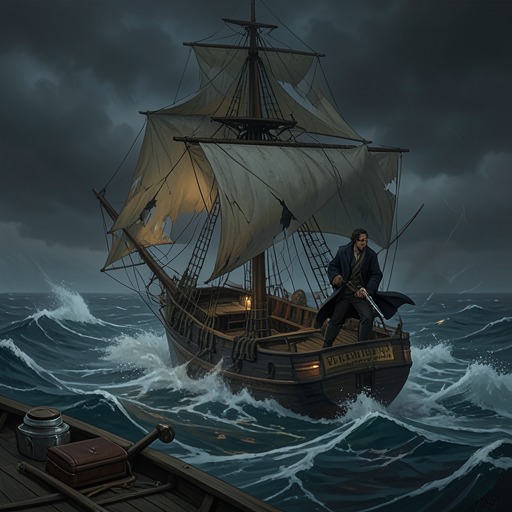
The sea’s changing conditions shape movement from scene to scene. On the night of 20 December 1849, a violent hurricane rages over Mompracem: wind drives clouds across the sky, rain falls on the island, and waves roar amid thunder. The storm frames the pirates’ island home as exposed to the force of the surrounding waters, even while ships lie sheltered in a bay behind a reef.
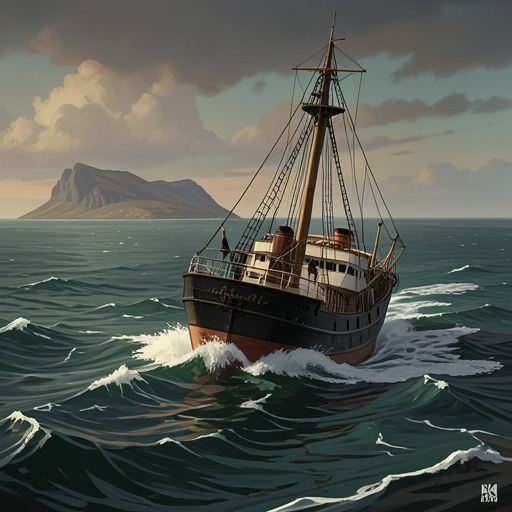
The conditions are different on the voyage toward the Romades. A southwest wind and calm sea let the two vessels move at more than twelve knots. Their speed depends not only on the weather but on deliberate design. Sandokan and Yanez have modified their Malay vessels with immense sails approaching forty metres in length, elastic masts, and rigging made from gamuti and rattan. They have also given the ships greater bulk, a faster keel, an almost indestructible bow, a bridge, and openings for oars, while removing the outrigger and one rudder to make boarding easier. The sea’s navigability and the ships’ construction together enable rapid travel and prepare the crew for attack.
Coasts, Concealment, and Pursuit
Near Labuan, the sea connects open-water travel to a more sheltered route inland. The two prahus follow the island’s coast for several miles, enter a small river, and proceed six or seven hundred metres upstream before anchoring beneath enormous trees. The vegetation and the river’s position conceal them from cruisers patrolling the coast. This sheltered waterway provides a temporary refuge, but it also places the vessels in a confined passage from which they must later emerge.
Labuan’s changing political and military role makes that approach especially charged. The island was occupied in 1847 by Sir Rodney Mundy, commander of the Iris, under orders from the British Government to eradicate piracy in the surrounding waters. The British had built the Victoria Citadel, with bastions intended to protect the island from the pirates of Mompracem. When Sandokan’s ships eventually reach open water, a heavily armed vessel of fifteen hundred tons is patrolling about six hundred metres from the coast and barring their westward route. The sea thus becomes a contested space where British patrols and pirate vessels attempt to control movement by force.
Narrative Significance
The sea’s material details repeatedly determine what the characters can do. Wind propels the prahus; calm water permits speed; a reef shelters the bay; a river and its banks hide ships; and darkness, clouds, and dense foliage restrict what can be seen during an attempted escape. These conditions do not guarantee safety: concealment can delay detection, but it can also make it difficult for Sandokan to scan the riverbanks as his prahu nears the river mouth.
The South China Sea also links the pirates’ base to the wider struggle around Labuan. The British citadel and patrolling warship represent an effort to suppress piracy through occupation and armed control, while Sandokan’s fleet uses mobility, local routes, and adapted vessels to challenge that authority. The narrative’s sea is therefore at once an environment, a transport network, and the ground on which rival claims to power are tested.