
A Predator’s Return to the Deep
The TrenchThis flow traces Angel’s biological journey from captive attraction to coastal predator and back to the Mariana Trench to reproduce.
increasing Bearing strength in each event
 decreasing
Bearing strength in each eventdecreasingCaptive Star
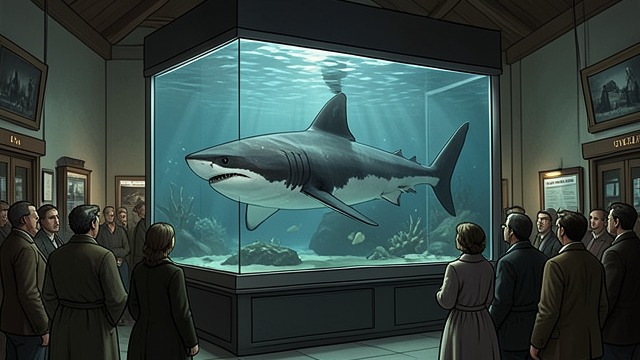
Captive Star
A public spectacle
Angel lives in the Tanaka Lagoon as a commercial attraction, fed before crowds and promoted as a singular killing machine. Her enormous size and strength grow within an artificial habitat.
Containment under strain
The lagoon provides food but not lasting security. Angel’s attacks on the gateway suggest that captivity cannot erase the animal’s drive to move toward open water and prey.
Estrus Draws the Males
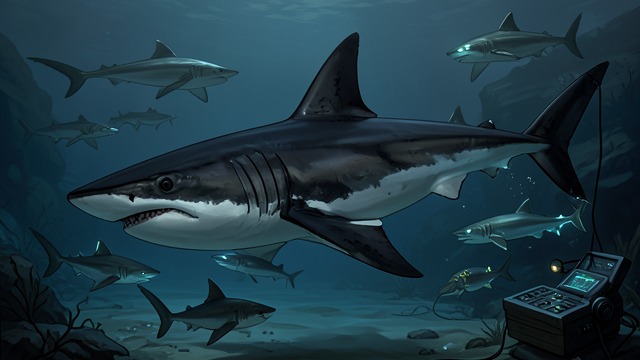
Estrus Draws the Males
A biological signal
Jonas later concludes that Angel is in estrus, explaining why male great white sharks gather around the gateway. Her presence draws other predators into an already dangerous area.
Instinct over containment
The mating cycle helps account for Angel’s agitation and the accumulating risks around the lagoon. The escape is not simply an isolated act of aggression but part of a wider biological process.
The Coastal Feeding Route
The Coastal Feeding Route
Prey draws her north
Angel follows prey along the California and Pacific Northwest coasts, attacking whales and sea lions as she moves. Her size and sensory systems make human activity another source of detectable disturbance.
Unintended encounters
The shark’s route intersects beaches, boats, and kayakers. Human casualties are disastrous, but they do not turn Angel’s behavior into a deliberate campaign against people; she is responding as a predator in an increasingly shared environment.
The Cross-Pacific Journey
The Cross-Pacific Journey
A navigational shift
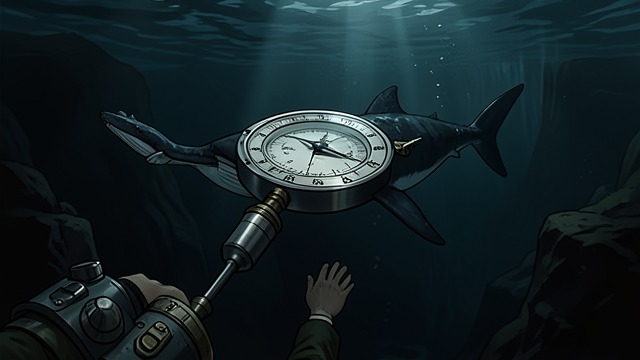
After the tracking signal is lost, Jonas argues that Angel follows seismic and magnetic cues along the Ring of Fire rather than simply following whale migration. The shark moves across the North Pacific toward the Asian trenches.
Return to a habitat
The journey reveals a route linking distant ocean regions to the Trench. Angel’s movement is driven by biological orientation and reproductive state, not by the human attempt to control her.
A Litter in the Abyss
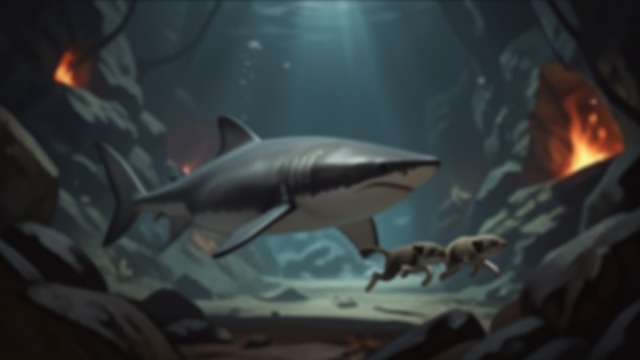
A Litter in the Abyss
Birth in the vent field
Back in the Mariana Trench, Angel gives birth to two male pups near the hydrothermal vents. The newborns flee immediately, while their mother turns to pursue them.
Survival remains uncertain
The pups face both their mother and the Kronosaurus packs. Angel’s return restores the abyssal cycle of predator and prey, leaving the future of her offspring—and the coastal world—unsettled.
Before the novel’s opening, after Angel is captured
Before the escape, during the repeated attacks on the gateway
After Angel escapes into the Pacific Ocean
After the failed capture near Kodiak Island
Epilogue, after the main survivors escape
