Angel's Estrus and Return to the Trench to Breed
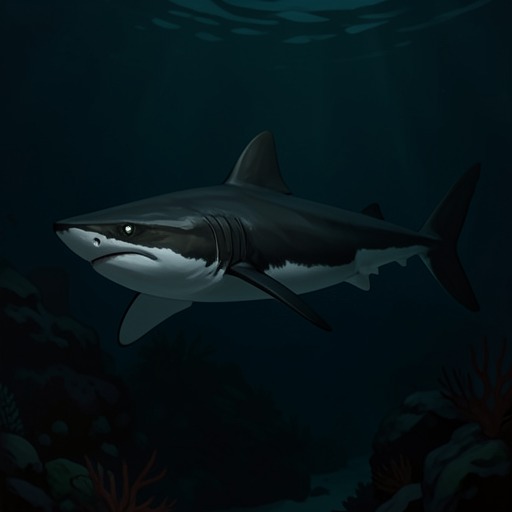
The TrenchAngel's Estrus and Return to the Trench to Breed traces a reproductive drive that redirects the Megalodon’s movement across the Pacific and culminates in mating in the Mariana Trench. The sequence gives Angel an existence beyond the human pursuit of her: cold, hunger, and estrus shape her journey, and the mating encounter ends not in submission but with her injuring the male.
Estrus and the Journey North
Angel’s reproductive state develops alongside physical strain. In the Gulf of Alaska, she has not fed for three days. Her rising visceral temperature has accelerated digestion, but the progression of estrus and the cold’s effect on her metabolism leave her sluggish. A large pod of whales is present as a possible food source, yet in her weakened condition she cannot risk attacking it. Hunger therefore does not simply propel her toward prey; it limits which prey she can pursue.
The cold also elicits a powerful bodily response. Angel’s evolutionary adaptations increase her muscular capacity and generate heat through stronger contractions; enlarged pericardial arteries circulate that heat to her internal organs, while her mass insulates her core. These details make the migration a struggle of physiology as well as direction. The same body that can cross great distances must continually meet the demands of cold water, depleted energy, and reproductive urgency.
As she follows the ferry’s wake, familiar pressure-wave vibrations reach her receptors. Angel accelerates with repeated thrusts of her caudal fin, initially struggling to move her immense mass, then settling into a cruising speed her torpedo-shaped body can sustain. She passes beneath the ferry and follows an acoustical beacon that instinct tells her will lead to food. The account connects her movement to immediate sensory information rather than human deliberation: pressure waves, vibrations, temperature, and instinct organize her route.
Navigation and the Human Interpretation
Angel’s return is also understood from the human side as a journey toward the Mariana Trench. Jonas rejects the idea that she is following migrating whales. He interprets her behavior as the result of powerful estrus and says she is using the Ring of Fire to navigate back to the Trench to breed. His explanation sharpens the stakes for him because Terry is in the Trench; he asks Captain Morgan to let him reach her before it is too late.
The distinction between the two perspectives matters. Jonas’s account links Angel’s route to his urgent effort to rescue Terry, but the narrative also follows the shark apart from that human crisis. Her migration has its own physical sequence: the cold bites into her hide, she swims faster despite the pain, and her core temperature falls dangerously as she descends. She passes through a dense layer of floating minerals and sulfur into the abyss’s warm hydrothermal waters. There, she moves beneath a ceiling of silty debris, warms herself in heat flowing from the Earth, and continues south along the canyon floor. The Trench is thus both the destination Jonas fears and an environment Angel enters through bodily adaptation.
Encounter and Reversal
Hours after reaching the warm depths, Angel’s receptor system detects another life-form approaching quickly. She turns toward its vibrations, which stimulate her reproductive system. The approaching male Megalodon is fifty-eight feet long and weighs forty-six thousand pounds: distinctly smaller than Angel, though quicker. He avoids a head-on confrontation, circles warily, and approaches from behind. Angel allows him to slide along her left flank.
The mating is physically forceful. The male lunges forward and bites Angel’s left pectoral fin as copulation begins. She arches her spine, inverts, and rolls over his dorsal surface, twisting beneath her smaller mate until they swim belly-to-belly, with the male above. He inserts one of his two rigid claspers into her cloaca while reestablishing his bite on her inverted fin. They remain locked together for several minutes. His deeper bite is an attempt to control her, but it does not establish lasting dominance.
Once copulation is complete, the exhausted male releases his grip and withdraws his clasper. Angel remains inverted, then lunges and snaps her jaws over his dangling caudal fin. She severs the lower lobe before he can react. The sequence ends on this abrupt reversal: the male’s attempt to hold the larger female gives way to her decisive counterattack. Estrus brings Angel to a mate, but the encounter does not make her passive or safe to control.
Narrative Significance
The episode gives reproductive behavior the same concrete, consequential force as hunger and cold. Angel is presented through her own sensory and bodily processes, not solely as a monster defined by human fear: she is depleted, physiologically adapted to cold, responsive to vibrations, and driven toward breeding. At the same time, the narrative does not soften the encounter. Mating involves biting, restraint, and injury, and its immediate outcome is another violent act. The return to the Trench therefore joins biological continuity with danger, while the parallel human rescue mission makes Angel’s independent course newly urgent to Jonas.