Benedict Singer
The TrenchBenedict Singer, the billionaire chief executive of Geo-Tech Industries, directs an ambitious expedition into the Mariana Trench and treats its scientific promise as justification for extraordinary risks. He speaks of exploration as humanity’s defining project, but his conduct reveals the harder terms beneath that ideal: he controls information, demands obedience, and is prepared to sacrifice people once they cease to serve his purpose. His search for manganese nodules with potential fusion value gives the expedition a commercial and strategic stake as well as a scientific one.
Identity and Command
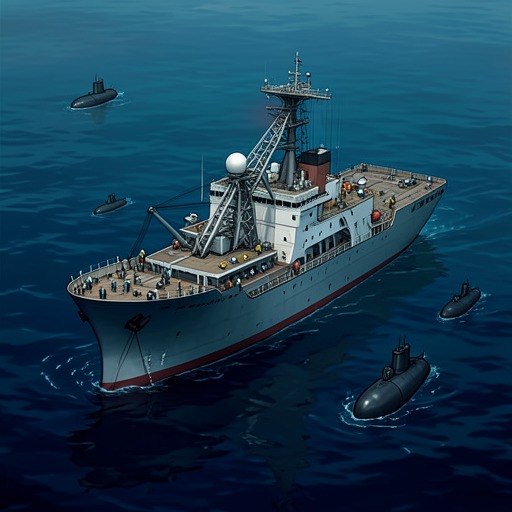
Benedict leads Geo-Tech Industries, whose investment of more than a billion dollars created the Benthos and its fleet of submersibles. The Benthos is both a mobile deep-sea laboratory and a docking station: a vast titanium structure designed to hover above the seafloor. Benedict presents this expenditure as an effort to open the planet’s last unexplored frontier, but the scale of the enterprise also places its personnel and equipment under the authority of one exceptionally powerful executive.
His command extends beyond the expedition’s public-facing science. When Terry Taylor and Masao Tanaka visit him, he is conducting business in Russian; he then receives them in the Benthos’s refurbished executive spaces. The change from watertight corridors to a carpeted, office-like interior reflects how thoroughly he has made the remote vessel his own domain. He negotiates with institutional partners, directs the ship’s senior personnel, and controls who may leave or continue working aboard.
Benedict’s influence also depends on concealed operations. Arie Levy, a Mossad agent using the identity Khali Habash, spent four years infiltrating Benedict’s organization while posing as a plasma physicist. The depth of that infiltration makes clear that Benedict’s enterprise attracts attention beyond its own employees: the expedition’s discoveries and intentions are consequential enough to prompt prolonged intelligence work.
Exploration and the Secret of the Nodules
Benedict gives exploration an expansive history, invoking human journeys across the globe and into space before turning to the comparatively little-known ocean depths. In his account, the trench is not merely a hazardous workplace but a place where the origins of life and answers to fundamental questions may be found. He presents fear of the deep as an obstacle that explorers must overcome. This rhetoric supplies a moral purpose for the mission, while also elevating his own willingness to press onward into a test of conviction.
The concrete object of his search is more specific than that public language suggests. Benedict explains that scientists Prestis and Shaffer recovered manganese nodules from a remote site in the Mariana Trench they called Devil’s Purgatory. Their vessel, the Seacliff, used a long suction device to collect them. Benedict suspects the pump’s vibrations attracted a Megalodon that attacked the submarine; his account identifies this as a suspicion, not a confirmed explanation. The Navy confiscated the nodules without recognizing their value, and Benedict later obtained some of the same material and tested it in his laboratory.
Those tests revealed a mixture of helium-3 and deuterium within the nodules, which could support a long-burning fusion reaction. The discovery changes the expedition’s stakes: access to the trench means access to a resource with a possible energy application, and Benedict’s determination to locate the precise collection area is tied to that prospect. His exploration speech invokes knowledge for humanity, but his operational focus on the site and its valuable material makes control of the discovery central to the plot.
Risk, Loyalty, and Institutional Conflict
Benedict frames the deaths of four soldiers as losses incurred in service of a larger public good. He compares the mission to war, arguing that uncertain hazards cannot be separated from the pursuit of a potentially life-saving objective and invoking the UNIS array as an example of that purpose. Captain Hoppe rejects this reasoning at the point where it becomes operational: the Prometheus is being sent too far ahead of the Benthos, and Benedict’s effort to compress a six-month mission into sixty days puts the crew at risk. The disagreement exposes the gap between accepting danger in principle and imposing it on people under one’s command.
His response to dissent is personal and controlling. When Captain Hoppe questions his judgment again, Benedict cuts off the challenge rather than reconsidering the timetable. Later, he decides that Terry must remain aboard the Benthos even though Captain Hoppe points out that she knows nothing and asks what harm there would be in letting her go. Benedict’s order prevails. The exchange shows that his authority is not limited to directing technical work: he determines who is permitted to leave, regardless of a subordinate’s appeal.
Benedict offers a similarly revealing account of the people he has recruited. He says his crew members were selected because their lives had lost purpose, and that he gave them a reason to live by giving them a mission. He describes himself as both a feared and loved figure in their lives, presenting their dependence on him as proof of his power. The admission complicates his language of shared sacrifice: the crew may be devoted to the expedition, but Benedict describes their loyalty as something he has deliberately cultivated among vulnerable people. In this arrangement, purpose and obedience are closely bound.
The expedition also strains Benedict’s partnership with Masao and the Tanaka Institute. Masao explains that the Mariana Trench site lies within an exclusive economic zone under American jurisdiction and that the Institute’s ongoing JAMSTEC contract permits its return. JAMSTEC requires a fuller report on an incident. Benedict treats the request as an insult to the investment and ingenuity behind the Benthos, and threatens to tear up the joint venture and take the vessel to other trenches. Masao answers that refusal could lead the Japanese to terminate the agreement. Benedict asks what JAMSTEC is requesting, but the confrontation has already exposed how readily he turns a procedural demand into a test of control over the partnership.
Terry Taylor and the Limits of His Idealism
Benedict’s relationship with Terry brings his principles into direct conflict with his actions. He addresses her warmly and casts her as a fellow explorer who has descended into danger to complete a mission. Yet the language of shared purpose does not give her equal standing. Terry has already questioned how much she should trust him; later, when she attempts to pursue her work, Benedict delays her and directs her toward the hangar instead. The gracious manner and the tight control operate together: personal attention does not amount to freedom.
The conflict becomes unmistakable when Benedict enters Sergei’s room and throws a hunting knife into the painting above the sleeping man. He reprimands Sergei for frightening Terry rather than killing her. The scene establishes that the earlier threat to Terry was not simply an unauthorized act by a subordinate: Benedict had ordered intimidation, while drawing a distinction between frightening her and killing her. That distinction does not make his conduct protective; it shows him managing the degree of danger she faces as part of his control over the situation.
Later, once the nodules have been located, Benedict says Terry is no longer needed and directs that she be killed before the day ends. The change is stark. While he can describe her as a fellow explorer when her presence serves his purposes, he treats her continued existence as dispensable once the expedition has secured its target. His professed public mission thus reaches its most troubling limit: people are valued according to their use to the project, and the explorer’s rhetoric does not restrain the power that enforces that rule.
Narrative Significance
Benedict is both the expedition’s advocate and the clearest source of its manufactured risk. The deep ocean presents real uncertainty, but the human dangers associated with the mission also arise from decisions about speed, secrecy, access, and the distribution of authority. His conflict with Captain Hoppe makes the timetable’s danger explicit; his response to Masao shows the commercial and institutional pressures surrounding the expedition; and his treatment of Terry reveals the personal consequences of his command.
His pursuit of the nodules binds scientific exploration to the contest over potentially valuable energy resources. The Benthos opens access to a remote environment, but that technical achievement does not make its uses neutral: Benedict’s choices decide who may investigate, who must accept danger, and who is excluded when the objective has been achieved. The contrast between his language of discovery for humanity and his readiness to subordinate partners and crew gives the exploration ideal its central tension. He does not merely lead the descent into the trench; he insists on defining what its risks mean and who will bear them.